K. Kavitha Issues Stark Warning Over Delimitation Threats in Telangana
Synopsis
In a bold statement, K. Kavitha, president of Telangana Jagruthi, warns that any attempts by the BJP-led Centre to alter Telangana's representation could ignite a movement akin to the Telangana agitation. She highlights the historical contributions of the South and stresses the need for equitable political representation.
Key Takeaways
Kavitha warns of potential agitation if delimitation undermines Telangana's representation.
Historical contributions of Southern states highlight the need for equitable political recognition.
The Women's Reservation Bill has been criticized as a political strategy by the BJP.
Kavitha emphasizes that demographic injustice will be resisted fiercely.
The current representation of 3.13 percent must not be reduced further.
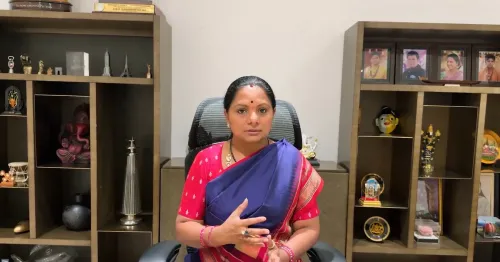
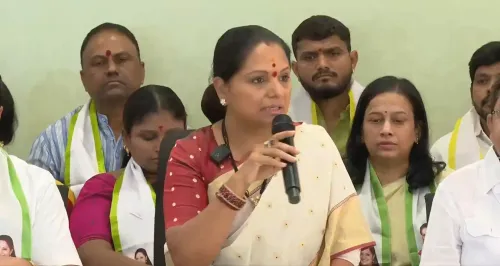
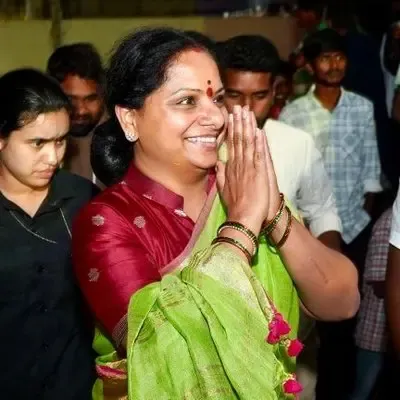
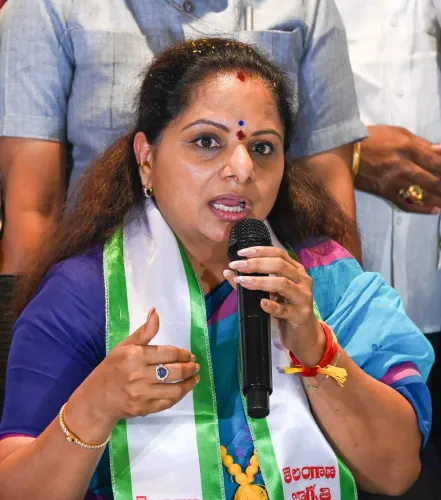
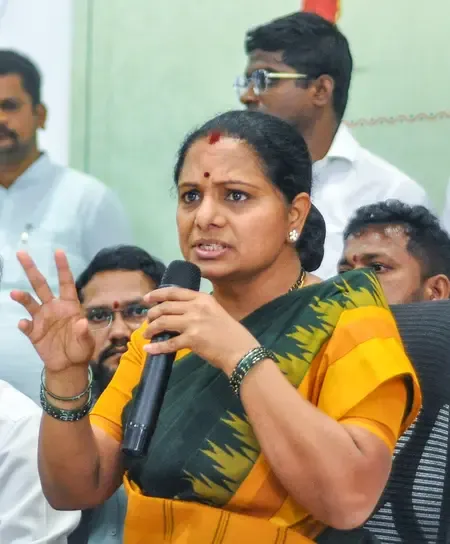
Hyderabad, April 15 (NationPress) K. Kavitha, the president of Telangana Jagruthi, issued a strong warning on Wednesday about the potential for a response reminiscent of the Telangana agitation if the BJP-led Central Government attempts to undermine the state’s democratic representation through delimitation.
The former Member of Parliament emphasized that the Southern region, which has been a leader in economic growth and family planning for many years, deserves recognition rather than punitive measures.
“The voices of the people in Telangana cannot be sidelined under the pretext of delimitation. Our stance is clear: the proportional representation of Telangana, and by extension, the Southern states, must be upheld,” Kavitha declared on ‘X’.
“For decades, the South has spearheaded national advancements in economic development and family planning; we should be acknowledged for our achievements, not faced with political marginalization,” she asserted.
“Presently, Telangana's representation in Parliament stands at 3.13 percent. While we consider this to be the bare minimum, our focus is on one fundamental demand: this 3.13 percent should be the baseline, not the upper limit,” she added.
“Should the BJP-led Centre choose to diminish our democratic rights, they should be prepared for a movement paralleling the scale and fervor of the Telangana Agitation. Our fight will extend from the corridors of Parliament to every street in our state. We will combat this demographic injustice relentlessly and will not stop until Telangana’s political sovereignty is fully assured,” Kavitha concluded.
Kavitha has previously criticized the Centre regarding the Women's Reservation Bill, labeling it a political maneuver by the BJP.
She alleged that the Bill was being introduced with the intent to influence elections in five states. Kavitha remarked that the BJP-led government's actions are playing with the livelihoods of 70 crore women.
She pointed out that the Women's Reservation Bill is scheduled for implementation from the 2029 elections, based on the 2027 census, and questioned the sudden shift to implementing it based on the 2011 census.
Additionally, she scrutinized the rationale behind connecting the Reservation Bill to the delimitation process, asserting that delimitation presents a significant disadvantage to Southern India, which exhibits lower population density.
Point of View
K. Kavitha's warnings highlight significant regional concerns regarding political representation. The implications of delimitation in South India raise critical questions about equity and representation in the political landscape. Her strong stance reflects the broader sentiment among Southern states, advocating for fair treatment in the political discourse.
NationPress
22 Oct 2026
Frequently Asked Questions
What is the main concern regarding delimitation in Telangana?
The primary concern is that delimitation may dilute Telangana's democratic representation, which K. Kavitha argues is already minimal.
What are the historical contributions of Southern states mentioned?
Southern states have led the country in economic growth and family planning for decades, according to K. Kavitha.
How does Kavitha link the Women's Reservation Bill to delimitation?
Kavitha questions the rationale of linking the Women's Reservation Bill to delimitation, suggesting it disadvantages Southern states with lower population densities.
What action is Kavitha prepared to take if representation is weakened?
Kavitha warns that any attempts to undermine representation could lead to a movement akin to the Telangana agitation, mobilizing widespread public support.
What does Kavitha demand regarding Telangana's representation?
She demands that Telangana's current 3.13 percent representation in Parliament should be considered the minimum threshold.