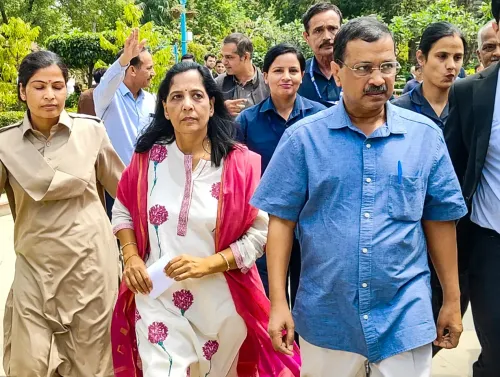
Kejriwal Questions Out-of-Turn SC Elevations, Warns of Court Weaponisation
Synopsis
AAP convenor Arvind Kejriwal has publicly questioned out-of-turn Supreme Court elevations, warning they create quid pro quo risks and amount to executive capture of the judiciary. He called opacity in appointments a threat to democratic integrity and demanded transparent, seniority-based processes.
Key Takeaways
AAP convenor Arvind Kejriwal questioned out-of-turn Supreme Court elevations on 9 August 2026 , without naming a specific judge.
He warned that bypassing seniority makes elevated judges 'vulnerable to quid pro quo' with the executive.
He called for no opaque, out-of-turn elevations, particularly for judges seen as favouring the executive.
The collegium system , created by SC judgments in 1993 and 1998 , governs higher judiciary appointments but has long faced transparency criticism.
The NJAC Act (2014) that sought to reform appointments was struck down by the Supreme Court in 2015 .
Kejriwal framed judicial integrity as essential to democratic survival, raising accountability to a generational level.
A pointed challenge to the opacity of India's judicial appointment process landed on Sunday evening, as AAP convenor Arvind Kejriwal questioned whether judges should be elevated to the Supreme Court of India out of turn, bypassing seniority — and whether such elevations risk becoming instruments of executive influence.
The seniority question at the heart of the challenge
Kejriwal's post, published on Sunday, 9 August 2026, did not name a specific judge or pending elevation — but its thrust was unmistakable. 'Should judges be allowed SC elevation out of turn, bypassing seniority? That makes him vulnerable to quid pro quo,' he wrote, framing the concern not as a personal attack but as a structural one.
He pressed further: 'What is examined before a judge is elevated to SC? Loyalty to the emperor?' The rhetorical sharpness was deliberate — raising the spectre of a judiciary shaped by executive preference rather than constitutional principle. 'No out of turn, opaque elevation should be permitted,' he added, calling out judges who 'throw law to the wind and go out of their way to please the executive.'
The collegium system and its long transparency deficit
India's judicial appointments to the higher courts are governed by the collegium system — a mechanism created through Supreme Court judgments of 1993 and 1998 that vests the power of recommendation in the apex court's senior judges, explicitly to insulate the process from executive interference. In practice, the system has drawn sustained criticism for doing the opposite of what it promises: operating without published criteria, deliberation records, or consistent adherence to seniority.
The tension is not new. In 2014, Parliament passed the 99th Constitutional Amendment and the National Judicial Appointments Commission (NJAC) Act to introduce a mixed civilian-executive body for appointments. The Supreme Court struck both down in 2015, ruling that judicial primacy in appointments was part of the basic structure of the Constitution. The collegium was restored — but the legitimacy questions it carries were not resolved.
Why Kejriwal's framing lands differently now
What distinguishes this intervention is its explicit linkage of judicial appointments to democratic survival. 'We should be careful of weaponisation of courts,' Kejriwal wrote. 'Integrity of courts is most important for democracy to survive.' That is not the language of a routine political complaint — it is a claim about institutional decay.
The question of what face the current generation of leaders will show 'the young gen,' as Kejriwal put it, adds a generational accountability dimension that is harder to dismiss as mere political point-scoring. When an opposition leader frames judicial opacity as a legacy problem, the audience being addressed is wider than Parliament.
The collegium's next round of elevation recommendations — and whether any out-of-seniority names surface — will now carry heightened public scrutiny. The post has ensured that.
Point of View
Agencies, and appointments. The specific framing around seniority and quid pro quo is significant: it shifts the critique from the government to the collegium itself, raising questions about internal judicial governance that the judiciary has historically resisted. If the unnamed elevation proceeds, this post becomes a reference point in any public debate about it. The broader arc here is a deepening legitimacy crisis for the collegium — caught between executive pressure on one side and transparency demands on the other, with no political consensus on an alternative.
NationPress
9 Aug 2026
Frequently Asked Questions
What did Kejriwal say about Supreme Court elevations?
Kejriwal questioned whether judges should be elevated to the Supreme Court out of turn, bypassing seniority, warning it creates vulnerability to quid pro quo with the executive and amounts to weaponisation of courts.
What is the collegium system for judicial appointments in India?
The collegium system is a mechanism established by Supreme Court judgments in 1993 and 1998 that gives the apex court's senior judges the power to recommend appointments and elevations to higher courts, keeping the executive out of the process.
Was there any attempt to reform the collegium system?
Yes. In 2014, Parliament passed the 99th Constitutional Amendment and the NJAC Act to create a mixed body for judicial appointments, but the Supreme Court struck both down in 2015, ruling judicial primacy in appointments is part of the Constitution's basic structure.
Which judge did Kejriwal name in his post about SC elevation?
Kejriwal did not name any specific judge in his post. His criticism was directed at the process of out-of-turn, opaque elevations as a structural concern.
Why is seniority important in Supreme Court elevations in India?
Seniority is considered a safeguard against executive influence in judicial appointments. Bypassing it to elevate a judge out of turn raises concerns about whether the selection is merit-based or driven by the judge's perceived proximity to the ruling establishment.