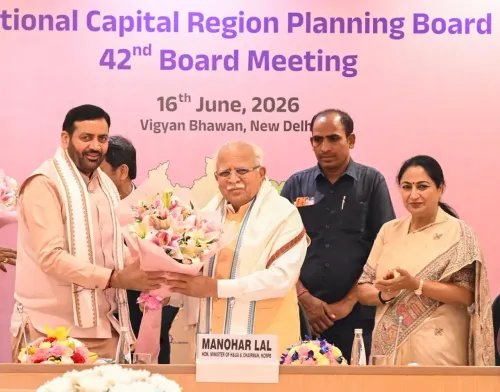
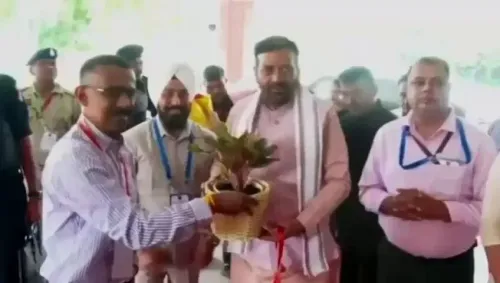
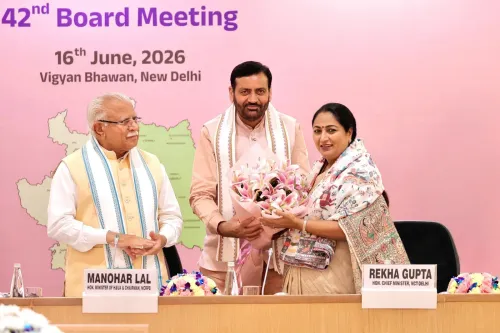
Khattar chairs 42nd NCRPB meet on NCR development
Synopsis
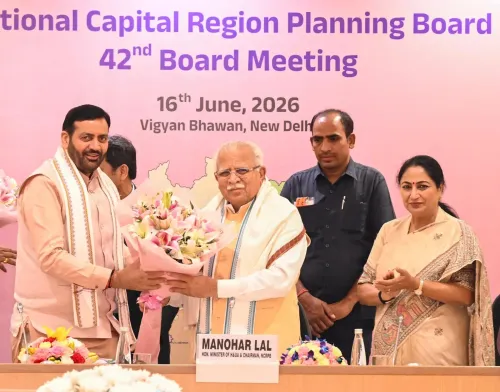
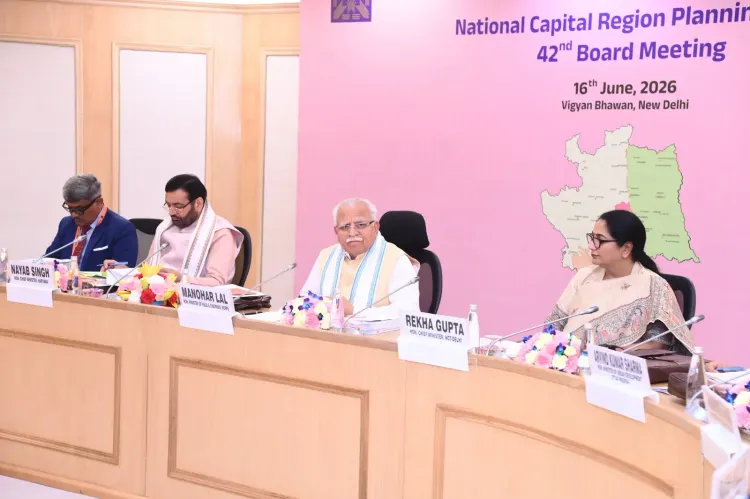
Union Minister Manohar Lal Khattar chaired the 42nd NCRPB meeting on 16 June 2026, bringing together Delhi CM Rekha Gupta, Haryana CM Nayab Saini and urban ministers from UP and Rajasthan to advance coordinated infrastructure and connectivity development across the National Capital Region.
Key Takeaways
Manohar Lal Khattar chaired the 42nd NCRPB meeting on 16 June 2026 in his capacity as Union Minister of Housing and Urban Affairs.
Delhi CM Rekha Gupta and Haryana CM Nayab Singh Saini attended, along with urban development ministers from Uttar Pradesh and Rajasthan .
The meeting focused on strengthening institutional coordination among the four NCR states and accelerating project implementation .
Improving regional mobility and connectivity was a central agenda item, reflecting long-standing inter-state infrastructure challenges.
The NCRPB , constituted under the NCRPB Act 1985 , serves as the statutory inter-governmental platform for coordinated NCR planning.
Follow-up will focus on project timelines and any new sub-committees formed for regional mobility mandates.
Union Minister of Housing and Urban Affairs Manohar Lal Khattar on Tuesday, 16 June 2026 chaired the 42nd meeting of the National Capital Region Planning Board (NCRPB), convened to advance coordinated and balanced development across the National Capital Region (NCR). The meeting brought together senior representatives from Delhi, Haryana, Uttar Pradesh and Rajasthan — the four states that constitute the NCR planning area.
Context
Khattar, posting in Hindi on X, said the meeting was chaired 'राष्ट्रीय राजधानी क्षेत्र के सुव्यवस्थित, समन्वित एवं संतुलित विकास को और अधिक प्रभावी बनाने के उद्देश्य से' — 'with the objective of making the organised, coordinated and balanced development of the National Capital Region more effective.' Attendees included Delhi Chief Minister Rekha Gupta, Haryana Chief Minister Nayab Singh Saini, Uttar Pradesh Urban Development Minister A.K. Sharma, and Rajasthan Urban Development Minister Jhaber Singh Kharra.
The gathering of four state-level heads in a single forum underscores the NCRPB's role as the primary inter-governmental platform for aligning development priorities across one of the world's most densely urbanised metropolitan corridors.
Policy Backdrop
The National Capital Region Planning Board Act, 1985 established the NCRPB as a statutory body tasked with preparing and monitoring a regional plan for coordinated development spanning Delhi and adjoining districts of the three neighbouring states. The board approved the NCR Regional Plan 2021 in 2005, and periodic review meetings have continued to address connectivity, housing and environmental priorities.
Successive central governments have used the NCRPB as a mechanism to align large infrastructure investments — including expressways, metro extensions and water supply networks — across state boundaries. The emphasis on institutional coordination reflects the persistent challenge of managing rapid urbanisation and inter-state spillovers in the capital region. Khattar, as Union Minister of Housing and Urban Affairs, holds the chairmanship of the board ex officio.
Stakeholders and Impact
The 42nd meeting addressed strengthening institutional coordination among the four states, improving regional mobility and connectivity, and accelerating the implementation of development projects. These are recurring pressure points for the estimated 4-5 crore residents of the extended NCR who depend on cross-border infrastructure for daily commuting, freight movement and civic services.
State governments stand to benefit from clearer project timelines and shared funding frameworks, while NCR residents could see faster delivery of road, transit and utility projects that have historically been delayed by inter-state coordination gaps. The presence of chief ministers and urban development ministers from all four constituent states signals political commitment at the highest available level.
What's Next
Follow-up action will centre on the specific project timelines and any new sub-committees or working groups formed during the 42nd meeting to handle regional mobility and connectivity mandates. The NCRPB secretariat is expected to circulate minutes and action-taken reports to participating state governments. Progress on these commitments will be a key indicator of whether the board's renewed coordination push translates into on-ground outcomes for the NCR's rapidly growing urban population.
Point of View
Chairing a multi-state body that spans his former home state of Haryana and the national capital reinforces his positioning as a central-government power-broker on urban affairs. The real test will be whether the meeting produces binding project timelines or remains at the level of broad agenda-setting.
NationPress
15 Sept 2026
Frequently Asked Questions
What is the NCRPB and why does it matter?
The National Capital Region Planning Board (NCRPB) is a statutory body set up under the NCRPB Act 1985 to prepare and monitor a regional development plan covering Delhi and adjoining districts of Haryana, Uttar Pradesh and Rajasthan. It matters because it is the only institutional mechanism that can coordinate large infrastructure projects — roads, metro lines, water supply — across four separate state governments.
Who chaired the 42nd NCRPB meeting?
Union Minister of Housing and Urban Affairs Manohar Lal Khattar chaired the 42nd NCRPB meeting on 16 June 2026.
Which states were represented at the 42nd NCRPB meeting?
All four NCR constituent states were represented: Delhi (Chief Minister Rekha Gupta), Haryana (Chief Minister Nayab Singh Saini), Uttar Pradesh (Urban Development Minister A.K. Sharma) and Rajasthan (Urban Development Minister Jhaber Singh Kharra).
What was discussed at the 42nd NCRPB meeting?
The meeting covered strengthening institutional coordination among the four states, improving regional mobility and connectivity, and accelerating the implementation of development projects in the NCR.
What happens after an NCRPB meeting?
After an NCRPB meeting, the board secretariat typically circulates minutes and action-taken reports to participating state governments. Follow-up focuses on agreed project timelines and any sub-committees formed to handle specific mandates such as regional transport or housing.