Khattar Meets Kerala Power Min, Discusses Key Allocations
Synopsis
Union Power Minister Manohar Lal Khattar met Kerala Power Minister Sunny Joseph on 11 August 2026, discussing additional power allocation, a 500 MW Shakti coal linkage, VGF support for battery storage, and HTLS-based transmission upgrades for Kerala.
Key Takeaways
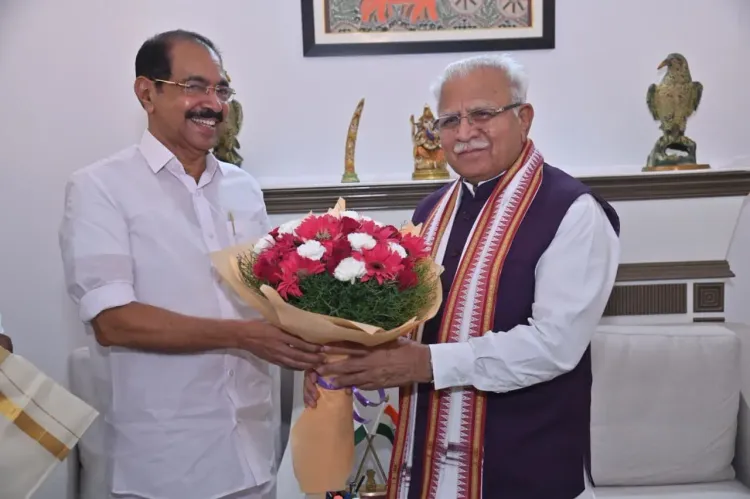
Union Power Minister Manohar Lal Khattar met Kerala Power Minister Sunny Joseph at his residence on 11 August 2026 .
Discussions covered extension of an existing 262 MW power allocation and operationalisation of a 500 MW Shakti coal allocation for Kerala.
VGF support for Battery Energy Storage Systems (BESS) was on the agenda, linked to the Ministry of Power's 2023 framework targeting 4,000 MWh of national grid-scale storage.
Upgrading Kerala's transmission network using HTLS conductors with Power Sector Development Fund assistance was also discussed.
Khattar reaffirmed full commitment to strengthening Kerala's power sector.
Coal, storage, and grid upgrades — the full power agenda landed on the table when Union Power Minister Manohar Lal Khattar hosted Kerala Power Minister Sunny Joseph at his residence on Tuesday, 11 August 2026, for what both sides described as a cordial and wide-ranging discussion on the state's electricity sector.
Five demands, one meeting: what Kerala brought to Delhi
The agenda was specific and dense. Khattar's post listed five distinct areas of discussion: additional power allocation for the state, extension of an existing 262 MW power allocation, operationalisation of a 500 MW Shakti coal allocation, Viability Gap Funding (VGF) support for Battery Energy Storage Systems (BESS), and Power Sector Development Fund assistance for upgrading transmission lines using High Temperature Low Sag (HTLS) conductors.
That breadth signals where Kerala's power sector pressure points are: not just supply, but the full chain from coal-linked generation through grid-scale storage to transmission capacity. Khattar closed his post with an unambiguous commitment — 'Kerala ke vidyut kshetra ko adhik sudridh karne ke liye hum poorn roop se pratibaddh hain' ('We are fully committed to further strengthening Kerala's power sector').
The Shakti scheme and what 500 MW means for Kerala
The Shakti coal linkage scheme, launched in 2017, replaced opaque administrative allocations with transparent, auction-based coal linkages for thermal power plants. For Kerala — a state with limited coal-based generation of its own — operationalising a 500 MW Shakti allocation would directly shore up supply headroom, particularly during dry months when hydro output dips. The Kerala State Electricity Board (KSEB) is the primary utility that would benefit.
BESS, HTLS, and the grid modernisation push
The two technology-focused items on the agenda reflect the Union Ministry of Power's broader infrastructure push. The VGF framework for Battery Energy Storage Systems, notified in 2023, targets 4,000 MWh of grid-scale storage nationally — Kerala's request for a share of that funding would help the state integrate its growing renewable capacity without destabilising the grid. Meanwhile, HTLS conductors allow existing transmission towers to carry significantly higher loads without new right-of-way acquisition, making them a cost-efficient upgrade path for a state where land constraints are real.
Southern states have repeatedly pressed the Centre for higher power allocations and grid modernisation support as peak demand climbs. Kerala's engagement fits a pattern of structured Union-state dialogue on energy security — and today's meeting, with its itemised agenda, suggests the conversation has moved well past the preliminary stage.
The next test is on paper: revised allocation orders from the Ministry of Power and fund-release timelines for BESS VGF and HTLS upgrades will determine whether Tuesday's commitments translate into electrons on the Kerala grid.
Point of View
Multi-point ask rather than a general grievance, and the Centre signalling receptivity. For the BJP-led Union government, visible engagement with a Congress-Left-governed Kerala on bread-and-butter infrastructure issues carries political utility beyond the power sector. The itemised agenda — Shakti coal, BESS VGF, HTLS upgrades — mirrors the Ministry of Power's own national priorities, suggesting Kerala is being folded into a template the Centre is rolling out across states. The real measure will come when allocation orders and fund-release timelines are published.
NationPress
11 Aug 2026
Frequently Asked Questions
What did Khattar and Kerala Power Minister discuss?
They discussed additional power allocation for Kerala, extension of an existing 262 MW allocation, operationalisation of a 500 MW Shakti coal linkage, VGF support for Battery Energy Storage Systems, and HTLS conductor-based transmission upgrades.
What is the Shakti coal linkage scheme?
The Shakti scheme, launched in 2017, allocates coal linkages to thermal power plants through transparent auctions, replacing earlier administrative allocations. Kerala sought operationalisation of a 500 MW allocation under this scheme.
What is VGF support for BESS in India?
The Ministry of Power notified a Viability Gap Funding framework in 2023 to support 4,000 MWh of grid-scale Battery Energy Storage Systems nationally, helping states integrate renewable energy more reliably.
What are HTLS conductors and why does Kerala need them?
High Temperature Low Sag (HTLS) conductors allow existing transmission towers to carry much higher electrical loads without new infrastructure, offering a cost-efficient way to expand grid capacity — important for a land-constrained state like Kerala.
Who is Sunny Joseph?
Sunny Joseph is the Power Minister of Kerala, representing the state government in discussions with the Union Ministry of Power on electricity allocations, storage support, and grid upgrades.