Khattar Rides Metro, Flags Urban Transport as Viksit Bharat Pillar
Synopsis
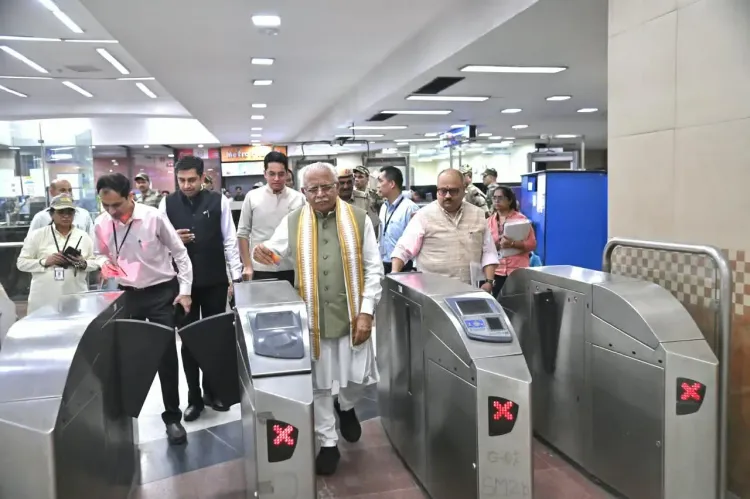
Union Minister Manohar Lal Khattar rode the Delhi Metro on October 16, calling it a smooth, safe, and punctual mode of urban transport and linking metro expansion directly to PM Modi's Viksit Bharat vision — a pointed policy signal from the minister who controls urban infrastructure funding.
Key Takeaways
Union Minister Manohar Lal Khattar rode the metro on Friday, October 16, 2026 and posted about the experience on X, tagging DMRC.
He described metro as effective for reducing traffic pressure, saving fuel, and protecting the environment.
Khattar framed metro expansion as central to PM Narendra Modi 's 'Viksit Bharat' (Developed India) vision.
As Minister for Housing and Urban Affairs, Khattar directly oversees metro policy, corridor approvals, and central funding for urban rail projects.
The Metro Rail Policy 2017 established the framework for metro planning and finance across Indian cities.
Delhi Metro Rail Corporation (DMRC) is widely regarded as the national benchmark for metro operations and is tagged in the minister's post.
A government minister boarding a metro train is not news. What Union Minister for Housing and Urban Affairs Manohar Lal Khattar said after stepping off on Friday, October 16 cuts closer to policy: that modern metro rail is a core instrument of India's urban future — not just a convenience, but a strategic bet on clean, efficient cities.
Posting on X and tagging the Delhi Metro Rail Corporation (DMRC), Khattar wrote in Hindi: 'Aaj ek baar phir metro se yatra karne ka avsar mila' ('Today I had the opportunity to travel by metro once again'). He described metro as 'an effective medium of urban transport — smooth, safe, and punctual' that contributes to reducing traffic pressure, saving fuel, and protecting the environment. He directly linked the expansion of modern and sustainable urban transport to Prime Minister Narendra Modi's vision of a 'Viksit Bharat' — a developed India.Why a Minister's Metro Ride Carries Policy Weight
Khattar is not a random passenger. As Union Minister for Housing and Urban Affairs, he sits at the centre of India's urban infrastructure decisions — the ministry that green-lights metro corridors, releases central funds, and sets the policy framework under which cities like Delhi, Mumbai, Bengaluru, Chennai, Hyderabad, and Pune build and operate their rail networks. His tagging of DMRC is deliberate: the corporation has long been held up as the benchmark for metro operations across the country.
The Metro Rail Policy 2017 gave Indian cities a structured framework for planning and financing metro projects, and since 2014, multiple new corridors and city systems have received central approval and funding. Metro rail now sits at the intersection of three government priorities: urban decongestion, fuel import reduction, and emissions control — all three of which Khattar named explicitly in Friday's post.
DMRC as the National Template
Delhi Metro Rail Corporation operates India's first large-scale modern metro network and remains the most-cited model as cities across India negotiate their own systems. Its performance on punctuality and ridership has repeatedly been invoked by central and state governments as proof that Indian public transit can scale. By tagging DMRC publicly, Khattar's post functions as an implicit endorsement of that model — and a signal to state transport authorities watching the ministry's priorities.
The broader pattern is consistent: successive central governments have treated metro rail as a non-negotiable pillar of urban growth policy, embedding it within budgetary allocations and annual urban affairs reviews. With Indian cities projected to absorb hundreds of millions of new residents over the coming decades, the pressure on surface roads makes underground and elevated rail not optional — but essential.
The minister did not announce a new project or a budget line on Friday. But in the grammar of Indian infrastructure politics, a senior minister riding a metro and publicly framing it as 'Viksit Bharat in motion' is a statement of intent — and a preview of where ministry attention is headed.
Point of View
Making urban mobility a campaign-ready talking point. The tagging of DMRC also reinforces the Centre's ownership of Delhi Metro's success at a time when the ministry is watching states negotiate new corridor approvals. It is routine in form, purposeful in message.
NationPress
16 Oct 2026
Frequently Asked Questions
What did Manohar Lal Khattar say about metro rail?
Khattar described metro as a smooth, safe, and punctual mode of urban transport that helps reduce traffic congestion, save fuel, and protect the environment, and linked its expansion to PM Modi's Viksit Bharat vision.
What is Manohar Lal Khattar's current role in the government?
Manohar Lal Khattar is India's Union Minister for Power and Housing and Urban Affairs, a senior BJP leader and former Chief Minister of Haryana.
What is the Metro Rail Policy 2017?
The Metro Rail Policy 2017 is a central government framework that provides guidelines for planning, financing, and operating metro rail projects in Indian cities, enabling structured expansion of urban rail networks.
What is Viksit Bharat and how does metro connect to it?
Viksit Bharat — meaning 'Developed India' — is PM Modi's long-term vision for India as a fully developed nation by 2047. Urban infrastructure like metro rail is positioned within this framework as a driver of sustainable, congestion-free city growth.
What is DMRC and why is it significant?
The Delhi Metro Rail Corporation (DMRC) operates India's first large-scale modern metro network and is widely regarded as the national template for metro planning and operations in other Indian cities.