Kishan Reddy Highlights PM Surya Ghar Yojana's Solar Push
Synopsis
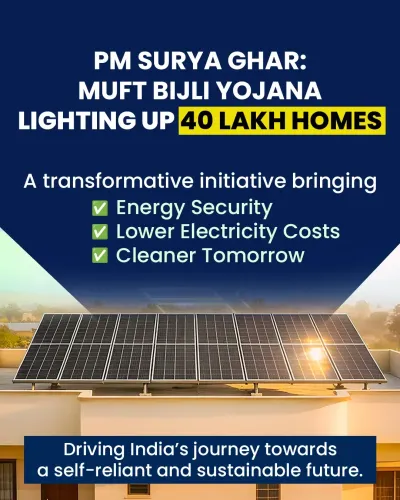
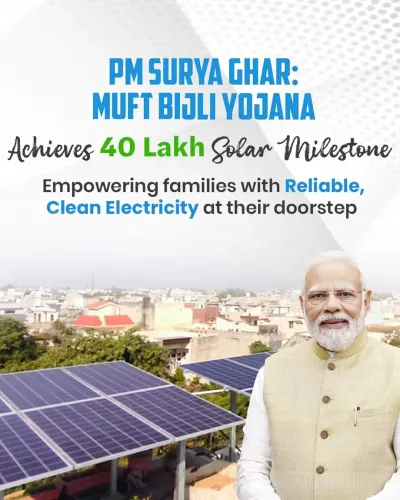
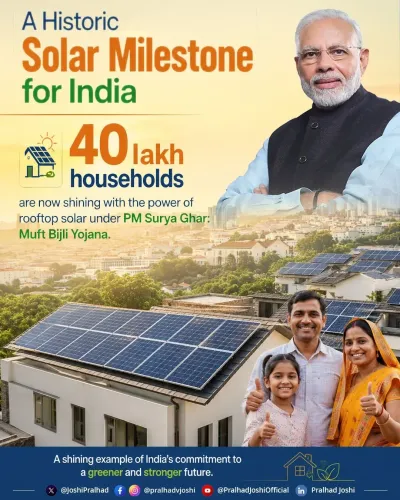
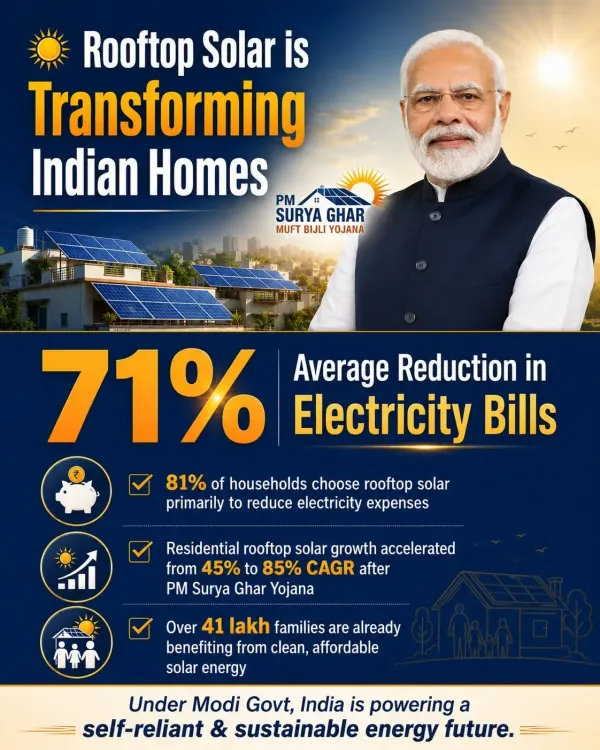
Union Minister G. Kishan Reddy on June 15, 2026 spotlighted the PM Surya Ghar Muft Bijli Yojana's 85% CAGR in residential rooftop solar installations, calling it a transformative step toward a self-reliant energy future under PM Modi's leadership.
Key Takeaways
Kishan Reddy , Union Coal and Mines Minister, highlighted progress of PM Surya Ghar Muft Bijli Yojana on June 15, 2026 .
The scheme reports an 85% Compound Annual Growth Rate (CAGR) in residential rooftop solar installations.
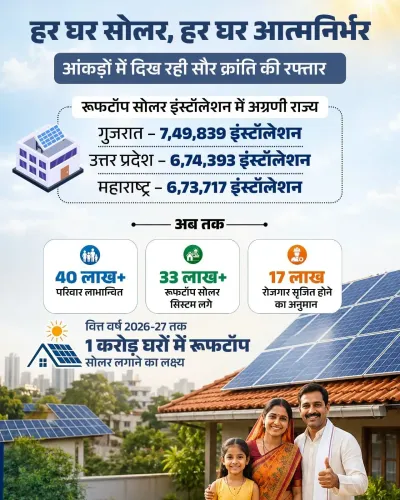
Launched in February 2024 , the scheme carries a budgetary outlay of Rs 75,000 crore targeting one crore households .
Beneficiaries can receive up to 300 units of free electricity per month through central financial assistance.
The scheme sits within India's larger goal of 500 GW non-fossil fuel capacity by 2030 and net-zero by 2070 .
Implementation involves the Ministry of New and Renewable Energy , state DISCOMs , and empanelled solar vendors.
Union Coal and Mines Minister G. Kishan Reddy on Monday, June 15, 2026, highlighted the rapid progress of the PM Surya Ghar Muft Bijli Yojana, crediting Prime Minister Narendra Modi's leadership for an accelerated push in residential rooftop solar adoption across India. The minister cited an 85% Compound Annual Growth Rate (CAGR) in solar installations under the scheme as evidence of its transformative impact on the country's energy landscape.
Context
In his post on X, Kishan Reddy described the scheme as 'rapidly transforming India's energy landscape by accelerating residential rooftop solar adoption.' He framed the initiative as building a 'self-reliant and sustainable energy future while providing substantial economic relief to millions of households.' The minister's remarks come as the government continues to position rooftop solar as a cornerstone of its distributed energy strategy.
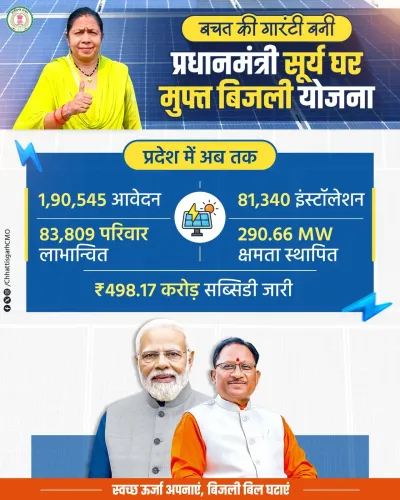
The PM Surya Ghar Muft Bijli Yojana was formally launched in February 2024 with a budgetary outlay of Rs 75,000 crore, targeting one crore households. The scheme provides central financial assistance for residential rooftop solar systems and promises up to 300 units of free electricity per month to beneficiary households.
Policy Backdrop
India's rooftop solar journey traces back to the Jawaharlal Nehru National Solar Mission launched in 2010, which set initial grid-connected solar targets. The national solar target was revised sharply upward in 2015 to 100 GW by 2022 as part of a broader 175 GW renewable energy goal. The PM-KUSUM scheme in 2019 further extended solar deployment to agricultural pumps and rural installations before the current household-focused programme took shape.
The Ministry of New and Renewable Energy is the nodal ministry implementing the scheme, working alongside state electricity distribution companies (DISCOMs) and a network of empanelled rooftop solar vendors. India's overarching target of 500 GW of non-fossil fuel capacity by 2030 and net-zero emissions by 2070 provides the strategic frame within which the PM Surya Ghar Yojana operates.
Stakeholders and Impact
For millions of residential households, the scheme offers a dual benefit: reduced electricity bills through free units and a long-term asset in the form of a rooftop solar system backed by central subsidy. DISCOMs stand to gain from reduced peak-hour demand pressure, while rooftop solar vendors and installers are experiencing a significant uptick in business volumes driven by scheme-linked demand.
The involvement of the Coal and Mines Ministry in amplifying a renewable energy scheme is itself notable. It underscores the government's broader messaging that the energy transition is a whole-of-government effort, even as coal continues to dominate India's baseload power generation in the near term.
What's Next
Parliamentary updates on cumulative installation numbers and subsidy disbursement rates are expected to provide a clearer picture of the scheme's on-ground reach. Any mid-term review of the programme's targets for 2026-27 will be closely watched by the renewable energy sector and state governments coordinating implementation. With the government actively promoting milestones, the scheme's performance data is likely to feature prominently in upcoming policy communications.
Point of View
Using a measurable metric — the 85% CAGR claim — to build a narrative of momentum around a flagship scheme ahead of potential parliamentary scrutiny. The choice of the Coal and Mines Minister, rather than the renewable energy minister, to amplify a solar programme signals a broader political strategy: projecting an image of unified transition even as coal remains central to India's energy mix. This pattern of cross-portfolio promotion is consistent with the BJP's approach of building a whole-of-government brand around PM Modi-linked schemes. The scheme's actual on-ground penetration and subsidy disbursement data will ultimately determine whether the political messaging holds up to legislative and public scrutiny.
NationPress
15 Sept 2026
Frequently Asked Questions
What is PM Surya Ghar Muft Bijli Yojana?
PM Surya Ghar Muft Bijli Yojana is a central government scheme launched in February 2024 with an outlay of Rs 75,000 crore to install rooftop solar systems in one crore households, providing up to 300 units of free electricity per month.
What is the CAGR claimed for PM Surya Ghar Yojana solar installations?
Union Minister G. Kishan Reddy cited an 85% Compound Annual Growth Rate (CAGR) in solar installations under the PM Surya Ghar Muft Bijli Yojana as of June 2026.
Who is responsible for implementing PM Surya Ghar Yojana?
The Ministry of New and Renewable Energy is the nodal ministry implementing the scheme, working with state DISCOMs and empanelled rooftop solar vendors.
How does PM Surya Ghar Yojana benefit households?
Eligible households receive central financial assistance to install rooftop solar panels and can avail up to 300 units of free electricity per month, reducing their energy costs significantly.
What is India's broader solar energy target?
India aims to achieve 500 GW of non-fossil fuel energy capacity by 2030 and reach net-zero emissions by 2070, with rooftop solar schemes like PM Surya Ghar Yojana forming a key part of the strategy.