Kishan Reddy: Coal Imports Fall 5.83% in August 2026
Synopsis
Coal Minister G. Kishan Reddy reports India's total coal imports fell 5.83% in August 2026 to 104.57 million tonnes, while blending imports for thermal power plants dropped a sharp 35.23%, reflecting gains in domestic production and supply-chain efficiency under the Atmanirbhar Bharat push.
Key Takeaways
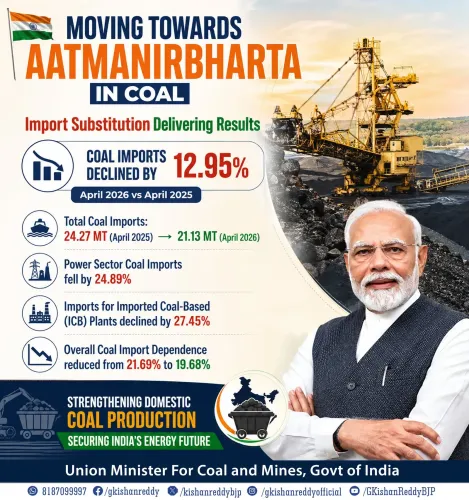
India's total coal imports fell 5.83% in August 2026 , declining to 104.57 million tonnes from 111.05 million tonnes in August 2025.
Imports for blending at domestic coal-based power plants dropped sharply by 35.23% — the standout figure in the data.
The Ministry of Coal attributes the decline to higher domestic production, improved mine-evacuation infrastructure and supply-chain efficiency gains.
The trend is framed as evidence of the Atmanirbhar Bharat energy-security agenda — launched in 2020 — translating into measurable import substitution.
Commercial coal mining was opened to private players in 2020 , a structural reform designed to boost output and reduce import reliance.
India's coal import bill is shrinking — and the numbers are hard to argue with. Union Coal and Mines Minister G. Kishan Reddy announced on Monday, November 2, 2026, that total coal imports dropped by 5.83% in August 2026, falling to 104.57 million tonnes from 111.05 million tonnes in August 2025 — with a particularly sharp swing in the power sector.
The blending number that stands out
The headline decline is significant, but one sub-figure commands attention: imports used for blending at domestic coal-based power plants fell by a steep 35.23%. Blending imports exist because the coal that Indian mines produce often has different calorific and ash characteristics than what certain power plants are calibrated to burn — so utilities mix imported coal with domestic coal to meet technical specifications. A 35% drop in that category signals that domestic supply is increasingly matching the quality and grade demands of the grid, not just the quantity.
The policy chain behind the decline
The shift did not happen overnight. Since 2020, when the government opened commercial coal mining to private players under the Atmanirbhar Bharat package, the Ministry of Coal has steadily expanded production targets and invested in mine-evacuation infrastructure — the rail sidings, conveyor systems and dedicated freight corridors that get coal from pithead to power plant. Kishan Reddy's post frames the August data as a direct result of 'sustained efforts to enhance domestic production, strengthen evacuation infrastructure and improve supply-chain efficiency.' Each of those three levers matters: higher output without better logistics simply creates stockpiles at mines rather than fuel at furnaces.
What it means for India's energy security calculus
India is the world's second-largest coal consumer and has historically relied on imports — primarily from Indonesia, Australia and South Africa — to bridge the gap between domestic output and demand. Every tonne of imported coal carries foreign-exchange cost and exposes the grid to global commodity-price volatility, as India's power sector discovered painfully during the 2022 energy crunch when seaborne coal prices spiked. A structural decline in blending imports, if sustained across subsequent months, would represent a meaningful reduction in that exposure. The Ministry of Coal's monthly statistics and progress on dedicated freight corridors will be the key indicators to watch.
One data point does not a trend make — but a 35% plunge in power-sector blending imports is exactly the kind of signal the Atmanirbhar Bharat energy agenda has been calibrated to produce.
Point of View
Quantifiable data point to anchor its Atmanirbhar Bharat energy narrative ahead of what is expected to be a high-demand winter. The 35.23% drop in blending imports is particularly politically useful because it speaks directly to power-sector self-sufficiency — a sore point after the 2022 grid stress. Sustaining this trajectory will depend on whether dedicated freight-corridor capacity keeps pace with rising domestic output; logistics have historically been the chokepoint, not mining volume. If the trend holds through the October-March peak season, it will substantially strengthen the government's case that structural coal-sector reforms are delivering real energy-security dividends.
NationPress
2 Nov 2026
Frequently Asked Questions
By how much did India's coal imports fall in August 2026?
India's total coal imports fell by 5.83% in August 2026, dropping to 104.57 million tonnes from 111.05 million tonnes in August 2025, according to Union Coal Minister G. Kishan Reddy.
Why did coal blending imports for power plants fall so sharply?
Blending imports at domestic coal-based power plants fell 35.23% because higher domestic production and improved supply-chain infrastructure allowed Indian utilities to source more coal locally, reducing the need to mix imported coal with domestic coal to meet technical specifications.
What is the Atmanirbhar Bharat policy for coal?
Atmanirbhar Bharat, launched in 2020, includes opening commercial coal mining to private players and expanding domestic production targets to reduce India's dependence on imported coal and strengthen energy security.
What is the Ministry of Coal doing to reduce coal imports?
The Ministry of Coal has been raising domestic production targets, expanding mine-evacuation infrastructure such as rail sidings and freight corridors, and improving supply-chain efficiency to bring more domestic coal to power plants and reduce blending imports.
Who is G. Kishan Reddy?
G. Kishan Reddy is India's Union Minister of Coal and Mines and the BJP's Telangana state president. He announced the August 2026 coal import decline figures on November 2, 2026.