Kishan Reddy credits Modi's reforms for India's economic rise
Synopsis
Union Coal and Mines Minister G. Kishan Reddy praised PM Modi's governance and structural reforms — citing strengthened economic data frameworks and a modernised services and export sector — as the drivers of India's resilient, high-impact economic growth.
Key Takeaways
Union Coal and Mines Minister G.
Kishan Reddy praised PM Modi 's structural reforms on September 29, 2026 , calling them the engine of India's resilient economic growth.
He specifically highlighted strengthened economic data frameworks and a modernised services and export sector as key outcomes of Modi's governance focus.
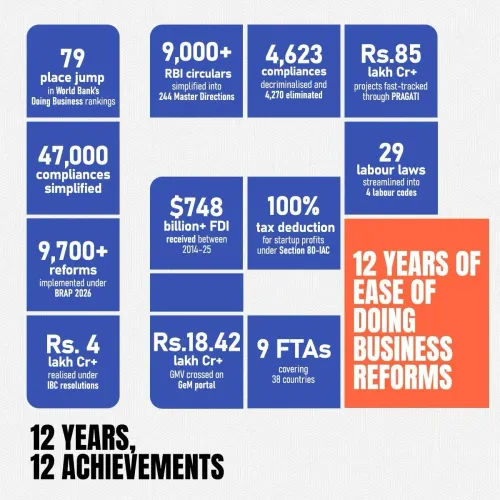
The reform arc includes the Goods and Services Tax (GST, 2017) and the Insolvency and Bankruptcy Code (IBC, 2016) — two of the most consequential economic overhauls of the post-2014 era.
As BJP Telangana state president , Kishan Reddy's endorsement serves both a national narrative and a regional political purpose in a state the party is working to consolidate.
The next Union Budget and Economic Survey will be closely watched for fresh commitments on data infrastructure and export incentives.
India's structural reform story got a fresh endorsement on Tuesday, September 29, 2026, as Union Coal and Mines Minister G. Kishan Reddy credited Prime Minister Narendra Modi's governance focus with steering the country toward 'resilient, high-impact economic growth' — pointing specifically to strengthened economic data frameworks and a modernised services and export sector.
A decade of reform, distilled into a post
Kishan Reddy's message is rooted in a genuine policy arc that stretches back to 2014. The Goods and Services Tax (GST), rolled out in 2017, unified India's fragmented indirect tax regime into a single national market — one of the most ambitious fiscal overhauls in the country's post-independence history. The Insolvency and Bankruptcy Code (IBC), enacted in 2016, injected credit discipline into an economy long burdened by unresolved corporate debt. Both reforms are now pillars of the 'structural reform' narrative that BJP leaders routinely invoke.
The emphasis on 'economic data frameworks' is notable. Modernising how India measures its own economy — from GDP methodology to trade statistics — has been a recurring theme in official economic statements, underpinning claims of formalisation and growth momentum.
Services and exports: the sectors in the spotlight
Kishan Reddy's shout-out to 'modern service and export sectors' reflects a deliberate strategic bet. India's services sector — anchored by technology, business process management, and increasingly financial services — has been a consistent engine of foreign exchange earnings and formal employment. Exporters, the other named stakeholder, have been the subject of successive policy interventions aimed at boosting competitiveness, from production-linked incentive schemes to trade facilitation measures.
Together, these two sectors carry the weight of India's ambition to punch above its weight in global value chains — and they are precisely the constituencies whose confidence the government is keen to reinforce.
Kishan Reddy's role in the BJP's Telangana calculus
As BJP Telangana state president, Kishan Reddy wears two hats: a Union Cabinet minister and the face of a party working to consolidate its footprint in a state it has historically found difficult terrain. Amplifying the Prime Minister's economic record serves a dual purpose — reinforcing the national narrative while making the case to Telangana voters that Modi's growth story is their story too.
The next Union Budget and Economic Survey will be the real test — watched closely for any fresh commitments on data infrastructure upgrades or expanded export incentive frameworks that could give substance to the ambitions Kishan Reddy described.
Point of View
IBC, data modernisation — rather than abstract slogans, the framing is harder to dismiss. For a BJP Telangana state president, it also doubles as a regional outreach tool, tying national economic wins to a constituency that the party has long sought to deepen its hold in. The real scrutiny will come at the next Budget: whether fresh policy moves on data infrastructure or export incentives can back up the rhetoric with new commitments.
NationPress
29 Sept 2026
Frequently Asked Questions
What economic reforms has PM Modi introduced since 2014?
Key structural reforms under PM Modi include the Goods and Services Tax (GST) in 2017, which unified India's indirect tax system, and the Insolvency and Bankruptcy Code (IBC) in 2016, which improved credit discipline and ease of doing business.
Who is G. Kishan Reddy?
G. Kishan Reddy is India's Union Minister of Coal and Mines and the BJP's Telangana state president, representing the Secunderabad constituency in the Lok Sabha.
What did Kishan Reddy say about India's economy?
Kishan Reddy said PM Modi's focus on robust governance and structural reforms is steering India toward resilient, high-impact economic growth, specifically highlighting strengthened economic data frameworks and modern service and export sectors.
Why is India's services sector important for economic growth?
India's services sector — spanning technology, business process management, and financial services — is a major source of foreign exchange earnings and formal employment, making it central to India's ambition to rise in global value chains.
What is the Insolvency and Bankruptcy Code (IBC)?
The Insolvency and Bankruptcy Code, enacted in 2016, is a landmark reform that streamlined the resolution of corporate insolvency in India, improving credit discipline and boosting investor confidence in the economy.