Kishan Reddy Hails India's First Hydrogen Train as Make in India Win
Synopsis
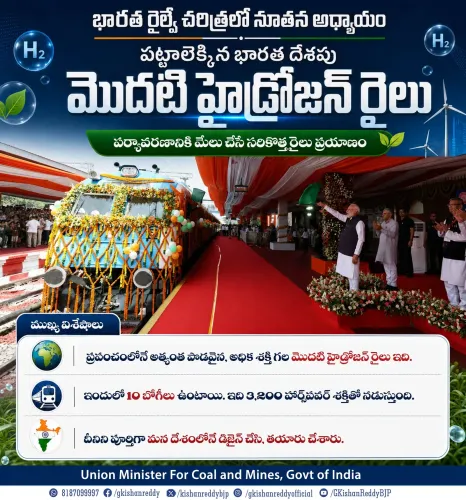
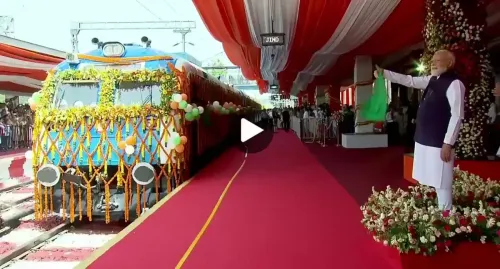
Union Minister G. Kishan Reddy amplified PM Modi's praise for India's first hydrogen-powered train on 17 July 2026, calling it a Make in India triumph built entirely by Indian engineers and domestic manufacturers — a zero-emission milestone for Indian Railways.
Key Takeaways
Kishan Reddy shared PM Narendra Modi's remarks on India's first hydrogen-powered train on 17 July 2026 .
The train is described as fully smoke-free and zero-emission, marking a clean-energy milestone for Indian Railways .
PM Modi confirmed the train was designed by Indian engineers and built by an Indian company, underlining its indigenous credentials.
The development is framed as a direct outcome of the Make in India initiative, launched in September 2014 .
Indian Railways' Hydrogen for Heritage initiative, announced in 2020-21, forms the policy foundation for this prototype.
Future steps include scaling hydrogen train prototypes and building dedicated refuelling infrastructure across the rail network.
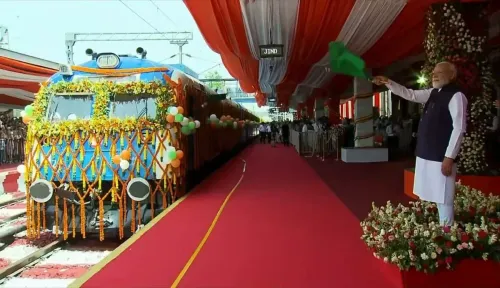
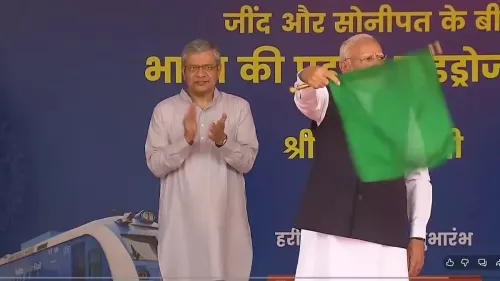
Union Coal and Mines Minister G. Kishan Reddy on Friday, 17 July 2026, amplified Prime Minister Narendra Modi's remarks on India's first hydrogen-powered train, calling it a 'shining example of the success of the Make in India initiative' — designed by Indian engineers and built by an Indian company.
Context
Reddy's post quotes PM Modi directly: 'India's first hydrogen-powered train is not only smoke-free but also a shining example of the success of the Make in India initiative. This is designed by Indian engineers and built by an Indian company.' The minister's amplification signals the ruling party's intent to position the hydrogen train as a flagship symbol of indigenous technological capability.
The train is described as entirely smoke-free, underlining its zero-emission credentials — a significant milestone for Indian Railways, which has been pursuing green hydrogen technology as part of its broader net-zero ambitions.
Policy Backdrop
Make in India, launched in September 2014, was conceived to transform India into a global manufacturing hub and reduce dependence on imported technology and equipment. The hydrogen train's domestic design and production directly embodies that mandate.
Indian Railways had earlier announced its Hydrogen for Heritage initiative — a programme aimed at deploying zero-emission hydrogen fuel-cell trains, initially envisaged for heritage and tourist routes. The current prototype represents the operational realisation of that policy direction, prioritising local rolling-stock development over procurement of foreign technology.
Stakeholders and Impact
For railway passengers, a hydrogen-powered fleet promises cleaner, quieter journeys with no direct exhaust emissions. For domestic manufacturers and engineering firms, the project signals government commitment to channelling advanced-technology contracts within India, potentially opening a new industrial segment around hydrogen mobility.
The broader transport sector stands to benefit as well. A proven domestic hydrogen train creates a template for scaling zero-emission rail across the network, reducing India's dependence on diesel traction and contributing to its international climate commitments.
What's Next
Attention will now turn to the rollout of additional hydrogen train prototypes and the development of dedicated hydrogen production and refuelling infrastructure by Indian Railways. The pace at which these supporting facilities are established will determine how quickly the technology can move from a single showcase prototype to a commercially viable fleet.
With the political establishment firmly behind the initiative, the hydrogen train is poised to feature prominently in the government's narrative around self-reliant, green infrastructure — a convergence of the Make in India and clean-energy agendas that both ministries and ruling-party leaders are likely to continue highlighting.
Point of View
The party frames green technology not as an imported solution but as homegrown achievement — a politically potent distinction. The post also reflects a broader pattern of senior ministers using social media to extend the prime minister's messaging reach, ensuring a coordinated chorus around flagship deliverables. Whether the hydrogen train scales beyond a single prototype will ultimately test whether the political narrative translates into durable industrial policy.
NationPress
17 Jul 2026
Frequently Asked Questions
What is India's first hydrogen-powered train?
India's first hydrogen-powered train is a zero-emission, smoke-free locomotive designed by Indian engineers and built by an Indian company, developed under Indian Railways' clean-energy push. PM Modi highlighted it as a Make in India success on 17 July 2026.
What is the Make in India initiative?
Make in India is a flagship government initiative launched in September 2014 by PM Narendra Modi to promote domestic manufacturing, reduce import dependence, and position India as a global production hub.
What is Indian Railways' Hydrogen for Heritage initiative?
Hydrogen for Heritage is an Indian Railways programme announced in 2020-21 to develop and deploy hydrogen fuel-cell trains, initially targeting heritage and tourist routes as a step toward zero-emission rail operations.
Why did G. Kishan Reddy post about the hydrogen train?
As Union Minister and BJP Telangana state president, Kishan Reddy shared PM Modi's remarks to amplify the government's self-reliance and green-technology narrative, framing the hydrogen train as proof of Make in India's success.
What are the next steps for hydrogen trains in India?
The focus will shift to rolling out additional hydrogen train prototypes and establishing dedicated hydrogen production and refuelling facilities, which will determine how quickly the technology can scale across India's rail network.