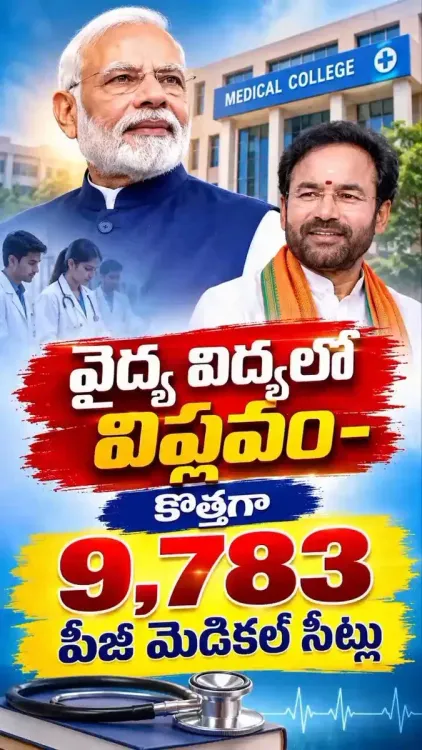
Kishan Reddy: NMC adds 9,783 PG medical seats for 2026-27
Synopsis
The National Medical Commission has approved 9,783 new PG medical seats for 2026-27, raising India's total to 68,305. Telangana receives 4,417 seats. Union Minister G. Kishan Reddy highlighted the expansion as reducing the need for Indian youth to seek specialist training abroad.
Key Takeaways
The NMC approved 9,783 new PG medical seats for the 2026-27 academic year.
India's total PG medical seat count now stands at 68,305 .
Telangana received 4,417 PG medical seats from this allocation.
The expansion is aimed at reducing the outflow of Indian medical graduates seeking postgraduate training abroad.
The NMC Act 2019 replaced the older Medical Council of India to enable faster regulatory approvals for seat expansion.
Kishan Reddy credited the Modi government with accelerating medical education infrastructure growth.
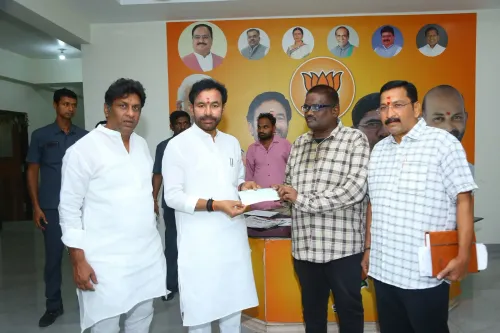
India's postgraduate medical training just got a significant upgrade. Union Coal and Mines Minister G. Kishan Reddy announced on Wednesday, 18 November 2026 that the National Medical Commission (NMC) has approved 9,783 new PG medical seats for the 2026-27 academic year, pushing the country's total PG medical seat count to 68,305 — a number that signals a deliberate, accelerating push to fix India's chronic specialist-doctor shortage.
Telangana's 4,417-seat haul
For Telangana, the numbers are striking. The state has secured 4,417 PG medical seats out of the national total — a share that reflects both the state's expanding medical college infrastructure and a central policy of distributing specialist training capacity more evenly across regions. Kishan Reddy, who serves as BJP Telangana state president in addition to his cabinet role, highlighted the figure directly, framing it as a reason Telangana's youth should no longer need to travel abroad for specialist medical training.
Posting in Telugu, the minister wrote that the central government is 'paving the way for our youth to become specialist doctors right here, without the need to go abroad for medical education.' The statement lands squarely in a long-running national conversation: every year, thousands of Indian MBBS graduates fly to Russia, Ukraine, China, and Eastern Europe for PG training they cannot access at home, spending foreign exchange and facing uncertain credential recognition on return.
From MCI to NMC — a decade of seat expansion
The National Medical Commission, established under the NMC Act 2019 to replace the older Medical Council of India, was explicitly designed to cut regulatory bottlenecks and enable faster seat approvals. Since 2014, successive rounds of central approvals have added both undergraduate and postgraduate seats, with the current administration framing annual NMC approvals as a structural fix rather than a one-off gesture.
The Modi government's approach has tied new seat approvals to upgrades at existing institutions and the commissioning of new medical colleges — particularly in states and districts that were historically underserved. Telangana's allocation in this round is partly a downstream effect of that regional-distribution logic.
What the numbers mean for aspirants
For a medical aspirant sitting the NEET-PG entrance exam, every additional seat represents a direct reduction in one of the world's most punishing competitive ratios. India trains roughly 100,000 MBBS doctors per year but — before this latest round — had fewer than 60,000 PG seats available, meaning tens of thousands of qualified graduates were locked out of specialisation annually. The jump to 68,305 seats narrows that gap meaningfully, though it does not close it.
The 2026-27 admissions cycle — including NEET-PG counselling rounds — will be the first to operationalise these new seats. How quickly institutions can fill faculty positions, equip wards, and absorb the increased intake will determine whether the numbers translate into trained specialists on the ground.
India's doctor-to-population ratio still trails WHO benchmarks. Each NMC approval round is a step, not a destination.
Point of View
Allowing the central government to claim credit for expanding opportunity while tying regional seat allocations to state-level goodwill — particularly in competitive states like Telangana. Kishan Reddy's framing of the expansion as a solution to foreign brain-drain taps a genuine anxiety among middle-class families and aligns with the broader 'Make in India' narrative applied to education. The structural challenge remains: seat numbers matter less if faculty shortages and infrastructure gaps prevent institutions from delivering quality training, a tension the NMC's approval process does not automatically resolve. Watchers of health-sector policy will track whether the 2026-27 counselling rounds successfully fill these seats and whether faculty recruitment keeps pace.
NationPress
18 Nov 2026
Frequently Asked Questions
How many new PG medical seats has the NMC approved for 2026-27?
The National Medical Commission approved 9,783 new PG medical seats for the 2026-27 academic year, raising the national total to 68,305 .
How many PG medical seats did Telangana get in 2026-27?
Telangana received 4,417 PG medical seats as part of the NMC's 2026-27 allocation announced in November 2026.
What is the National Medical Commission and why does it approve medical seats?
The National Medical Commission (NMC) is a statutory body set up under the NMC Act 2019 to replace the Medical Council of India. It regulates medical education in India, including approving the number of UG and PG seats institutions can offer each academic year.
Why do Indian medical graduates go abroad for PG training?
India has historically had far fewer PG medical seats than MBBS graduates each year, forcing tens of thousands of qualified doctors to seek specialist training in countries like Russia, Ukraine, and China. Expanding domestic PG seats is intended to reduce this outflow.
What did G. Kishan Reddy say about PG medical seats?
Union Minister G. Kishan Reddy announced on 18 November 2026 that the NMC's approval of 9,783 new PG seats — including 4,417 for Telangana — means the central government is building pathways for Indian youth to become specialist doctors at home without going abroad.