Kishan Reddy Highlights 5F Vision, PM MITRA Park on National Handloom Day
Synopsis
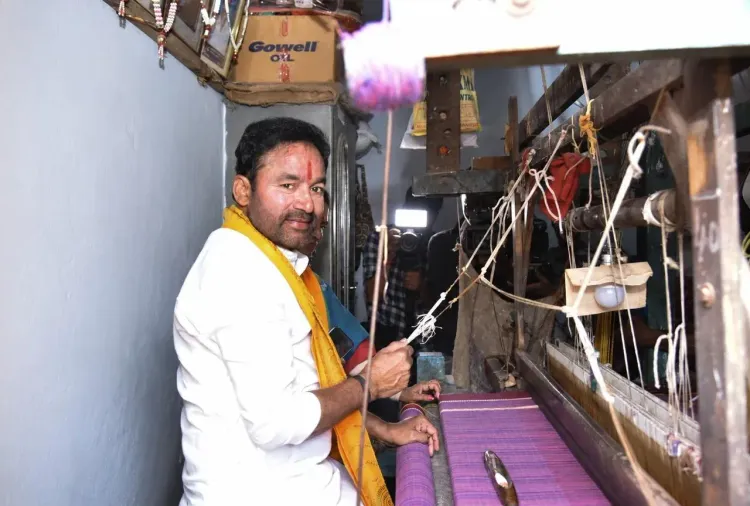
On National Handloom Day, Union Minister G. Kishan Reddy outlined the central government's 5F Vision, PM MITRA Mega Textile Park in Warangal, and India's ambition to hit Rs 9 lakh crore in textile exports by 2030, while calling on citizens to buy handloom.
Key Takeaways
Kishan Reddy marked National Handloom Day on 7 August 2026 with a detailed post in Telugu addressing India's weaving communities.
The textile sector employs nearly 5 crore people directly and indirectly, making it India's second-largest employer after agriculture.
The central government's 5F Vision — Farm to Fibre, Fibre to Fabric, Fabric to Fashion, Fashion to Foreign Markets — frames the policy approach alongside Make in India .
A PM MITRA Mega Textile Park is being established in Warangal district, Telangana , combining traditional weaving with advanced machinery.
The government has reportedly spent over Rs 69,860 crore on MSP cotton procurement from Telangana farmers.
India's stated goal is to scale textile exports to Rs 9 lakh crore by 2030 , backed by PLI, PM MITRA, National Handloom Development Programme, and Weavers MUDRA Scheme.
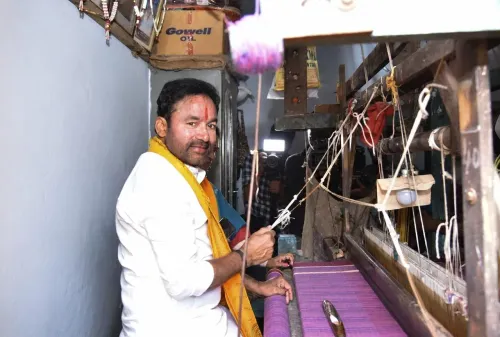
On National Handloom Day, 7 August, Union Coal and Mines Minister and BJP Telangana president G. Kishan Reddy turned the spotlight on India's weaving communities — and on the central government's ambition to transform the country into a global textile powerhouse by 2030.
A sector second only to farming
In a detailed post in Telugu addressed to 'priya netannalu' ('dear weaver brothers and sisters'), Kishan Reddy underscored the scale of what is at stake. The textile and handloom sector directly and indirectly employs nearly 5 crore people across India — making it the country's largest employer after agriculture. It also generates significant foreign exchange, two facts that together explain why successive governments have treated it as a strategic priority rather than a heritage footnote.
The minister cited the central government's '5F Vision' — Farm to Fibre, Fibre to Fabric, Fabric to Fashion, Fashion to Foreign Markets — as the organising logic behind current policy. Paired with the Make in India programme, the framework is designed to capture value at every link in the chain, from the cotton field to the export invoice.
The Warangal PM MITRA park and Telangana's cotton belt
For Telangana specifically, Kishan Reddy pointed to a PM MITRA Mega Textile Park being set up in Warangal district — a region with deep handloom roots. The park is intended to house both traditional weaving methods and advanced machinery, bridging craft heritage with industrial scale. PM MITRA (Mega Integrated Textile Region and Apparel) parks received Cabinet approval in 2021, with seven locations identified nationwide; Warangal's inclusion positions Telangana's weaving clusters directly within that national grid.
Cotton farmers in the region are also part of the equation. The minister stated that the central government has spent over Rs 69,860 crore procuring cotton from Telangana farmers under the Minimum Support Price mechanism — a figure that, if borne out, would represent one of the largest MSP outlays for a single state's cotton crop.
Schemes, technology, and the Rs 9 lakh crore export target
The policy toolkit Kishan Reddy listed is wide: the Production Linked Incentive (PLI) scheme for man-made fibre and technical textiles, the National Handloom Development Programme, the Raw Material Supply Scheme, and the Weavers MUDRA Scheme. Together, these are meant to give weavers access to modern looms, raw material, worksheds, design support, marketing channels, credit, and social security.
Technology is now part of the pitch too. The minister highlighted the integration of Artificial Intelligence, automation, and advanced analytics into the sector to raise productivity, quality, and market reach — a signal that the government sees handloom's future as digitally augmented, not just tradition-preserved.
The headline ambition: grow textile exports to Rs 9 lakh crore by 2030. That target, combined with the infrastructure push and scheme architecture, is the government's answer to competition from textile giants in Southeast Asia and Bangladesh.
Kishan Reddy closed with a direct appeal to citizens — buy handloom. The minister's message: preserving a craft and building an export economy are, in this case, the same act.
Point of View
He positions the BJP's central government as the primary engine of the state's textile economy ahead of state elections. The 2030 export target of Rs 9 lakh crore is an ambitious benchmark that will be tested against real commissioning timelines for PM MITRA parks and PLI uptake. The explicit embrace of AI and automation alongside traditional crafts signals a deliberate attempt to rebrand handloom as a future-facing industry, not a welfare cause — a framing that could prove decisive in attracting private investment into the sector.
NationPress
21 Sept 2026
Frequently Asked Questions
What is National Handloom Day and when is it observed?
National Handloom Day is observed every year on 7 August to honour India's weaving communities and recall the Swadeshi movement's role in the independence struggle. It was instituted in 2015 .
What is the 5F Vision in India's textile policy?
The 5F Vision stands for Farm to Fibre, Fibre to Fabric, Fabric to Fashion, and Fashion to Foreign Markets — a vertically integrated framework the central government is implementing alongside Make in India to add value at every stage of the textile supply chain.
What is the PM MITRA park in Warangal?
PM MITRA (Mega Integrated Textile Region and Apparel) is a central government scheme approved in 2021 to create large integrated textile parks. The Warangal, Telangana park is one of seven locations identified nationwide, combining traditional handloom methods with advanced industrial machinery.
What is India's textile export target for 2030?
The central government has set a target of growing India's textile exports to Rs 9 lakh crore by 2030 , backed by schemes including the PLI programme, PM MITRA parks, and the National Handloom Development Programme.
What schemes are available for handloom weavers in India?
Weavers can access the National Handloom Development Programme, Raw Material Supply Scheme, Weavers MUDRA Scheme , and the PLI scheme , which together provide modern looms, raw materials, worksheds, design support, credit, and social security cover.