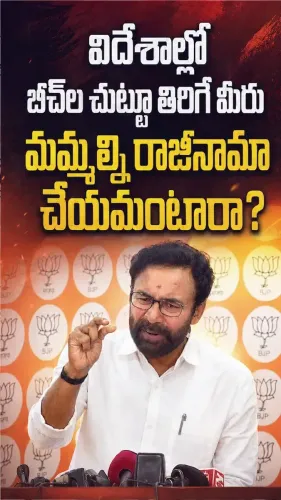
Kishan Reddy Rebukes Owaisi Over Passport-Citizenship Remarks
Synopsis
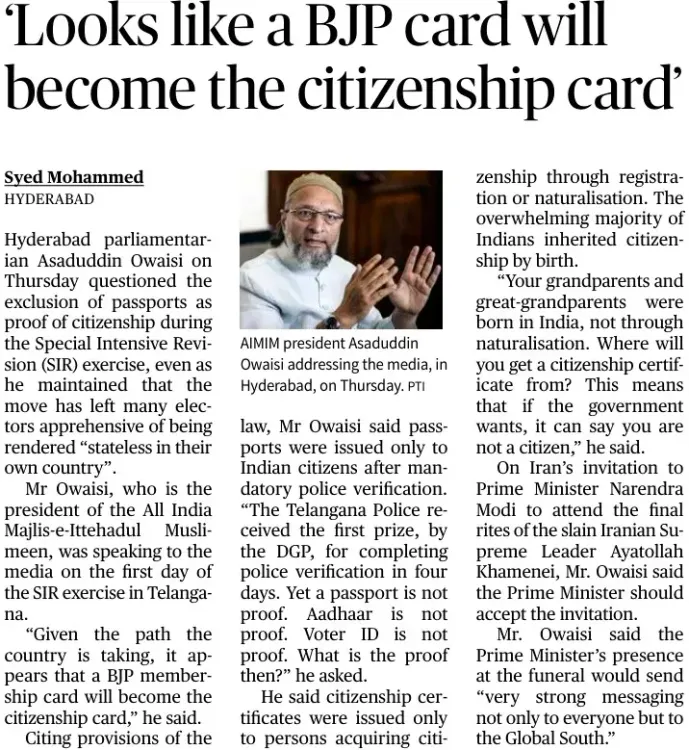
Union Minister G. Kishan Reddy on June 26 publicly rebuked AIMIM MP Asaduddin Owaisi, calling his remarks on passports and citizenship legally incorrect. Citing the Passports Act, 1967 and a 2013 Bombay High Court ruling, Reddy argued the MEA's clarification restates a six-decade-old legal position, not a new BJP policy.
Key Takeaways
Kishan Reddy called Asaduddin Owaisi's remarks on passports and citizenship 'legally incorrect and misleading' on June 26, 2026 .
The Passports Act, 1967 — enacted under a Congress government — explicitly allows passports to be issued to non-citizens under Section 20 , meaning a passport cannot serve as absolute proof of citizenship.
The Citizenship Act, 1955 governs Indian citizenship through birth, descent, registration, or naturalisation — not through any single document.
The Bombay High Court in 2013 held that a passport, even alongside Aadhaar and a birth certificate, cannot by itself establish citizenship; other High Courts have followed suit.
Kishan Reddy argued the MEA clarification restates a legal position settled for nearly 60 years and is not a new Modi government policy.
The minister urged Owaisi to read both Acts before making public statements on the issue.
Union Coal and Mines Minister G. Kishan Reddy on Friday, June 26, 2026, sharply rebutted AIMIM MP Asaduddin Owaisi, calling his remarks on passports and citizenship 'legally incorrect and misleading.' The minister, who also serves as BJP Telangana state president, invoked the Passports Act, 1967 and the Citizenship Act, 1955 to argue that the legal position Owaisi criticised has been settled for nearly six decades.
Context
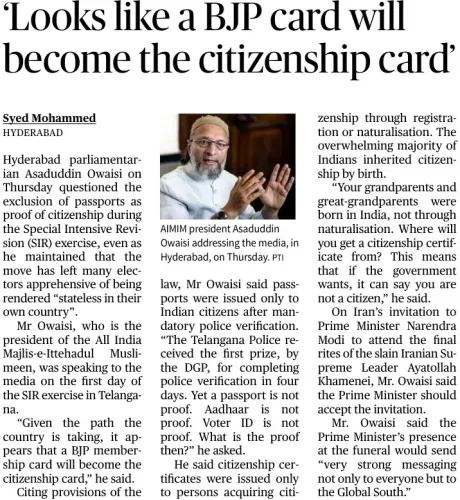
The exchange was triggered by remarks Owaisi made in response to a Ministry of External Affairs (MEA) clarification stating that an Indian passport, by itself, is not conclusive proof of citizenship. Owaisi, a trained barrister and sitting MP from Hyderabad, had questioned the legal and practical implications of that position for ordinary passport holders. Kishan Reddy countered that Owaisi, given his legal training, 'is expected to know the clear distinction in law between a passport and citizenship.'
The minister argued that Owaisi's remarks reflected 'either a basic misunderstanding of the law or a deliberate attempt to confuse people for political gain.' He stressed that the MEA clarification 'does not mean the Indian passport is worthless' but only that it is not, on its own, conclusive evidence of citizenship.
Policy Backdrop
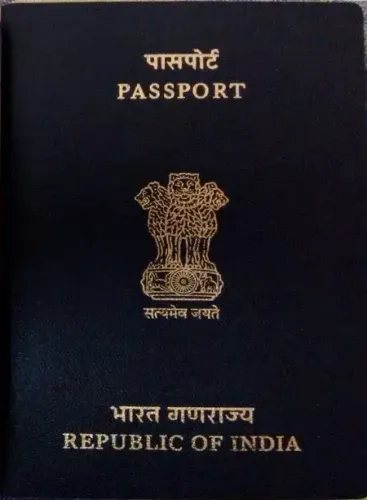
At the heart of the dispute are two foundational statutes. The Citizenship Act, 1955 governs acquisition of Indian citizenship through birth, descent, registration, or naturalisation. The Passports Act, 1967 — enacted under a Congress government — defines a passport primarily as a travel document.
Crucially, Section 20 of the Passports Act empowers the Central Government to issue a passport or travel document even to a person who is not a citizen of India, if it is deemed in the public interest. Kishan Reddy noted this provision has been invoked 'several times in the past,' meaning the legal separation between a passport and citizenship proof is written into the statute itself. 'This is not a new rule,' he stated. 'To blame the Modi Government for a position settled for nearly 60 years is either ignorance or a deliberate hiding of the truth.'
Judicial precedent reinforces the statutory position. The Bombay High Court in 2013 held that a passport — even alongside documents such as Aadhaar and a birth certificate — cannot by itself establish citizenship. Multiple other High Courts have followed the same principle, making this a well-entrenched legal doctrine rather than a policy innovation of the current government.
Stakeholders and Impact
The debate has practical resonance for millions of Indian passport holders who may interpret the MEA's clarification as diminishing the document's value. Kishan Reddy sought to address that anxiety directly, reiterating that the passport remains a valid and recognised travel document — its limitations apply specifically to citizenship adjudication, not to its utility for international travel or general identification.
For citizenship applicants and communities historically sensitive to documentation issues — including those whose citizenship status has been questioned in courts or before tribunals — the clarification carries greater weight. The minister's rebuttal is also significant for political representatives across parties, as it draws a line between permissible political critique and what the BJP characterises as legally inaccurate public statements by an elected official.
What's Next
The exchange is likely to spill into parliamentary proceedings, where Opposition members may seek a formal statement from the MEA or the Ministry of Home Affairs on the evidentiary weight of passports in citizenship determinations. Pending petitions in various High Courts on document verification in citizenship cases could also be influenced by the renewed public attention on this legal question.
Kishan Reddy closed with a direct challenge: 'Shri Owaisi should read the Citizenship Act, 1955 and the Passports Act, 1967 before misleading the very people he represents.' Whether Owaisi responds — in Parliament or on social media — will shape the next phase of this legal-political debate.
Point of View
He pre-empts the charge that the MEA clarification is ideologically motivated. The exchange reflects a broader pattern in Indian politics where identity documents — passports, Aadhaar, birth certificates — have become proxies for deeper contests over citizenship, belonging, and state power. How the Opposition responds, and whether the MEA issues further clarification, will determine whether this remains a social-media skirmish or escalates into a parliamentary flashpoint.
NationPress
25 Sept 2026
Frequently Asked Questions
Does an Indian passport prove citizenship?
No, an Indian passport is not conclusive proof of citizenship. The Bombay High Court ruled in 2013 that a passport, even alongside documents like Aadhaar and a birth certificate, cannot by itself establish citizenship. Citizenship is governed by the Citizenship Act, 1955.
What did the MEA say about Indian passports and citizenship?
The Ministry of External Affairs clarified that an Indian passport alone does not conclusively prove citizenship. This restates a legal position embedded in the Passports Act, 1967 and upheld by multiple High Courts, not a new government policy.
What is Section 20 of the Passports Act, 1967?
Section 20 of the Passports Act, 1967 empowers the Central Government to issue a passport or travel document to a person who is not a citizen of India, if it is in the public interest. This provision has been invoked multiple times historically.
Why did Kishan Reddy criticise Owaisi over citizenship remarks?
Union Minister G. Kishan Reddy said Owaisi's remarks were legally incorrect, arguing that the distinction between a passport and proof of citizenship has been settled in law since 1967 and in courts since at least 2013, and is not a creation of the current government.
How is Indian citizenship acquired?
Indian citizenship is acquired through birth, descent, registration, or naturalisation as defined by the Citizenship Act, 1955. No single document, including a passport, is treated as absolute proof of citizenship by Indian law or courts.