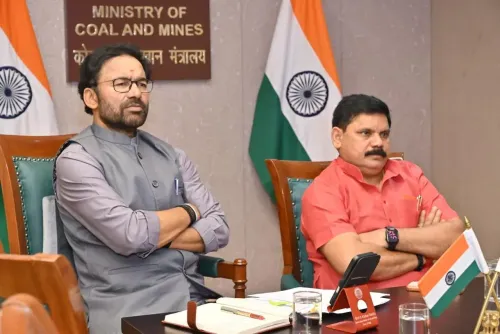
Kishan Reddy Hails Decade of Mining Reforms Under PM Modi
Synopsis
Union Coal and Mines Minister G. Kishan Reddy has credited PM Narendra Modi's decade-long leadership for transforming India's mining sector through e-auctions, the National Mineral Policy 2019, and commercial coal mining reforms — framing resource self-reliance as central to Atmanirbhar Bharat and Viksit Bharat.
Key Takeaways
Union Coal and Mines Minister G.
Kishan Reddy on June 8, 2026 highlighted a decade of mining sector reforms under PM Narendra Modi .
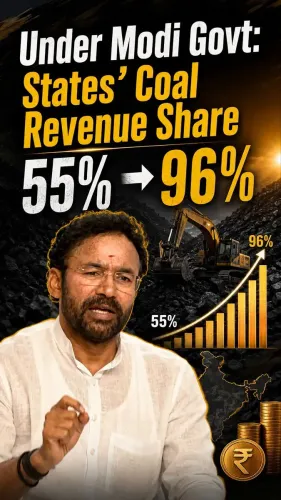
The MMDR Amendment Act, 2015 replaced discretionary allocations with competitive e-auctions , improving transparency and state revenues.
The National Mineral Policy, 2019 prioritised exploration, sustainability, and private-sector participation in the mining sector.
Commercial coal mining auctions launched in 2020 ended Coal India Limited 's monopoly and opened blocks to private players.
Reforms are framed as foundational to Atmanirbhar Bharat and the Viksit Bharat vision, linking resource security to manufacturing and infrastructure goals.
The next phase will hinge on critical mineral block auctions and potential further amendments to the MMDR Act in Parliament.
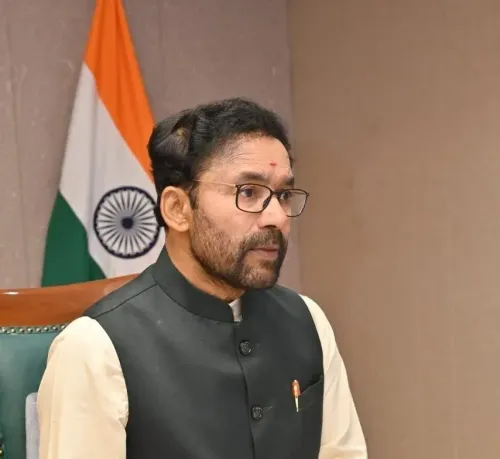
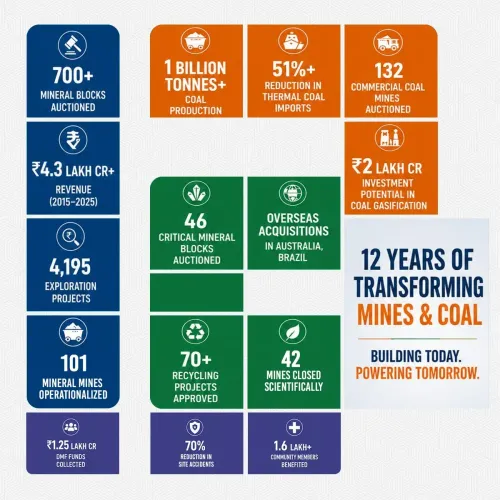
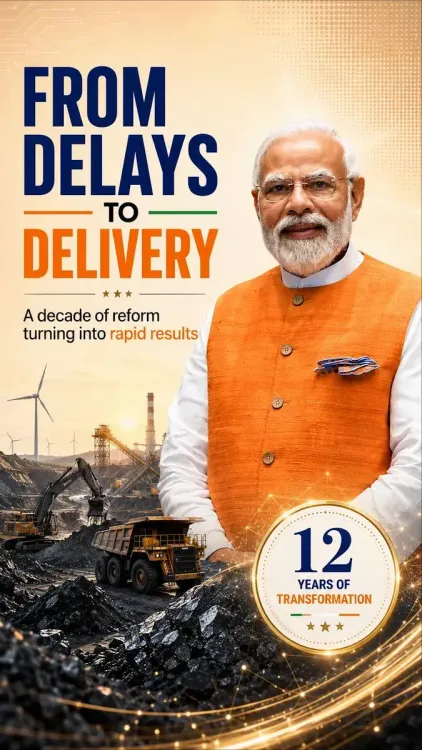
Union Coal and Mines Minister G. Kishan Reddy on Monday, June 8, 2026, credited Prime Minister Narendra Modi's decade-long leadership for a 'transformative journey' in India's mining sector, citing landmark reforms, greater transparency, streamlined approvals, and a commitment to sustainable development as the pillars of this change.
Context
In his post, Minister Reddy stated that the mining sector has 'emerged as a key pillar of economic growth and resource security,' attributing the shift to policy innovation and on-ground impact. He linked these gains to the broader goals of Atmanirbhar Bharat and the vision of a Viksit Bharat, framing resource self-reliance as central to India's development trajectory.
The post, addressed jointly to @MinesMinIndia and @CoalMinistry, appears to mark a retrospective assessment of reforms undertaken since 2014, coinciding with over a decade of the BJP-led central government.
Policy Backdrop
The reforms Reddy references have a clear legislative lineage. The Mines and Minerals (Development and Regulation) Amendment Act, 2015 replaced the earlier first-come-first-served system of mineral block allocation with competitive e-auctions, a move widely credited with reducing discretionary allocations and improving revenue transparency for mineral-rich states.
The National Mineral Policy, 2019 built on this foundation by emphasising exploration, sustainable mining practices, and greater private-sector participation. A landmark shift came in 2020, when commercial coal mining auctions were launched, ending the long-standing monopoly of Coal India Limited and opening coal blocks to private players for the first time.
These successive reforms are part of a wider industrial strategy that links domestic resource security to India's manufacturing and infrastructure ambitions, including reducing import dependence on thermal coal, iron ore, and critical minerals.
Stakeholders and Impact
The beneficiaries of this reform arc span multiple layers. Mineral-rich states such as Jharkhand, Odisha, Chhattisgarh, and Rajasthan stand to gain from higher auction-derived revenues that flow directly to state exchequers under the amended framework. Private mining companies, both domestic and foreign, have gained a more structured and competitive entry point into a sector that was previously dominated by public-sector entities.
For the broader economy, the push toward domestic mineral production is directly tied to India's ambitions in sectors like steel, cement, electronics manufacturing, and the emerging critical minerals supply chain — areas where import dependence has historically been a vulnerability.
What's Next
Attention in the sector is now focused on the next rounds of critical mineral block auctions, which are seen as essential to India's ambitions in clean energy and advanced manufacturing. Any further amendments to the MMDR Act tabled in Parliament will be closely watched by industry and state governments alike.
With Minister Reddy's post signalling a confident official narrative around the reform decade, the government appears to be laying the groundwork for the next phase of mining sector expansion — one that will test whether the transparency and efficiency gains of the auction era can be sustained and deepened.
Point of View
Using the tenth year of the Modi government as a moment to consolidate the official narrative around mining sector reform. By tying e-auctions, the National Mineral Policy, and commercial coal liberalisation into a single arc, the BJP is positioning these changes as a coherent legacy rather than incremental policy shifts. The invocation of both 'Atmanirbhar Bharat' and 'Viksit Bharat' signals that the government intends to carry this reform story into the next electoral and policy cycle. The real test, however, will be whether critical mineral auctions and MMDR amendments can deliver the same transparency dividends in a far more geopolitically contested resource environment.
NationPress
22 Oct 2026
Frequently Asked Questions
What mining reforms has India carried out under PM Modi?
Under PM Modi, India replaced discretionary mineral block allocations with competitive e-auctions through the MMDR Amendment Act of 2015, introduced the National Mineral Policy 2019 to boost exploration and private participation, and in 2020 launched commercial coal mining auctions that ended Coal India's monopoly.
What is Atmanirbhar Bharat in the context of mining?
Atmanirbhar Bharat, in the mining context, refers to India's push to reduce import dependence by boosting domestic production of coal, iron ore, and critical minerals, ensuring resource security for the country's manufacturing and infrastructure sectors.
Who is G. Kishan Reddy and what ministry does he head?
G. Kishan Reddy is the Union Minister of Coal and Mines in the Government of India and also serves as the BJP's Telangana state president.
What is the MMDR Act and why does it matter?
The Mines and Minerals (Development and Regulation) Act, or MMDR Act, is the central legislation governing mineral exploration and mining in India. Its 2015 amendment introduced e-auctions for mineral blocks, replacing a system that was prone to discretionary and opaque allocations.
What are critical minerals and why is India auctioning them?
Critical minerals are resources essential for clean energy technologies, electronics, and defence manufacturing — such as lithium, cobalt, and rare earth elements. India is auctioning critical mineral blocks to reduce dependence on imports and build a domestic supply chain for these strategic materials.