KTR hails Skyroot Vikram-1 launch as historic space milestone

Synopsis
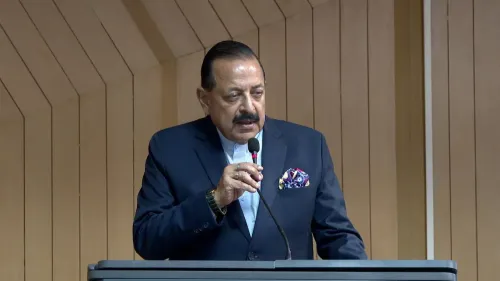
BRS working president K. T. Rama Rao hailed the launch of Skyroot Aerospace's Vikram-1 on 18 July 2026 as a historic milestone — India's first privately developed orbital-class rocket — crediting T-Hub Hyderabad's incubation support and congratulating the Skyroot founding team.
Key Takeaways
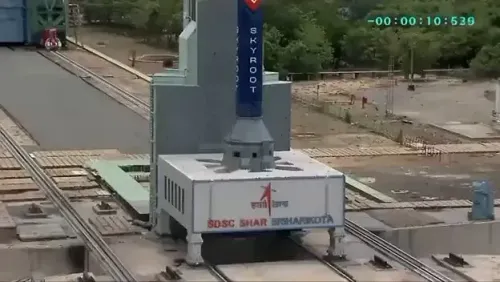
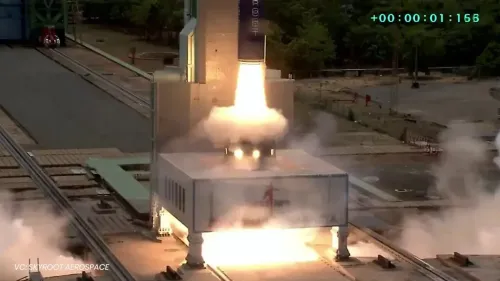
Skyroot Aerospace successfully launched Vikram-1 , described as India's first privately developed orbital-class rocket, on 18 July 2026 .
BRS working president K.
Rama Rao publicly congratulated co-founders Pawan Kumar Chandana and Bharat Daka and the full Skyroot team.
Skyroot was incubated at T-Hub Hyderabad , the Telangana government-backed startup incubator established in 2015 .
India opened its space sector to private players in 2020 , creating IN-SPACe as the nodal regulatory authority for private launches.
The mission, tagged #MissionAagaman , positions Hyderabad as a significant hub in India's emerging private space industry.
Further commercial missions and regulatory frameworks from IN-SPACe on launch licensing and orbital debris are expected to follow.
BRS working president K. T. Rama Rao on Saturday, 18 July 2026, congratulated Hyderabad-based Skyroot Aerospace on the successful launch of Vikram-1, describing it as India's first privately developed orbital-class rocket and calling the achievement a proud milestone for the country's space sector.
Context
In his post on X, K. T. Rama Rao wrote: 'History made! A proud milestone for India's space sector. Skyroot Aerospace has successfully launched Vikram-1, India's first privately developed orbital-class rocket.' He specifically highlighted that the company was incubated at T-Hub Hyderabad, the Telangana government-backed startup incubator, underscoring the role of state-level policy in nurturing the achievement. The post, tagged #MissionAagaman, also carried personal congratulations to Skyroot co-founders Pawan Kumar Chandana and Bharat Daka, as well as the entire Skyroot team.
Rama Rao's connection to this milestone is direct: as Telangana's former Minister for IT, Industries and Municipal Administration, he was among the architects of the state's innovation ecosystem, including the establishment and expansion of T-Hub, which provided early-stage support to Skyroot Aerospace.
Policy Backdrop
The launch sits at the intersection of two major policy shifts. In 2020, the Government of India approved structural reforms opening the space sector to private players and created IN-SPACe — the Indian National Space Promotion and Authorisation Centre — as the nodal regulatory body for private space activity. This move was framed as part of the broader Atmanirbhar Bharat drive to build indigenous technology capability and reduce dependence on foreign launch providers.
Telangana set up T-Hub in 2015 as the centrepiece of its startup and innovation policy. The incubator has since supported a range of deep-technology enterprises, with space-tech firms like Skyroot among its notable portfolio companies. The Vikram-1 mission, if it achieves full orbital insertion, would represent the most tangible commercial outcome yet of that ecosystem investment.
Stakeholders and Impact
Skyroot Aerospace is focused on developing small satellite launchers for the Indian and global market, a segment that analysts consider one of the fastest-growing verticals in the global space economy. A successful orbital-class launch would position the company to compete for commercial contracts from domestic and international satellite operators seeking cost-effective, dedicated launch options.
For Hyderabad's broader technology ecosystem, the milestone reinforces the city's emergence as a node in India's private space industry, complementing its established presence in pharmaceuticals, IT services and defence electronics. Private space startups across the country are watching Skyroot's regulatory and commercial trajectory closely, as it sets a template for licensing, liability, and orbital debris management under IN-SPACe guidelines.
What's Next
Skyroot Aerospace is expected to pursue further test flights and commercial missions following this launch, with regulatory attention likely to focus on IN-SPACe's evolving framework for private launch licensing and orbital debris obligations. The success of Vikram-1 is also likely to intensify investor and government interest in scaling up India's private space launch capacity ahead of a competitive global small-satellite deployment window in the late 2020s.
For K. T. Rama Rao and the BRS, the moment offers a political narrative linking Telangana's decade-long investment in startup infrastructure to a nationally significant technological first — a theme the party is expected to amplify as it seeks to rebuild electoral ground in the state.
Point of View
Demonstrating that IN-SPACe's regulatory architecture can take a private orbital-class vehicle from incubation to launch within half a decade. KTR's prominent congratulatory post is not merely ceremonial — it is a calculated assertion of Telangana's claim to credit for the outcome, linking T-Hub's decade-old investment directly to a nationally resonant technological first. For BRS, which lost power in Telangana in late 2023, this narrative of inherited institutional success offers a politically useful counter-point. More broadly, Skyroot's trajectory will be watched as a commercial blueprint by the dozen-odd private launch startups now navigating IN-SPACe's licensing pipeline.
NationPress
17 Oct 2026
Frequently Asked Questions
What is Vikram-1 and who built it?
Vikram-1 is India's first privately developed orbital-class rocket, built by Hyderabad-based startup Skyroot Aerospace. It is designed to carry small satellites into orbit and represents a milestone in India's privatised space programme.
What is T-Hub Hyderabad and what role did it play?
T-Hub is a Telangana government-backed startup incubator established in Hyderabad in 2015. It provided early-stage support to Skyroot Aerospace, making it a key enabler of the company's growth into an orbital launch vehicle developer.
Who are the founders of Skyroot Aerospace?
Skyroot Aerospace was co-founded by Pawan Kumar Chandana and Bharat Daka, both of whom were personally congratulated by BRS working president K. T. Rama Rao following the Vikram-1 launch.
What is IN-SPACe and why does it matter for private space companies?
IN-SPACe, the Indian National Space Promotion and Authorisation Centre, was created in 2020 as the nodal regulatory body enabling private companies to build and operate launch vehicles in India. It is the key licensing authority for companies like Skyroot Aerospace.
Why is KTR congratulating Skyroot Aerospace?
As Telangana's former IT and Industries Minister, K. T. Rama Rao was instrumental in building the state's startup ecosystem, including T-Hub, which incubated Skyroot. His congratulations reflect both personal advocacy for Hyderabad's tech sector and political pride in the outcome.