Lalan Singh slams Rahul Gandhi, backs Modi's Parliament debate offer
Synopsis
Union Minister Lalan Singh launched a pointed attack on Rahul Gandhi on November 4, calling his events daily drama and challenging Congress to debate inside Parliament, while praising PM Modi's Viksit Bharat mission.
Key Takeaways
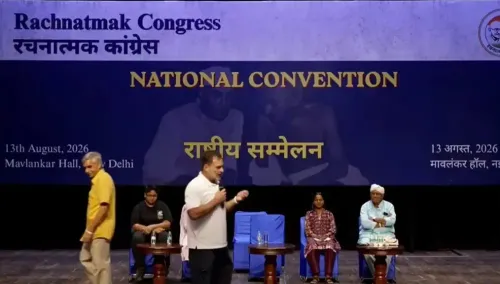
Lalan Singh posted a direct attack on Rahul Gandhi on November 4, 2026 , calling his events 'daily drama.' The minister alleged Gandhi's public programmes — including a mock parliament and a rally — have been 'flops.' He declared that Parliament is democracy's most appropriate venue for debate and that the government is 'ready to debate at any time.' He invoked PM Modi 's Viksit Bharat and Atmanirbhar Bharat goals as the governing contrast to opposition 'nautanki.' As a senior JD(U) leader in the NDA , Lalan Singh's attack reflects coordinated coalition messaging ahead of the next parliamentary session.
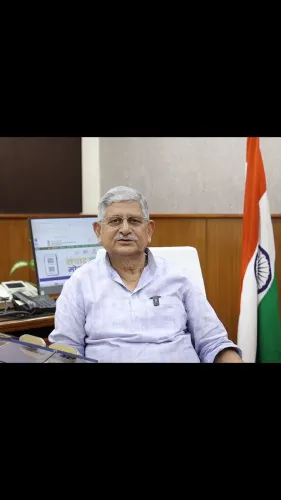
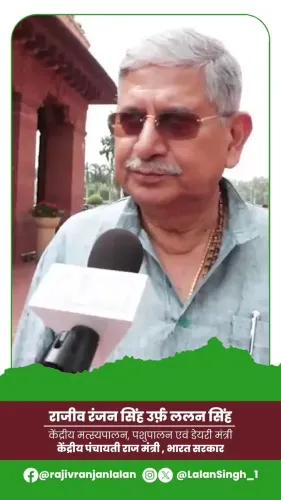
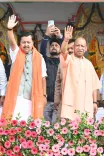
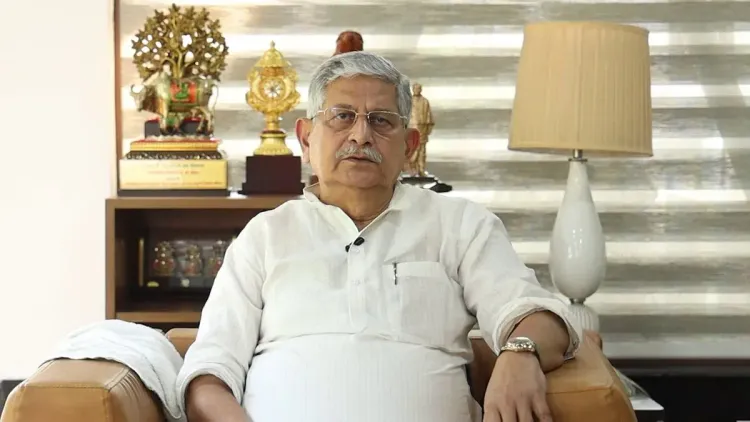
A sharp political broadside landed on Wednesday, November 4, 2026, when Union Minister for Panchayati Raj, Fisheries, Animal Husbandry and Dairying Rajiv Ranjan Singh — popularly known as Lalan Singh — took direct aim at Congress leader Rahul Gandhi, accusing him of staging political theatre while Prime Minister Narendra Modi pursues the work of governing 140 crore Indians.
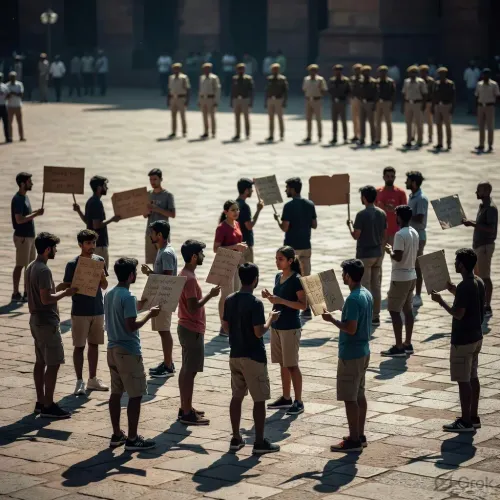
Posting on X in Hindi, Lalan Singh wrote: 'Rahul Gandhi ji roz naya drama karte hain' — 'Rahul Gandhi stages a new drama every day.' He alleged that Gandhi's public events — from a mock parliament to a rally described as drawing near-empty chairs — have one after another fallen flat.
Parliament named as the only legitimate arena for debate
The sharpest line in the post was a direct challenge: 'In a democracy, Parliament is the most appropriate place for debate. The government is ready to debate at any time — but you just put on a spectacle.' The framing explicitly repositions Parliament of India as the ruling party's preferred battlefield, one the minister implies the opposition is unwilling to enter on those terms.
This is a well-worn but potent rhetorical move. Successive governments since 2014 have argued that opposition parties — particularly the Congress — prefer street-level symbolism and media moments over legislative engagement. Lalan Singh's post slots neatly into that pattern, amplifying it ahead of what is likely to be a charged parliamentary calendar.
The 'Viksit Bharat' anchor versus the 'nautanki' charge
Lalan Singh also invoked Modi's twin policy slogans — Viksit Bharat (Developed India) and Atmanirbhar Bharat (Self-Reliant India) — as the substantive contrast to what he called Gandhi's 'nautanki' (street theatre). The juxtaposition is deliberate: frame the ruling side as mission-driven, the opposition as performative.
Rahul Gandhi, who leads the Congress party's public-outreach campaigns and has repeatedly pressed the government on issues ranging from unemployment to foreign policy, has not yet publicly responded to the post. His political events — including padyatras and citizen-engagement gatherings — draw significant crowds and media coverage, though the ruling party has consistently characterised them as stunts rather than policy interventions.
JD(U)'s voice in the NDA chorus
Lalan Singh, a senior Janata Dal (United) leader and a key pillar of the National Democratic Alliance, has consistently punched above his party's weight in the coalition's communication offensive. His public interventions carry weight precisely because JD(U) — rooted in Bihar — represents a constituency that both the BJP and Congress are contesting hard. When a regional ally attacks the opposition this bluntly, it signals NDA messaging discipline that extends beyond the BJP's own ranks.
With the next parliamentary session on the horizon, the exchange sets up a familiar contest: will the opposition bring its grievances to the floor of the House, or continue with public mobilisation that the government can dismiss as spectacle? The answer to that question will shape the political temperature for months to come.
Point of View
Not just the BJP, delivers the attack, broadening the ruling camp's communication front. The 'Parliament-or-nothing' framing is a standing NDA strategy to delegitimise street-level opposition campaigns as anti-democratic theatre, a line that gains traction with voters who value institutional order. The specific references to a mock parliament and empty-chair rallies — even if details remain unverified — are designed to lodge a mockery image in the public mind before the opposition can define those events on its own terms. Watch whether Congress responds with a floor strategy or doubles down on public mobilisation; that choice will tell us which audience each party is really courting.
NationPress
4 Nov 2026
Frequently Asked Questions
Why did Lalan Singh criticise Rahul Gandhi on November 4 2026?
Lalan Singh accused Rahul Gandhi of staging daily political drama through events he claimed were poorly attended, while calling on Congress to debate inside Parliament rather than hold public spectacles.
What is Viksit Bharat and why did Lalan Singh mention it?
Viksit Bharat, meaning 'Developed India,' is PM Modi's flagship vision for transforming India into a developed nation. Lalan Singh cited it to contrast the government's stated policy goals against what he called the opposition's performative politics.
What did Lalan Singh say about Parliament and democracy?
He stated that in a democracy, Parliament is the most appropriate place for debate and that the government is ready to engage at any time, challenging the opposition to bring its grievances to the House.
Who is Lalan Singh and what party does he belong to?
Lalan Singh, formally known as Rajiv Ranjan Singh, is a senior Janata Dal (United) leader and Union Minister for Panchayati Raj, Fisheries, Animal Husbandry and Dairying in the NDA government.
What is Atmanirbhar Bharat?
Atmanirbhar Bharat, meaning 'Self-Reliant India,' is PM Modi's economic initiative aimed at boosting domestic manufacturing and reducing dependence on imports, launched in 2020 and repeatedly cited as a core government goal.