Madras High Court Orders Investigation into Udhayanidhi Stalin's Asset Declarations Ahead of TN Elections

Synopsis
With the Tamil Nadu Assembly elections approaching, the Madras High Court has ordered the Income Tax Department to investigate Udhayanidhi Stalin's asset disclosures. This move aims to ensure transparency for voters ahead of polling day, raising critical questions about accountability in political finance.
Key Takeaways
Madras High Court directs an investigation into Udhayanidhi Stalin's asset disclosures.
Income Tax Department must submit a report by April 20.
Concerns raised about transparency and accountability in political finance.
Petitioner emphasizes voters' right to accurate information.
Potential penalties exist for false declarations under election law.
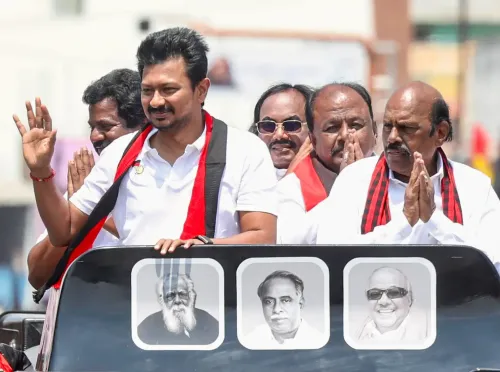
Chennai, April 15 (NationPress) In an important turn of events leading up to the Assembly elections, the Madras High Court has mandated the Income Tax Department to initiate a preliminary investigation into the alleged irregularities in the asset disclosures of Udhayanidhi Stalin, with the expectation of a report by April 20.
A First Division Bench, including Chief Justice Sushrut Arvind Dharmadhikari and Justice G. Arul Murugan, emphasized the urgency of the matter, as voters prepare to cast their ballots on April 23 and deserve precise information regarding the financial declarations of candidates.
The petition was submitted by R. Kumaravel, a voter from the Chepauk-Thiruvallikeni constituency, where Udhayanidhi Stalin is contesting for re-election.
In arguments on behalf of the petitioner, senior counsel V. Raghavachari asserted that a comparison of the affidavits filed by Stalin during the 2021 Assembly elections and the current election cycle has uncovered numerous discrepancies.
As stated by the petitioner, these irregularities include missing assets that were previously declared, unexplained changes in liabilities, misrepresentation of financial transactions, and inconsistencies between election affidavits and corporate records.
The counsel highlighted that these issues raise significant questions about transparency and accountability, particularly in the framework of democratic elections.
Advocate Niranjan Rajagopalan, representing the Election Commission of India, noted that while candidates must provide complete and accurate disclosures as mandated by the Supreme Court, Returning Officers lack the capacity to independently verify the accuracy of each declaration during the nomination process.
He further mentioned that Section 125A of the Representation of the People Act, 1951, prescribes penalties for false declarations, which may include imprisonment of up to six months, fines, or both.
However, such actions typically occur only after the electoral process is complete.
Nonetheless, the petitioner maintained that the aim is not to pursue criminal charges but to guarantee that voters are well-informed about candidates' financial backgrounds prior to voting.
The court has postponed the case until April 20, awaiting the Income Tax Department's report.
Point of View
My perspective underscores the importance of transparency and accountability in political processes. The Madras High Court's decision to investigate asset disclosures reinforces the need for candidates to provide truthful information to voters, fostering trust in democratic elections.
NationPress
7 Oct 2026
Frequently Asked Questions
What prompted the Madras High Court to order the investigation?
The investigation was prompted by allegations of discrepancies in Udhayanidhi Stalin's asset declarations, raising concerns about transparency and accountability before the upcoming elections.
What is the deadline for the Income Tax Department's report?
The Income Tax Department has been directed to submit its report by April 20.
Who filed the petition that led to this investigation?
The petition was filed by R. Kumaravel, a resident of the Chepauk-Thiruvallikeni constituency.
What are the potential penalties for false declarations under the law?
Under Section 125A of the Representation of the People Act, 1951, penalties may include imprisonment for up to six months, a fine, or both.
Is the investigation focused on criminal charges?
No, the petitioner clarified that the objective is to ensure that voters have accurate financial information about candidates, not to initiate criminal proceedings.