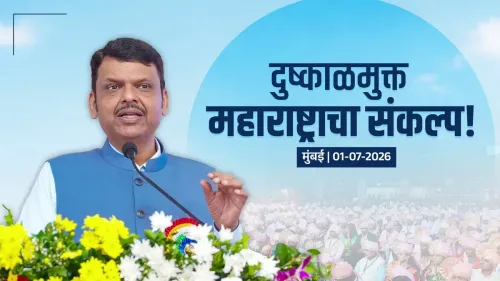
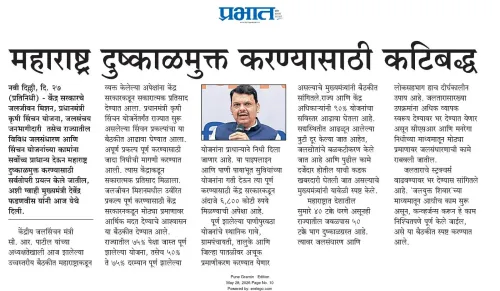
Maharashtra eyes drought-free future, expects ₹6,800 crore Central funds: CM Fadnavis
Synopsis
Maharashtra holds 40% of India's dams yet half the state is drought-prone — and CM Fadnavis is betting ₹6,800 crore in Central funds, river-linking megaprojects, and restructured MGNREGA spending to break that paradox for good. The Wainganga-Nalganga link alone could end drought in 52% of affected regions, if CWC clearance arrives in time.
Key Takeaways
CM Devendra Fadnavis announced Maharashtra's drought-free push on 27 May 2025 after a high-level meeting with Union Jal Shakti Minister C.R.
Paatil in New Delhi .
Maharashtra expects approximately ₹6,800 crore from the Centre to accelerate pending water infrastructure projects under PMKSY .
Despite holding nearly 40% of India's dams, around 50% of Maharashtra remains drought-prone.
The Wainganga-Nalganga river link and Ulhas Basin diversion projects could eliminate drought in 52% of affected regions; both await CWC clearance.
MGNREGA water conservation funds will be restructured by groundwater depletion level — 65% for dark zones, 40–45% for semi-critical zones, 30% for others.
The 'Jal Tara' initiative, costing just ₹4,000–₹5,000 per structure, enables 3–4 lakh litres of groundwater recharge per acre per season.
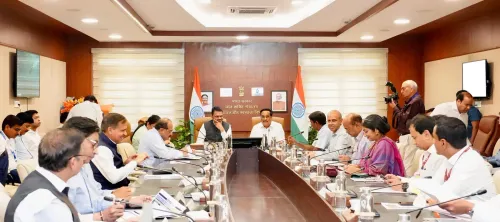
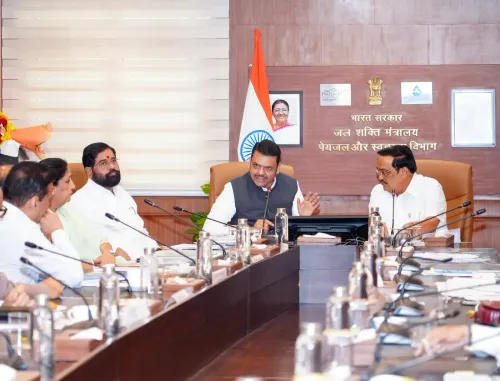
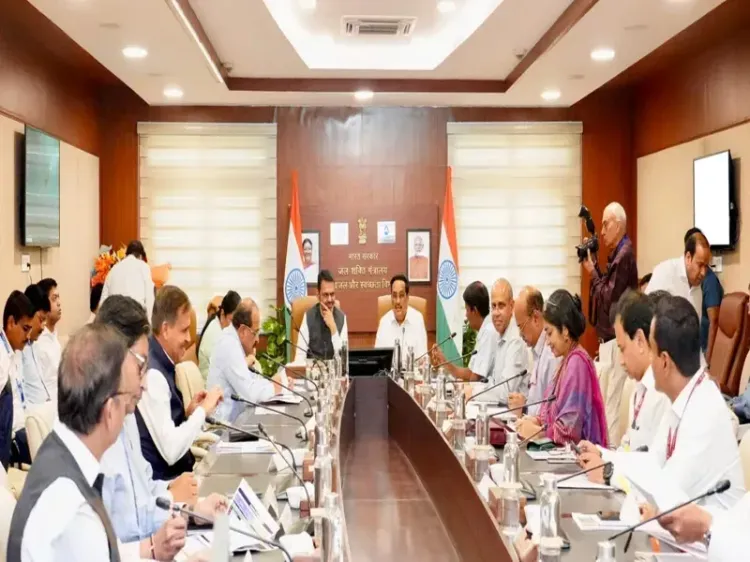
Maharashtra Chief Minister Devendra Fadnavis on Wednesday, 27 May announced a sweeping push to make the state drought-free, prioritising the Jal Jeevan Mission, the Pradhan Mantri Krishi Sinchayee Yojana (PMKSY), and a range of state-level water conservation programmes. The announcement followed a high-level meeting in New Delhi chaired by Union Jal Shakti Minister C.R. Paatil, at which the Centre reportedly responded positively to Maharashtra's financial and infrastructural demands.
Central Funds and Project Pipeline
CM Fadnavis said Maharashtra expects to receive approximately ₹6,800 crore from the Central government to accelerate pending water infrastructure projects. Funding, he said, will be prioritised for schemes that are already 50% to 75% complete, as well as those over 75% complete. According to the Chief Minister, state and Central officials have already reviewed 90% of the schemes to ensure transparency and quality.
'Completed water supply schemes will undergo precise verification at the village, Gram Panchayat, taluka and district levels. We are rectifying identified gaps and strengthening water sources to ensure high-quality execution,' Fadnavis said.
Maharashtra's Drought Paradox
The Chief Minister highlighted a striking contradiction at the heart of Maharashtra's water crisis: despite housing nearly 40% of the nation's dams, approximately 50% of the state remains drought-prone. Fadnavis stressed that long-term water conservation and public participation — referred to as Jan Bhagidari — are the only sustainable solutions to this structural challenge.
This comes amid years of recurring agrarian distress in regions such as Vidarbha, Marathwada, and parts of north Maharashtra, where farmer suicides linked to crop failures and water scarcity have drawn national attention.
MGNREGA Restructured for Water Conservation
Under revised guidelines, MGNREGA funds allocated for water conservation will be structured according to groundwater depletion levels. For dark zones — areas with severely depleted groundwater — 65% of funds will be reserved for water conservation. Semi-critical or semi-dark zones will see 40% to 45% of funds directed toward conservation, while other zones will have 30% earmarked for the purpose.
The state also plans to scale up its 'Jal Tara' and 'Jalyukt Shivar' initiatives by converging them with Corporate Social Responsibility (CSR) funds and MGNREGA, broadening the financial base for grassroots water conservation.
River-Linking Projects and CWC Clearance
Aligning with the Prime Minister's vision to prioritise intra-state river grid systems over time-consuming inter-state projects, Maharashtra is advancing major river-linking networks. The Wainganga-Nalganga river link project proposes diverting 62 TMC of the 100 TMC of water that currently drains into the sea annually. The Ulhas Basin project plans to divert 75 TMC of the available 350 TMC of water toward the parched Marathwada region.
CM Fadnavis asserted that these projects could permanently eradicate drought in 52% of the affected regions. All feasibility studies and reports have been completed, and the state is now awaiting final clearance from the Central Water Commission (CWC) to initiate the tendering process.
Jal Tara and Cross-Border Collaboration
Union Jal Shakti Minister C.R. Paatil reportedly lauded Maharashtra's 'Jal Tara' initiative for its effectiveness in mitigating the agrarian crisis and preventing farmer suicides in Vidarbha and Nagpur. The low-cost structure — costing just ₹4,000 to ₹5,000 — allows 3 lakh to 4 lakh litres of water to percolate into the ground per acre in a single season.
Additionally, Fadnavis highlighted a cross-border 'Mega Recharge' project signed between Maharashtra and Madhya Pradesh, describing it as a national model for groundwater replenishment. With CWC clearance pending and disbursements contingent on project completion milestones, the true test of this drought-free ambition lies in execution speed.
Point of View
And neither are the announcements. PMKSY has been a fixture of Centre-state water meetings for years, and the Wainganga-Nalganga link has been on the drawing board for over a decade. The more telling signal is the MGNREGA restructuring: tying fund allocation to groundwater depletion levels is a structural fix, not a headline number, and that kind of granular reform is harder to game. The real accountability test will be whether the ₹6,800 crore flows against verifiable project milestones — or simply adds to Maharashtra's long list of ambitious water targets that stalled at the tendering stage.
NationPress
23 Sept 2026
Frequently Asked Questions
What is Maharashtra's plan to become drought-free?
Maharashtra is prioritising the Jal Jeevan Mission, PMKSY, and state water conservation schemes such as Jal Tara and Jalyukt Shivar, backed by an expected ₹6,800 crore in Central funding. The plan also includes river-linking projects and restructured MGNREGA spending tied to groundwater depletion levels.
How much Central funding does Maharashtra expect for water projects?
Maharashtra expects approximately ₹6,800 crore from the Central government to accelerate pending pipeline and water infrastructure projects under PMKSY. Funds will be prioritised for schemes that are 50–75% or more than 75% complete.
What are the Wainganga-Nalganga and Ulhas Basin projects?
The Wainganga-Nalganga river link proposes diverting 62 TMC of water that currently drains into the sea toward drought-hit regions, while the Ulhas Basin project plans to divert 75 TMC toward Marathwada. Together, they could permanently end drought in 52% of affected areas, according to CM Fadnavis; both are awaiting CWC clearance.
How will MGNREGA funds be restructured for water conservation?
Under revised guidelines, 65% of MGNREGA water conservation funds will go to dark zones with severely depleted groundwater, 40–45% to semi-critical zones, and 30% to other zones. This tiered approach is designed to direct the most resources to the most water-stressed areas.
What is the Jal Tara initiative and why is it significant?
Jal Tara is a low-cost water conservation structure costing ₹4,000–₹5,000 that enables 3–4 lakh litres of groundwater recharge per acre in a single season. Union Jal Shakti Minister C.R. Paatil reportedly praised it for helping reduce farmer suicides linked to water scarcity in Vidarbha and Nagpur.