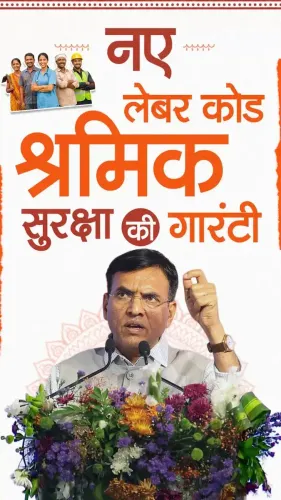
Mandaviya Highlights Four Labour Codes on Garib Kalyan Anniversary
Synopsis
Union Labour Minister Mansukh Mandaviya invoked the BJP's 12-year Garib Kalyan record to spotlight India's four New Labour Codes, which consolidate 29 laws, guarantee minimum wages across sectors, and bring gig workers under statutory social security for the first time.
Key Takeaways
Union Labour Minister Mansukh Mandaviya posted on June 8, 2026 highlighting the four New Labour Codes under PM Modi 's government.
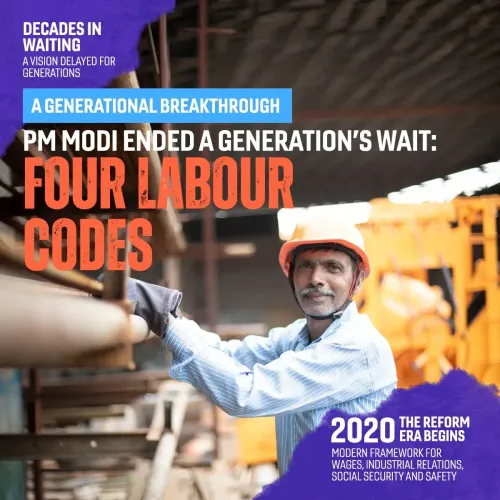
The four codes, enacted 2019-2020 , consolidate 29 central labour laws into a single framework covering wages, industrial relations, social security, and occupational safety.
The Code on Social Security, 2020 is the first Indian statute to bring gig and platform workers within a statutory social-security framework.
Full implementation requires state governments to frame and notify their own rules — progress has been uneven across India.
The post was tagged #12YearsOfGaribKalyan , situating labour reform within the BJP's broader welfare-delivery narrative since 2014 .
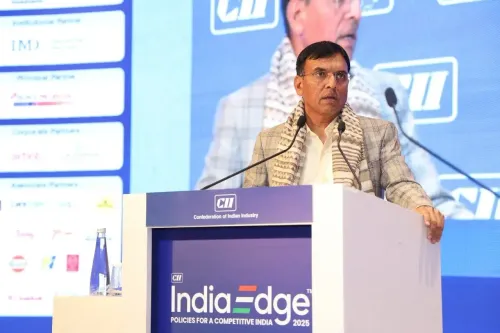
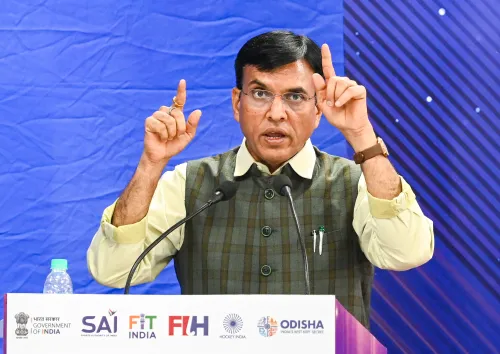
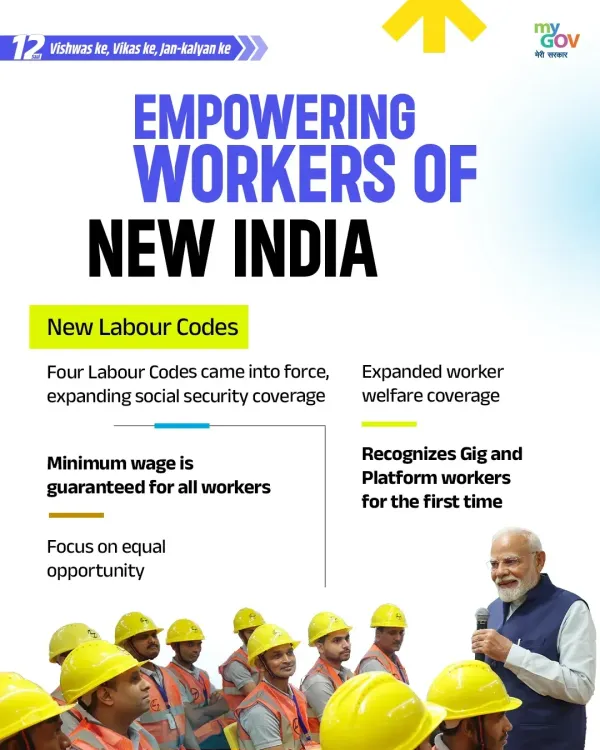
Union Labour and Sports Minister Mansukh Mandaviya on Monday, June 8, 2026, highlighted the four New Labour Codes as a cornerstone of the Modi government's welfare agenda, crediting the reforms with guaranteeing minimum wages, expanding social security, and extending statutory protections to gig workers for the first time.
Context
The minister's post, tagged #12YearsOfGaribKalyan (12 years of welfare for the poor), marks a milestone in the Bharatiya Janata Party's annual reckoning of its pro-poor governance record since 2014. Mandaviya described workers as the 'backbone of New India' and framed the labour codes as a direct product of Prime Minister Narendra Modi's leadership.
The hashtag situates the labour-reform message within a broader political narrative that the ruling party has cultivated around social-sector delivery, spanning direct-benefit transfers, housing, and now formalised labour protections.
Policy Backdrop
The four New Labour Codes — covering wages, industrial relations, social security, and occupational safety — were enacted between 2019 and 2020, consolidating 29 central labour laws into a single legislative framework. The Code on Wages, 2019 was the first to pass, extending a universal minimum-wage floor to both organised and unorganised sector workers.
The remaining three codes were passed in September 2020 during a special session of Parliament held amid the COVID-19 pandemic. Among them, the Code on Social Security, 2020 is particularly significant: it is the first Indian statute to bring gig and platform workers within a statutory social-security framework, acknowledging the rapid growth of app-based employment in logistics, food delivery, and ride-hailing.
Draft rules were circulated by the Centre in 2020-2021 for state-level consultation. Because labour is a concurrent subject under the Constitution, full operationalisation requires each state to frame and notify its own rules — a process that has progressed unevenly across India.
Stakeholders and Impact
Unorganised-sector workers, estimated to constitute the overwhelming majority of India's labour force, stand to gain the most from a universal minimum-wage guarantee if the codes are fully enforced. Gig workers — a constituency that has grown sharply with the expansion of platform-economy companies — gain the prospect of welfare-fund contributions and social-security benefits that were previously unavailable to them.
Employer groups and industry bodies have broadly welcomed the rationalisation of compliance requirements, while labour unions have raised concerns about provisions in the industrial-relations code that they argue dilute collective-bargaining rights. The uneven pace of state rule-notification means workers in some states remain outside the new framework's practical reach.
What's Next
Attention will focus on how many state governments complete rule-notification under all four codes and whether the Centre introduces a dedicated registration or welfare-fund mechanism specifically for gig workers. Minister Mandaviya's public emphasis on the codes signals continued political priority for labour formalisation as a campaign-ready welfare metric. The degree to which on-ground implementation matches legislative intent will determine the codes' long-term credibility with India's vast informal workforce.
Point of View
The government signals awareness of a fast-growing, digitally connected constituency that straddles the formal-informal divide. The reform's real test, however, lies not in legislation but in state-level rule notification, where progress has stalled in several large states. Until that gap closes, the political messaging risks outpacing the ground reality for the workers it seeks to champion.
NationPress
24 Oct 2026
Frequently Asked Questions
What are the four New Labour Codes in India?
The four New Labour Codes are the Code on Wages (2019), the Industrial Relations Code (2020), the Code on Social Security (2020), and the Occupational Safety, Health and Working Conditions Code (2020). Together they consolidate 29 older central labour laws into a unified framework.
Do the new labour codes cover gig workers in India?
Yes. The Code on Social Security, 2020 is the first Indian law to explicitly recognise gig and platform workers and bring them within the scope of social-security provisions, including potential welfare-fund contributions.
Have the four labour codes been implemented across India?
Labour is a concurrent subject, so states must frame and notify their own rules before the codes take effect locally. As of mid-2026, implementation remains uneven, with several states yet to complete rule-notification.
What is the significance of #12YearsOfGaribKalyan?
#12YearsOfGaribKalyan marks 12 years since the BJP-led government came to power in 2014. The hashtag is used to highlight welfare and social-sector initiatives, including direct-benefit transfers, housing schemes, and labour reforms.
Who is Mansukh Mandaviya and what is his role in labour reform?
Mansukh Mandaviya is India's Union Minister of Labour and Employment and Youth Affairs and Sports, and a senior BJP leader. He is responsible for overseeing the promotion and implementation of the new labour codes at the central level.