Mandaviya Backs Modi Govt on Jobs and Business Support
Synopsis
Union Labour Minister Mansukh Mandaviya reaffirmed the Modi government's dual pledge on employment and entrepreneurship on 24 June 2026, echoing the Atmanirbhar Bharat vision backed by Skill India, Mudra Yojana, and the four consolidated labour codes.
Key Takeaways
Union Labour and Sports Minister Mansukh Mandaviya posted on 24 June 2026 asserting the Modi government's support for both employment and business.
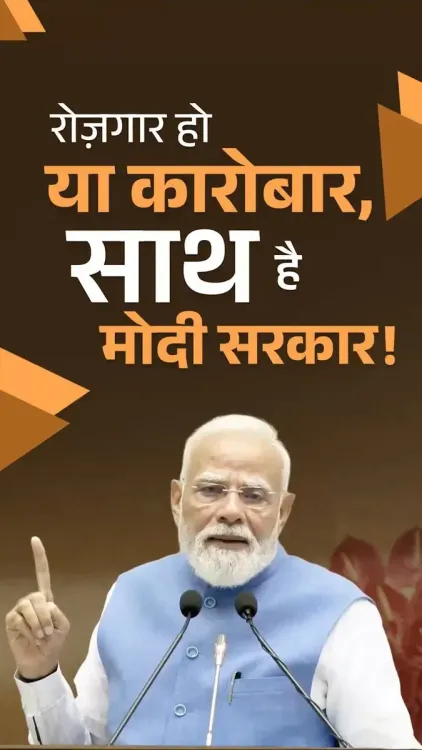
The post — 'Rozgar ho ya karobar, saath hai Modi sarkar!' — targets two key constituencies: wage workers and MSME entrepreneurs.
The Skill India Mission (2015) and Pradhan Mantri Mudra Yojana (2015) are the flagship schemes underpinning this dual-track commitment.
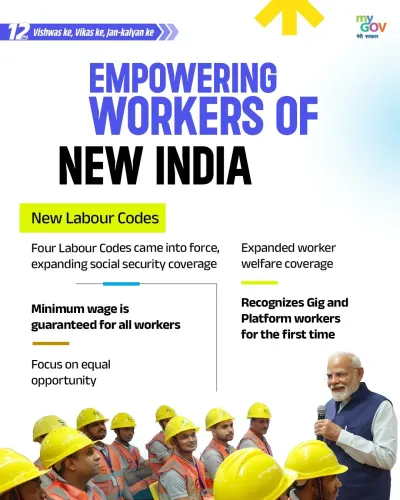
The government consolidated 29 labour laws into four labour codes between 2019 and 2020 to ease business compliance and expand worker social security.
Implementation of the four labour codes by state governments and fresh Budget incentives remain the key policy tests ahead.
Union Labour and Sports Minister Mansukh Mandaviya on Wednesday, 24 June 2026, reaffirmed the Modi government's twin commitment to employment generation and entrepreneurship support, posting a pointed message on X that encapsulated the ruling dispensation's economic outreach to workers and business owners alike.
The minister's post — 'Rozgar ho ya karobar, saath hai Modi sarkar!' (Whether it is employment or business, the Modi government stands with you!) — is a compact articulation of a policy posture the Bharatiya Janata Party-led government has maintained since at least 2020, when the Atmanirbhar Bharat initiative formalised the dual focus on wage jobs and self-employment under a single national economic vision.
Context
The slogan directly addresses two distinct constituencies: salaried and wage workers who depend on formal or informal employment, and the millions of micro, small, and medium entrepreneurs who power India's non-farm economy. By invoking both in a single breath, Mandaviya signals that the government does not see employment and enterprise as competing priorities but as complementary pillars of economic security.
The post carries a video — the contents of which are not independently described here — suggesting it is part of a broader outreach or campaign communication rather than a standalone statement.
Policy Backdrop
The message draws its substance from a well-established policy architecture. The Skill India Mission, launched in 2015, was designed to equip youth with vocational competencies for both formal employment and self-employment. In the same year, the Pradhan Mantri Mudra Yojana was introduced to extend collateral-free credit to micro and small enterprises, directly targeting the 'karobar' — or business — segment the minister references.
Between 2019 and 2020, the government consolidated 29 central labour laws into four labour codes — covering wages, industrial relations, social security, and occupational safety — with the stated aim of simplifying compliance for businesses while widening social security coverage for workers. The Ministry of Labour and Employment, which Mandaviya heads, is the nodal body responsible for implementing these codes once notified by states.
Stakeholders and Impact
The primary audiences for this messaging are India's youth job seekers and MSME owners, two groups that together represent an enormous share of the country's working-age population. India's MSME sector is estimated to account for a significant portion of non-agricultural employment, making it a critical variable in any employment narrative ahead of electoral cycles.
For wage workers, the government points to employment-linked incentive schemes and social security expansion under the new labour codes. For entrepreneurs, credit access through Mudra and ease-of-doing-business reforms remain the flagship offerings. Mandaviya's post reinforces that both tracks are active and government-backed.
What's Next
Observers will watch for concrete follow-through in two areas: the pace at which state governments notify and implement the four labour codes, which remain pending in several large states, and any fresh employment-linked incentives that may be announced in the next Union Budget. Periodic releases of official employment data — including the Periodic Labour Force Survey — will serve as the key empirical test of whether the government's twin-track promise translates into measurable outcomes for workers and entrepreneurs on the ground.
Point of View
Slogan-form post is textbook BJP outreach — compressing a complex policy portfolio into a voter-friendly couplet that travels easily on social media. It signals the government is in active mobilisation mode on the economy, likely ahead of a data release or Budget cycle, reinforcing the Atmanirbhar Bharat narrative that has been the party's economic anchor since 2020. The dual invocation of 'rozgar' and 'karobar' is deliberate: it allows the government to claim credit with both organised-sector workers and the vast informal entrepreneurial class simultaneously. Whether the messaging is backed by fresh policy action or is primarily communicative will depend on what follows in the coming weeks.
NationPress
23 Sept 2026
Frequently Asked Questions
What did Mansukh Mandaviya post about jobs and business on 24 June 2026?
Mandaviya posted the slogan 'Rozgar ho ya karobar, saath hai Modi sarkar!' — meaning 'Whether it is employment or business, the Modi government stands with you!' — reaffirming the government's commitment to both wage workers and entrepreneurs.
What is the Pradhan Mantri Mudra Yojana and how does it help businesses?
The Pradhan Mantri Mudra Yojana, launched in 2015, provides collateral-free credit to micro and small enterprises, helping entrepreneurs access formal finance without needing to pledge assets.
What are India's four labour codes?
Between 2019 and 2020, the central government consolidated 29 labour laws into four codes covering wages, industrial relations, social security, and occupational safety, aiming to simplify compliance for businesses and expand worker protections.
What is the Skill India Mission?
The Skill India Mission, launched in 2015, trains Indian youth in vocational and technical skills to improve their employability in both formal jobs and self-employment.
Which ministry does Mansukh Mandaviya head?
Mansukh Mandaviya is the Union Minister of Labour and Employment and Youth Affairs and Sports, overseeing labour welfare, employment programmes, industrial relations, and sports policy at the central government level.