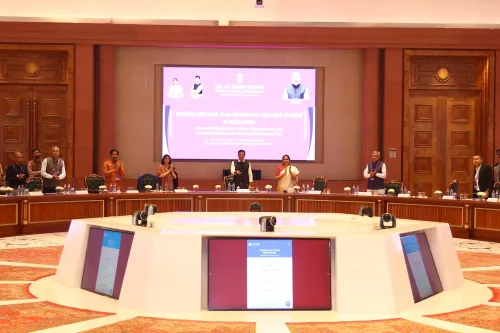
Mandaviya flags PMVBRY as jobs leap on EPFO's 74th year

Synopsis
On EPFO's 74th anniversary, Union Labour Minister Mansukh Mandaviya highlighted the PMVBRY scheme as a major push for employment creation, promising gains for youth and industry through EPFO-linked incentives.
Key Takeaways
Mansukh Mandaviya announced on November 1, 2026 that PMVBRY marks a 'big leap' in employment creation under the #EPFOat74 milestone.
The scheme is positioned to deliver new opportunities for youth and new possibilities for industries simultaneously.
EPFO , founded in 1952 , is India's primary organised-sector social security body and a key vehicle for formalising employment.
The model follows the precedent of PMRPY (2016) , which used EPFO-linked employer subsidies to incentivise formal hiring.
Net new EPFO subscriber addition data will serve as the primary metric to gauge the scheme's real-world impact.
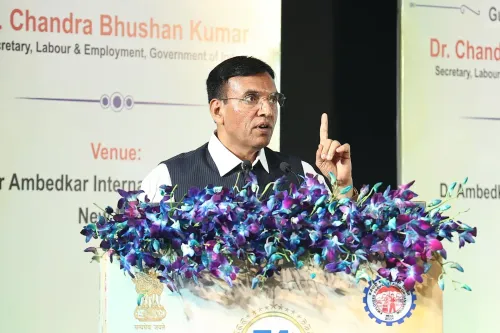
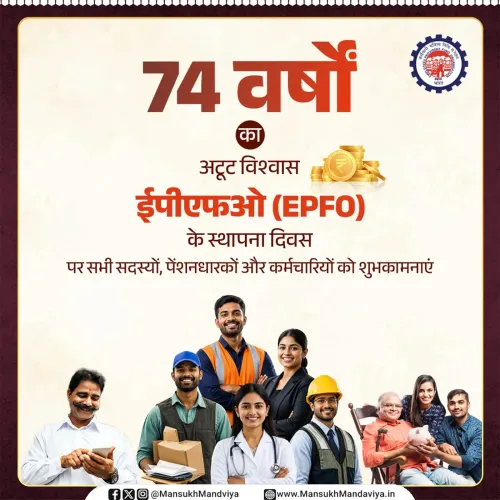
A new employment scheme is drawing attention on the 74th founding anniversary of the Employees' Provident Fund Organisation (EPFO) — and Union Labour and Sports Minister Mansukh Mandaviya is calling it a watershed moment for India's workforce. On Sunday, November 1, 2026, the minister took to X to describe the Pradhan Mantri Vayoshri Bhavishya Rozgar Yojana (PMVBRY) as a 'big leap' in the direction of employment creation, promising fresh opportunities for youth and new possibilities for industries.
Posting under the hashtag #EPFOat74, Mandaviya wrote: 'Rojgar srijan ki disha mein ek badi chhalang!' — 'A big leap in the direction of employment creation!' — framing the scheme as a dual-action measure that simultaneously expands the talent pipeline for young job-seekers and eases the hiring calculus for employers.
EPFO at 74: Why an anniversary matters for jobs policy
Founded in 1952, EPFO is India's largest social security institution, administering provident fund and pension benefits for organized-sector workers. Every anniversary has traditionally served as a policy marker — a moment when the government of the day spotlights employment-generation measures tied to EPFO's contribution infrastructure. This year's milestone is no different, with PMVBRY positioned as the centrepiece announcement under the #EPFOat74 banner.
The precedent is well-established. The Pradhan Mantri Rojgar Protsahan Yojana (PMRPY), launched in 2016, offered employer-side contribution subsidies to incentivise formal hiring — the logic being that if the government absorbs part of the compliance cost, more employers bring workers into the organized sector. PMVBRY appears to follow the same structural logic: link incentives to EPFO registrations, and formalisation follows employment.
The twin beneficiaries: youth on one side, industry on the other
Mandaviya's framing is deliberate — 'new opportunities for youth' and 'new possibilities for industries' in the same breath. That pairing is the core pitch of contribution-linked employment schemes: workers gain access to provident fund, insurance, and pension cover the moment they enter the formal system, while employers gain a subsidy that reduces the per-head cost of compliance. The incentive runs in both directions.
India's formal employment expansion has been a persistent policy challenge. EPFO's net subscriber addition data — released monthly — is now one of the most closely watched proxies for organised-sector job creation. Any scheme that moves the needle on those numbers carries real macroeconomic weight, particularly for a government navigating youth unemployment as a political and economic pressure point.
What to watch as PMVBRY rolls out
The scheme's detailed provisions and implementation mechanics are yet to be fully in the public domain. The numbers that will matter most are EPFO's net new subscriber additions in the quarters following the scheme's operationalisation — those figures will be the empirical test of whether the 'big leap' lives up to its billing. Parliamentary updates on budget allocations and any performance audit findings will offer the next layer of accountability.
At 74, EPFO is an institution old enough to have seen multiple employment cycles — and sharp enough, after decades of reform, to know that the hardest part is not announcing a scheme but measuring whether it actually pulls workers into the formal economy. That measurement begins now.
Point of View
Even if questions about job quality persist. Mandaviya's choice of EPFO's 74th anniversary as the launch platform is textbook policy communication: milestone anniversaries command media attention and frame the government as a steward of institutional continuity. The real test, however, will come in the quarterly subscriber data — the one number India's labour economists cannot spin.
NationPress
1 Nov 2026
Frequently Asked Questions
What is PMVBRY scheme?
PMVBRY — Pradhan Mantri Vayoshri Bhavishya Rozgar Yojana — is an employment generation scheme flagged by Union Minister Mansukh Mandaviya on EPFO's 74th anniversary, designed to create opportunities for youth and incentivise formal hiring by industries through EPFO-linked mechanisms.
What is EPFO's 74th anniversary significance in 2026?
EPFO was established in 1952 , making 2026 its 74th year. The anniversary is used by the government as a platform to announce and highlight employment-generation measures tied to the organisation's social security infrastructure.
How is PMVBRY different from PMRPY?
Both schemes use EPFO-linked incentives to encourage formal employment. PMRPY, launched in 2016, offered employer contribution subsidies for new hires; PMVBRY is the latest iteration in that policy lineage, though its specific provisions are still being detailed publicly.
Who is Mansukh Mandaviya?
Mansukh Mandaviya is India's Union Minister of Labour and Employment and Youth Affairs and Sports, a senior BJP leader responsible for employment policy, EPFO oversight, and sports administration at the central government level.
How will the government measure PMVBRY's success?
The primary metric will be EPFO's net new subscriber addition data, released monthly, which tracks how many workers enter the formal organised sector — the clearest empirical signal of whether contribution-linked employment schemes are working.