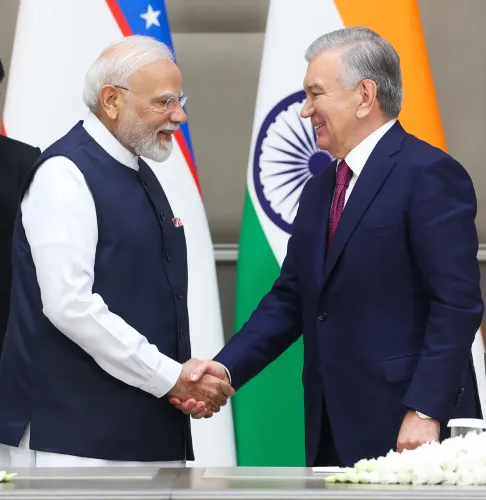
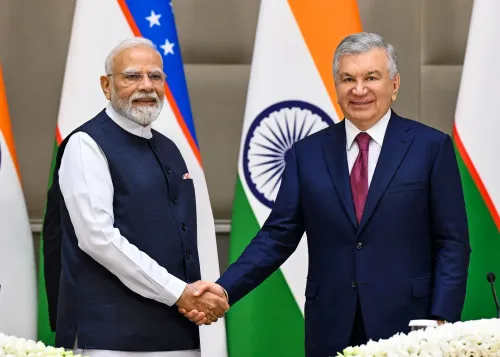
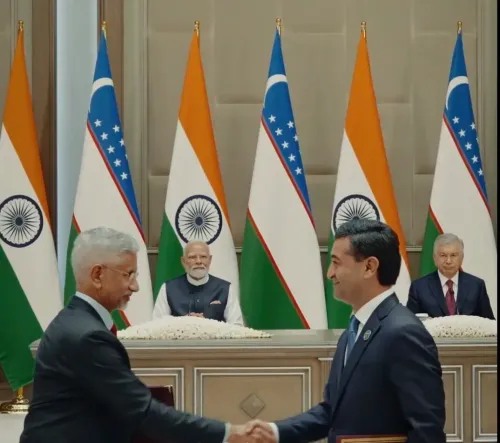
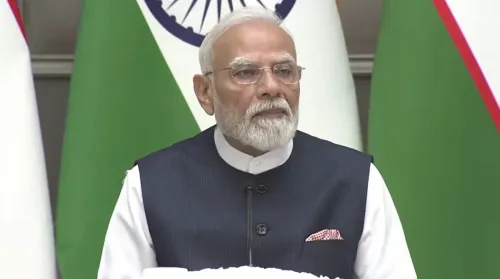
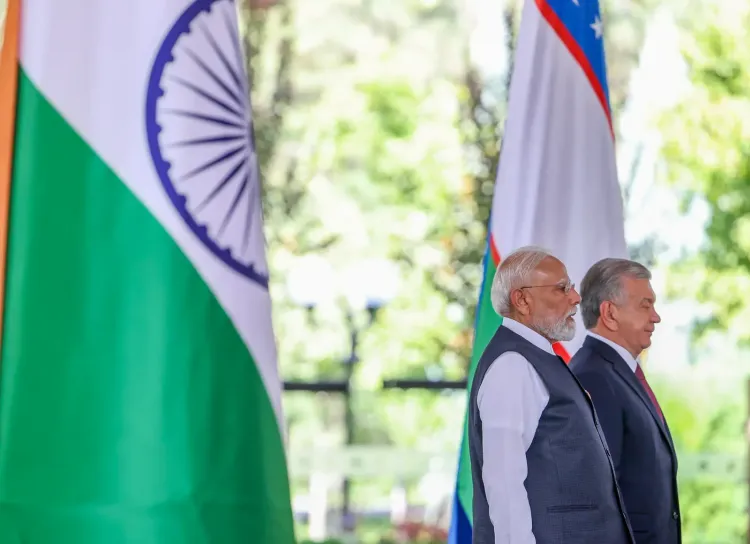
Modi, Mirziyoyev agree to boost India-Uzbekistan trade in Tashkent
Synopsis
PM Modi and Uzbekistan's President Mirziyoyev signed off on one of the broadest India-Central Asia bilateral frameworks in recent memory — covering critical minerals, nuclear energy, AI, outer space, and WTO accession support. The Tashkent meeting signals India's intent to convert its Central Asia outreach into sector-specific, institutionally backed economic partnerships.
Key Takeaways
PM Narendra Modi and Uzbekistan President Shavkat Mirziyoyev met in Tashkent on 30 August and issued a joint statement on deepening bilateral ties.
Priority trade sectors identified include electrical items , engineering products , automobiles , and pharmaceuticals .
Both sides agreed to cooperate on critical and strategic minerals , including joint geological exploration and mineral processing projects.
Cooperation extended to nuclear energy , renewable energy , artificial intelligence , and outer space applications.
India extended support for Uzbekistan's WTO accession ; both nations pledged to defend the multilateral trading system.
An institutional mechanism will be established to address investor concerns and facilitate ease of doing business for companies from both countries.
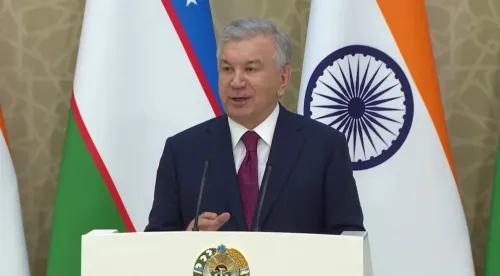
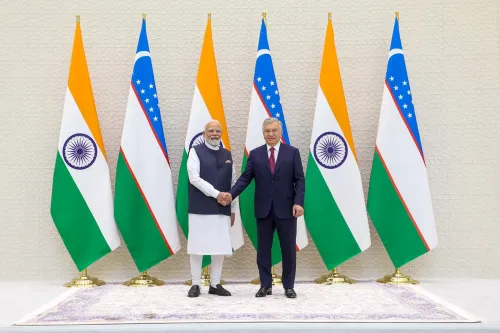
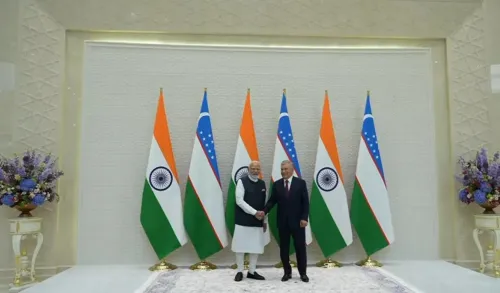
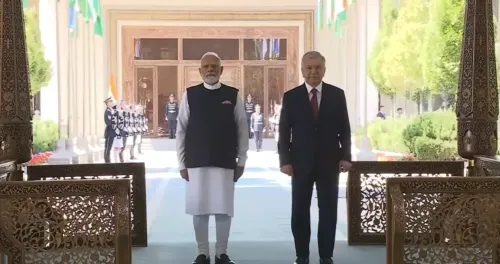
Prime Minister Narendra Modi and Uzbekistan President Shavkat Mirziyoyev on Sunday, 30 August agreed to significantly deepen trade and investment ties between the two nations, according to a joint statement released following their bilateral meeting in Tashkent. The agreement spans sectors from critical minerals and nuclear energy to artificial intelligence and outer space cooperation.
Key Trade and Investment Commitments
Both leaders underscored the need to enhance and diversify bilateral trade, with particular emphasis on electrical items, engineering products, automobiles, and the pharmaceuticals sector. They agreed to foster closer business-to-business linkages in these areas and to undertake joint measures to broaden the range of traded goods.
Both sides also committed to removing non-tariff barriers and promoting industrial cooperation to increase overall bilateral trade turnover. An institutional mechanism is to be established to address investor concerns and improve ease of doing business for companies on both sides.
Critical Minerals, Energy and Nuclear Cooperation
A notable area of convergence was cooperation in geology, mining, nuclear energy, and critical and strategic minerals. The leaders expressed interest in encouraging Indian companies to participate in the development of mineral deposits in Uzbekistan, while Uzbek enterprises were invited to explore joint collaboration opportunities in India.
The joint statement also highlighted plans for joint projects in geological exploration, mineral processing, and the development of integrated value chains. Both sides welcomed discussions on renewable energy, modernisation of energy infrastructure, and the implementation of prospective investment projects. Cooperation in the peaceful uses of nuclear energy was reaffirmed by both governments.
Digital Trade, AI and Space
India and Uzbekistan agreed to strengthen cooperation in e-commerce, the digitalisation of trade procedures, and the deployment of digital platforms to support small and medium-sized enterprises. The two countries also committed to advancing safe, secure, and trustworthy artificial intelligence systems through experience-sharing and best practices, with the aim of driving sustainable economic growth and innovation.
The leaders reaffirmed their interest in expanding practical cooperation in the exploration and peaceful uses of outer space, including space applications, scientific data exchange, and capacity-building through joint workshops and training programmes.
Connectivity, Agriculture and WTO
On logistics, both sides reaffirmed their commitment to enhancing transport connectivity through multimodal routes and logistics corridors to facilitate the seamless movement of goods between the two countries. They also agreed to explore environmentally friendly and energy-efficient solutions for Uzbekistan's public transport sector.
In agriculture, the leaders agreed to cooperate on developing value chains, strengthening export capabilities, and enhancing the technical capacity of the agriculture and livestock sectors. Cooperation between research institutions on agricultural productivity and plant genetic resource conservation was also supported.
Notably, the Uzbek side expressed appreciation for India's support on Uzbekistan's accession to the World Trade Organization (WTO). Both nations agreed to work together to preserve the multilateral trading system, particularly in the interests of developing countries.
The wide-ranging agreements signal a structured effort to move the India-Uzbekistan relationship beyond diplomatic goodwill into verifiable economic outcomes, with implementation frameworks expected to be detailed in the months ahead.
Point of View
Uzbekistan's mineral deposits offer a diversification play away from China-dominated sourcing. Whether Indian companies actually mobilise capital into Uzbek mining projects — or whether this joins a long list of bilateral frameworks that gather dust — will be the real test of this summit's legacy.
NationPress
14 Oct 2026
Frequently Asked Questions
What did PM Modi and Uzbekistan President Mirziyoyev agree on in Tashkent?
The two leaders agreed on 30 August in Tashkent to deepen trade and investment ties across multiple sectors including pharmaceuticals, critical minerals, nuclear energy, AI, and outer space cooperation. A joint statement was issued outlining specific commitments and an institutional mechanism to support bilateral business.
Which sectors are prioritised under the India-Uzbekistan trade agreement?
The joint statement identifies electrical items, engineering products, automobiles, and pharmaceuticals as priority trade sectors. Cooperation in critical and strategic minerals, renewable energy, nuclear energy, e-commerce, and artificial intelligence was also agreed upon.
What is India's role in Uzbekistan's WTO accession?
India has expressed support for Uzbekistan's bid to join the World Trade Organization. Both countries agreed to work together to preserve the multilateral trading system, with a particular focus on the interests of developing nations.
How will the two countries address investor concerns?
Both sides agreed to establish an institutional mechanism specifically to address investors' concerns and facilitate ease of doing business, signalling a shift toward structured economic engagement rather than broad diplomatic commitments alone.
Why does the critical minerals agreement matter for India?
India is actively seeking to diversify its critical and strategic mineral supply chains to reduce dependence on a limited set of suppliers for sectors like EVs and semiconductors. Uzbekistan's mineral deposits offer a potential sourcing alternative, and the agreement includes joint geological exploration and mineral processing projects.