PM Modi shares Bhagavad Gita verse on faith and character

Synopsis
Prime Minister Narendra Modi shared a Sanskrit verse from Bhagavad Gita Chapter 17 on October 29, stating that a person's faith mirrors their inner nature — continuing his practice of weaving classical Indian philosophy into public discourse.
Key Takeaways
PM Modi posted a Bhagavad Gita Chapter 17 verse on October 29, 2026 .
The shloka teaches that every person's faith is shaped by their inherent guna (quality of nature).
The verse belongs to Shraddhatraya Vibhaga Yoga , the Gita's chapter on the threefold nature of faith.
Modi has a recurring practice of sharing classical Sanskrit texts on social media outside formal policy announcements.
The Bhagavad Gita is a 700-verse ancient dialogue widely studied across the world.
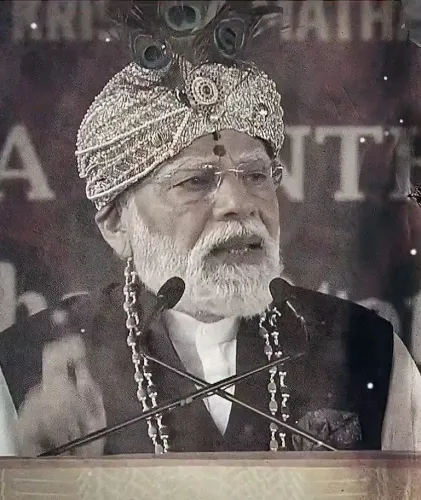
A Sanskrit shloka on the inseparable bond between a person's inner nature and their faith — Prime Minister Narendra Modi turned to the Bhagavad Gita on Thursday, October 29, 2026, sharing one of its most quoted verses on the nature of human belief.
The verse, drawn from the Bhagavad Gita's Chapter 17, reads: 'सत्त्वानुरूपा सर्वस्य श्रद्धा भवति भारत। श्रद्धामयोऽयं पुरुषो यो यच्छ्रद्धः स एव सः॥' — 'O Bharata, the faith of every individual is shaped by their inherent nature. A person is made of their faith; as their faith is, so are they.'
What the Gita's Chapter 17 teaches about Shraddha
The verse belongs to the Shraddhatraya Vibhaga Yoga — the chapter on the threefold division of faith. Lord Krishna tells Arjuna that faith is not arbitrary: it mirrors the fundamental quality, or guna, that dominates a person's character. The shloka is among the Gita's most cited because it frames identity itself as an expression of belief — a person does not simply hold a faith, they become it.
The teaching maps onto the Gita's broader framework of three qualities — sattva (clarity and goodness), rajas (passion and drive), and tamas (inertia and dullness) — and argues that each shapes not just what a person worships, but how they act, eat, and give.
Modi's pattern of sharing classical texts
Prime Minister Modi has periodically posted verses from the Bhagavad Gita and other classical Sanskrit texts on social media, weaving India's philosophical traditions into his public communication outside formal policy announcements. The practice positions the ancient scripture as a living document relevant to contemporary reflection, reaching a vast digital audience that spans devotees, students, and global followers of Indian philosophy.
The Bhagavad Gita — a 700-verse dialogue embedded within the Mahabharata — has long been one of the most translated and studied texts in the world, influencing thinkers from Adi Shankaracharya to figures far beyond India's borders. Its verses on duty, nature, and faith carry a universality that travels well across languages and generations.
What makes this particular shloka resonate is its directness: faith is not imposed from outside, it is grown from within. Character and conviction, it says, are the same thing. That is a message with staying power — in any era.
Point of View
Accessible tradition rather than a museum artifact. By sharing these verses on a mass digital platform, he subtly reinforces a Hindu civilisational identity as part of mainstream public discourse. The choice of a Chapter 17 verse on 'shraddha' — faith shaping identity — carries a quiet universality that invites broad resonance while still speaking directly to the Prime Minister's core cultural base. It is governance-by-texture: not a policy announcement, but a steady accumulation of symbolic messaging.
NationPress
29 Oct 2026
Frequently Asked Questions
What is the meaning of the Gita verse Modi posted on October 29, 2026?
The verse from Bhagavad Gita Chapter 17 means: 'O Bharata, the faith of every individual is shaped by their inherent nature. A person is made of their faith; as their faith is, so are they.' It teaches that inner character and belief are inseparable.
Which chapter of the Bhagavad Gita does this shloka come from?
The shloka comes from Chapter 17 of the Bhagavad Gita, known as Shraddhatraya Vibhaga Yoga — the chapter on the threefold division of faith according to the three gunas: sattva, rajas, and tamas.
Why does PM Modi post Bhagavad Gita verses on social media?
PM Modi has periodically shared verses from the Bhagavad Gita and other classical texts as part of a broader communication practice that highlights India's philosophical and spiritual traditions, independent of specific policy announcements.
What is 'shraddha' in the context of the Bhagavad Gita?
'Shraddha' in the Bhagavad Gita means faith or devoted belief. Chapter 17 explains that shraddha is not uniform — it takes three forms (sattvic, rajasic, and tamasic) depending on a person's dominant inner nature or guna.
What is the Bhagavad Gita?
The Bhagavad Gita is a 700-verse ancient Hindu scripture embedded within the Mahabharata, recording a philosophical dialogue between Lord Krishna and Arjuna. It covers themes of duty, nature, devotion, and the self, and is one of the most studied texts in the world.