What Vision Did PM Modi Unveil at Chhattisgarh's Vidhan Sabha Inauguration?

Synopsis
On November 1st, Prime Minister Modi unveiled a powerful vision connecting Lord Ram to nation-building at the inauguration of Chhattisgarh's new Assembly. He emphasized inclusive governance, urged lawmakers to embody Ram Rajya, and celebrated the state's 25th Foundation Day, intertwining spiritual reverence with political ambition.
Key Takeaways
Lord Ram is central to Chhattisgarh's identity.
The new Assembly symbolizes inclusive governance.
Ram Rajya serves as a guiding principle for lawmakers.
Historical and cultural values are vital in modern governance.
Environmental sustainability is emphasized in the new complex.
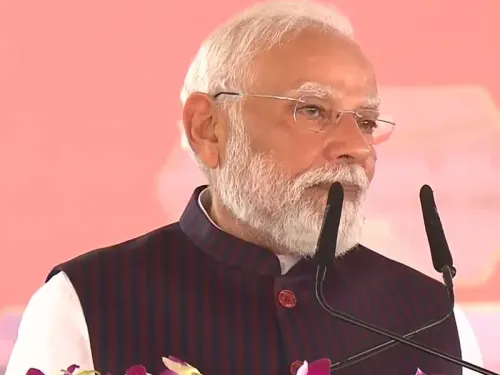
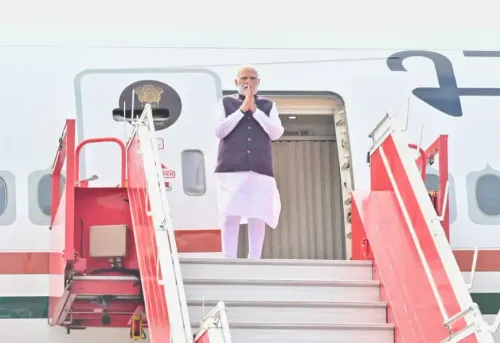
Raipur, Nov 1 (NationPress) Prime Minister Narendra Modi on Saturday articulated a significant narrative connecting Lord Ram — whom he referred to as the eternal spirit of Chhattisgarh, the place of his "Nanihal" (maternal grandparents’ home) — to the fundamental principles of nation-building during the inaugural session of Chhattisgarh’s impressive new Assembly in Nava Raipur on the state’s 25th Foundation Day.
"Chhattisgarh is the maternal home of Lord Shri Ram," the PM proclaimed, his voice echoing in the intricately carved Assembly hall.
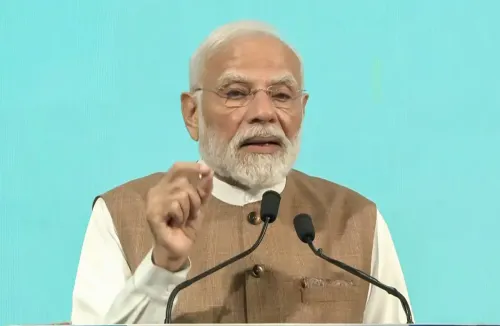
"What does 'Ram se Rashtra' signify for governance? It embodies 'Sabka Saath, Sabka Vikas' - a model of inclusive development that ensures no one is left behind. 'Ram' represents a nation devoid of poverty, where no one meets an untimely end due to illness, fostering health and happiness. It exemplifies a society free from discrimination, grounded in social justice. 'Ram' symbolizes the eradication of anti-human forces—as evidenced in Operation Sindoor, where India is dismantling Naxalism (Maoism)," PM Modi stated during his day-long visit to Chhattisgarh for the state’s silver jubilee celebration.
He encouraged lawmakers to transform the Vidhan Sabha into a living testament of Ram Rajya. "Every law, every debate, and every decision should embody this ideal—promoting the welfare of farmers, empowering women, ensuring dignity for tribals, and fostering youth prosperity. Let ‘Ram’ guide us from self to society, from state to nation."
Referencing the state’s tribal heritage and the democratic spirit of the Muria Darbar, PM Modi called for a governance model where "Nagarik Devo Bhava" (the citizen is God) prevails.
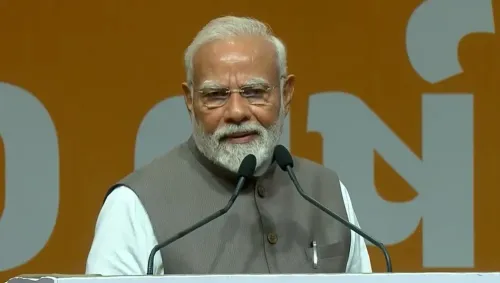
"This is not merely a building," he remarked, gesturing towards the environmentally conscious, culturally vibrant complex, "it is the temple where Ram Rajya will be inscribed for Viksit Bharat 2047."
His call intertwined spiritual reverence with political foresight, positioning Chhattisgarh as a symbol of ethical, people-centric leadership rooted in ancient wisdom while advancing towards a self-reliant future.
"This is not just an inauguration; it celebrates 25 years of the people's struggle," PM Modi asserted.
"From sessions in Rajkumar College to this modern, digital, self-sufficient Vidhan Sabha—each pillar signifies transparency, and every corridor represents accountability."
He celebrated the complex as a reflection of India’s ancient heritage and future aspirations, where tribal wisdom like the Muria Darbar, teachings of Guru Ghasidas — "Manke Manke Ek Saman", devotion of Mother Shabari, and the equality preached by Kabirdas embellish the walls and furnishings.
The Prime Minister connected the event to the 75th year of India’s Constitution—“Amrit Varsh”—and honored architects such as the former Chief Minister of undivided Madhya Pradesh, Ravi Shankar Shukla.
"Atal ji’s decision bestowed identity upon Chhattisgarh; today, it thrives with confidence," he remarked while unveiling a statue of former PM Atal Bihari Vajpayee.
He commended Speaker Raman Singh, a former Chief Minister who now serves as a dedicated worker, as a testament to the humility that sustains democracy.
The Rs 324 crore complex, themed “Dharti Dhurandhar,” harmoniously combines Chhattisgarhi artistry—rice grain ceilings and tribal motifs—with sustainable design: solar power, 200 seats (expandable post-delimitation), a 500-seat auditorium, healthcare facilities, and civic amenities.
"This is not just a building; it embodies Chhattisgarh’s essence in stone," PM Modi stated, garnering thunderous applause.
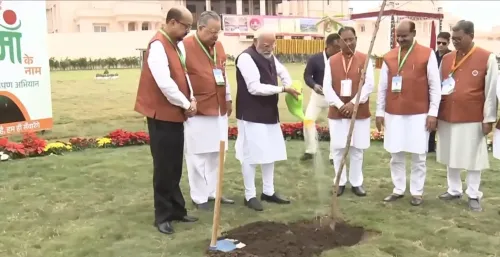
Accompanied by Governor Raman Deka and Chief Minister Vishnu Deo Sai, the Prime Minister planted a sapling under the initiative “Ek Ped Maa Ke Naam,” intertwining the environment with heritage. As the tricolour fluttered atop the dome, Chhattisgarh boldly ventured into its next chapter—anchored in Ram, advancing towards Viksit Bharat.
Point of View
Prime Minister Modi’s address at the inauguration of Chhattisgarh’s new Assembly encapsulates a significant moment in Indian politics. His emphasis on inclusive governance and the intertwining of spiritual ideals with contemporary governance reflects a broader trend towards integrating cultural values in political discourse. This approach resonates with the aspirations of a diverse population seeking progress while honoring its heritage.
NationPress
2 Oct 2026
Frequently Asked Questions
What is the significance of Lord Ram in Chhattisgarh?
Lord Ram is viewed as the eternal spirit of Chhattisgarh, symbolizing the state's rich cultural heritage and serving as a guiding principle for governance.
What does 'Ram se Rashtra' mean?
'Ram se Rashtra' translates to a governance model that emphasizes inclusive development, ensuring that no one is left behind.
What are the key features of the new Assembly complex?
The new Assembly complex includes eco-friendly designs, solar power, 200 expandable seats, a 500-seat auditorium, and various civic amenities.
How does PM Modi envision Chhattisgarh's future?
PM Modi envisions Chhattisgarh as a beacon of ethical leadership, progressing towards a self-reliant future while rooted in the principles of Ram Rajya .
What role does tribal wisdom play in governance according to PM Modi?
Tribal wisdom is seen as integral to governance, promoting democratic values and cultural heritage that inform modern political practices.