Mahua Moitra Slams Rejection of INC RS Candidate Natarajan

Synopsis
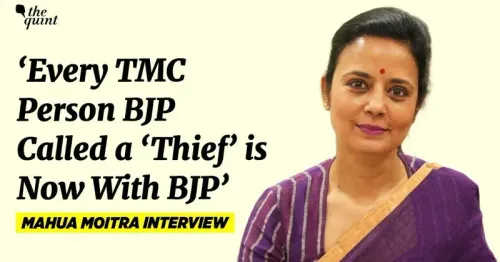
TMC MP Mahua Moitra has accused Prime Minister Modi and Home Minister Shah of blocking INC's Rajya Sabha candidate Meenakshi Natarajan on a 'flimsy excuse', alleging the ruling dispensation is engineering upper-house control to enable constitutional amendments and avoid electoral accountability.
Key Takeaways
TMC MP Mahua Moitra publicly condemned the rejection of INC Rajya Sabha candidate Meenakshi Natarajan on June 10, 2026.
Moitra alleged the rejection was a deliberate move by PM Modi and Home Minister Amit Shah to control both Houses of Parliament.
She warned the ruling dispensation that 'their time is up' — invoking the general election as an accountability moment.
The BJP has steadily expanded its Rajya Sabha numbers since 2014 through state assembly victories, though it still falls short of the two-thirds threshold for most constitutional amendments.
Opposition parties have repeatedly alleged procedural or administrative pressure during Rajya Sabha biennial polls.
State assembly outcomes in 2025-26 will determine Rajya Sabha vacancies and the legislative arithmetic in upcoming sessions.
TMC MP Mahua Moitra on Wednesday, June 10, 2026 publicly condemned the rejection of Indian National Congress Rajya Sabha candidate Meenakshi Natarajan, accusing the BJP-led dispensation of manufacturing a pretext to block the nomination and warning that the ruling coalition's grip on power would end in the next general election.
Context
Moitra, the Lok Sabha MP from Krishnanagar, West Bengal, posted on X that rejecting Meenakshi Natarajan on what she called 'a flimsy joke of an excuse' was evidence of how desperate Prime Minister Narendra Modi and Home Minister Amit Shah are to control both Houses of Parliament. She added bluntly: 'Else their time is up in 2024' — a reference to the general election that had already tested the BJP's majority.
Natarajan is a former Lok Sabha MP from Mandsaur, Madhya Pradesh and a prominent Congress leader. Rajya Sabha members are elected by state legislatures, making the upper house a battleground where state assembly outcomes directly shape the balance of power in Parliament.
Policy Backdrop
Since 2014, the BJP-led government has steadily expanded its Rajya Sabha numbers through successive state assembly victories, progressively narrowing the gap with the combined opposition. The upper house remains a critical arena because most constitutional amendments require a two-thirds majority in both chambers — a threshold the ruling alliance has not yet consistently commanded.
The significance of Rajya Sabha arithmetic was underscored in 2019, when the government used its combined parliamentary majority to abrogate Article 370 — a constitutional change that required passage in both the Lok Sabha and the Rajya Sabha. Opposition parties have since raised repeated concerns about procedural pressure during biennial Rajya Sabha polls.
Stakeholders and Impact
For the Indian National Congress, the rejection of a high-profile candidate like Natarajan represents a direct blow to the party's effort to consolidate its Rajya Sabha presence ahead of potential legislative battles. Opposition unity in the upper house is seen as the last institutional check against constitutional amendments that critics argue could alter the basic structure of the republic.
Smaller regional parties, including Moitra's own All India Trinamool Congress, have a stake in maintaining opposition numbers in the Rajya Sabha. Any erosion of those numbers could tilt the balance on key legislation, from electoral reforms to federal resource allocation.
What's Next
State assembly outcomes scheduled through 2025-26 will determine the next wave of Rajya Sabha vacancies and the arithmetic that follows. Any fresh constitutional amendment proposals tabled in the monsoon or winter sessions of Parliament will test whether the ruling alliance has the numbers to push through changes without opposition support.
Moitra's post signals that the opposition intends to frame upper-house management as a democratic accountability issue going into the next electoral cycle — making Rajya Sabha candidacy disputes a live political fault line rather than a procedural footnote.
Point of View
Opposition parties have grown more vocal about nomination-stage interference. Whether or not the specific rejection holds up to scrutiny, the political signal is clear — the opposition intends to make Rajya Sabha arithmetic a mobilising issue. The reference to electoral accountability in the same breath as constitutional amendment risk is a deliberate attempt to connect institutional concerns to voter-level consequences.
NationPress
16 Sept 2026
Frequently Asked Questions
Why did Mahua Moitra criticise the rejection of Meenakshi Natarajan?
Moitra said the rejection was made on a 'flimsy excuse' and accused Modi and Shah of trying to control both Houses of Parliament to push through constitutional amendments without adequate opposition resistance.
Who is Meenakshi Natarajan?
Meenakshi Natarajan is a senior Indian National Congress leader and former Lok Sabha MP from Mandsaur, Madhya Pradesh , who was fielded as the party's Rajya Sabha candidate.
Why does controlling the Rajya Sabha matter for constitutional amendments?
Most constitutional amendments require a two-thirds majority in both the Lok Sabha and the Rajya Sabha. If the ruling alliance controls both chambers, it can pass amendments without opposition support — which is why upper-house arithmetic is politically sensitive.
What is the BJP's current position in the Rajya Sabha?
Since 2014 , the BJP-led alliance has steadily expanded its Rajya Sabha numbers through state assembly victories, narrowing the gap with the opposition, though it has not consistently commanded the two-thirds majority needed for constitutional amendments.
What did Mahua Moitra mean by 'their time is up in 2024'?
Moitra was invoking the general election as an accountability moment, warning that the ruling dispensation's attempts to consolidate parliamentary control would be judged by voters at the polls.