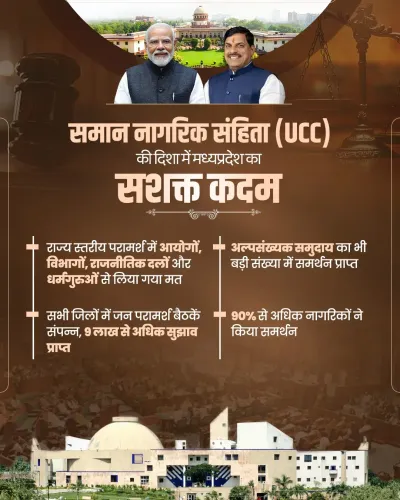
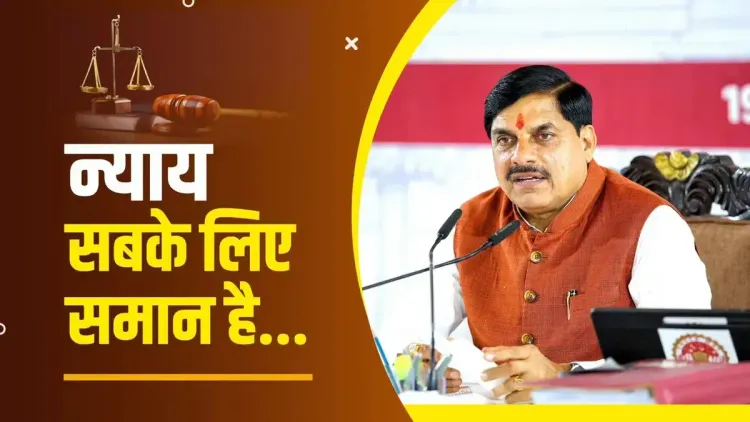
CM Mohan Yadav Backs UCC With Equal Property Rights for Women
Synopsis
Madhya Pradesh CM Dr. Mohan Yadav on 19 July 2026 announced a cabinet-backed Uniform Civil Code proposal featuring mandatory marriage registration, equal property rights for women, and up to five years imprisonment for married persons in live-in relationships — marking a major step in the BJP's long-standing UCC agenda.
Key Takeaways
Madhya Pradesh CM Dr.
Mohan Yadav announced a UCC cabinet decision on 19 July 2026 .
All marriages will require mandatory registration under the proposed code.
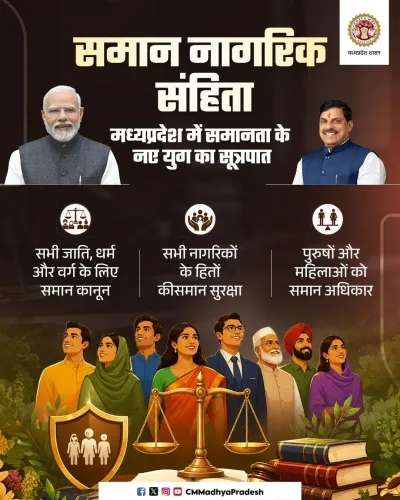
Women will be granted equal property rights on par with men.
Married persons in live-in relationships face up to five years in prison under the proposed provision.
Uttarakhand was the first Indian state to pass a UCC bill, in February 2024 , setting the legislative precedent.
The BJP has advocated for a Uniform Civil Code in its party manifestos since 1996 .
Madhya Pradesh Chief Minister Dr. Mohan Yadav on Sunday, 19 July 2026 publicly backed a cabinet-level push for a Uniform Civil Code (UCC) in the state, outlining key provisions including mandatory registration of all marriages, equal property rights for women, and a prison term of up to five years for married persons who enter live-in relationships.
Context
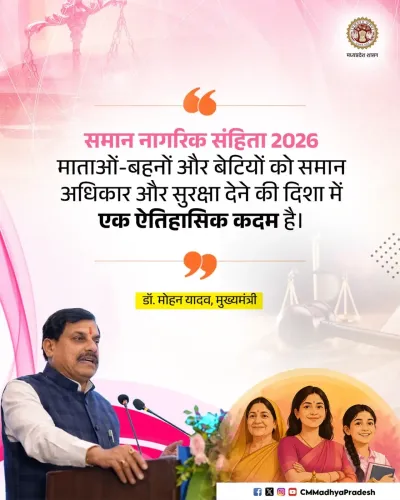
Dr. Yadav's post, shared in Hindi, described the UCC as 'ek naye yug ka prarambh' — 'the beginning of a new era' — and framed it as a significant step toward women's empowerment and dignity. The three headline provisions he cited are: compulsory registration of all marriages, equal rights for women in property on par with men, and criminal liability for married individuals who enter live-in relationships, punishable by up to five years in prison.
The post was tagged with #UniformCivilCode, #UCC, and #CabinetDecision, indicating the proposals were placed before or cleared by the Madhya Pradesh cabinet.
Policy Backdrop
Article 44 of the Constitution of India (1950) directs the state to endeavour to secure a Uniform Civil Code for all citizens — a directive principle that has remained unimplemented at the national level for over seven decades. The Bharatiya Janata Party (BJP) has carried UCC as a core manifesto commitment since 1996, reiterating it in its 2024 general election manifesto.
Uttarakhand became the first Indian state to pass a UCC bill in February 2024, setting a legislative template that BJP-governed states have since looked to replicate. Madhya Pradesh, governed by the BJP since 2003 (with brief interruptions), has been among the states where UCC proposals have been discussed in the wake of Uttarakhand's legislation.
The framing of UCC as a gender-equality measure — centring mandatory marriage registration and equal inheritance rights — reflects the BJP's broader communication strategy of positioning the code as a reform for women rather than a rollback of minority personal laws.
Stakeholders and Impact
Women stand to be the most directly affected beneficiary group if the equal-property-rights provision is enacted, as existing personal laws across several communities do not guarantee gender parity in inheritance. Mandatory marriage registration is widely seen as a safeguard against child marriages and the denial of spousal rights, particularly in rural areas.
The provision criminalising live-in relationships for married persons — carrying a sentence of up to five years — is likely to draw scrutiny from civil liberties advocates and legal experts who may argue it conflicts with the right to privacy upheld by the Supreme Court of India in its landmark 2017 judgment. Religious communities governed by distinct personal laws — including Muslim, Christian, and Hindu communities with varied inheritance customs — will watch the legislative process closely for how the code reconciles religious practice with uniform civil standards.
What's Next
The immediate next step is the formal introduction of a UCC bill in the Madhya Pradesh Legislative Assembly, where the BJP holds a comfortable majority. Legal challenges in the High Court or Supreme Court are widely anticipated once any bill is enacted, as has been the pattern in Uttarakhand following its 2024 legislation.
Parallel developments in other BJP-governed states mean Madhya Pradesh's legislative journey will be watched as a potential model — or cautionary tale — for the national UCC debate that continues to simmer ahead of future electoral cycles.
Point of View
While the live-in relationship penalty signals a socially conservative counterweight aimed at the party's core base. The move intensifies pressure on Congress-governed states to articulate a counter-position on personal law reform, and raises the stakes for the Supreme Court, which will likely be the final arbiter of how far state-level UCC legislation can go.
NationPress
18 Oct 2026
Frequently Asked Questions
What is the Uniform Civil Code proposed in Madhya Pradesh?
The Madhya Pradesh UCC proposal, announced by CM Dr. Mohan Yadav on 19 July 2026, would make registration of all marriages compulsory, grant women equal property rights with men, and impose up to five years in prison on married persons who enter live-in relationships.
Which was the first Indian state to implement UCC?
Uttarakhand was the first Indian state to pass a Uniform Civil Code bill, doing so in February 2024, and it has served as a legislative model for other BJP-governed states including Madhya Pradesh.
Is live-in relationship illegal in Madhya Pradesh under the new UCC?
Under the proposed UCC provision announced by CM Yadav, live-in relationships would be criminalised specifically for married persons, carrying a sentence of up to five years. The proposal is yet to be enacted as law and may face legal challenges.
What does UCC mean for women's property rights in India?
The Madhya Pradesh UCC proposal would give women property rights equal to men, replacing personal laws under which women in some communities receive a smaller or no share of inheritance. This is framed by CM Yadav as a core pillar of women's empowerment.
What is Article 44 of the Indian Constitution?
Article 44 is a Directive Principle of State Policy in the Constitution of India (1950) that directs the state to endeavour to secure a Uniform Civil Code for all citizens. It is non-justiciable but has underpinned decades of political debate on replacing religion-based personal laws.