CM Mohan Yadav backs UCC, says divorce by words alone to end
Synopsis
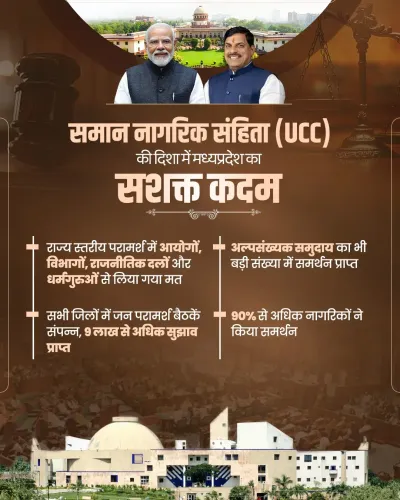
Madhya Pradesh CM Dr. Mohan Yadav announced a cabinet decision endorsing the Uniform Civil Code on 19 July 2026, declaring that divorce by mere utterance of words will no longer be valid and that the UCC aims to guarantee equal rights and justice for all citizens.
Key Takeaways
Madhya Pradesh CM Dr.
Mohan Yadav announced a cabinet decision in favour of implementing the Uniform Civil Code (UCC) on 19 July 2026 .
The announcement explicitly states that divorce by mere utterance of words — widely read as a reference to instant triple talaq — will no longer be permissible.
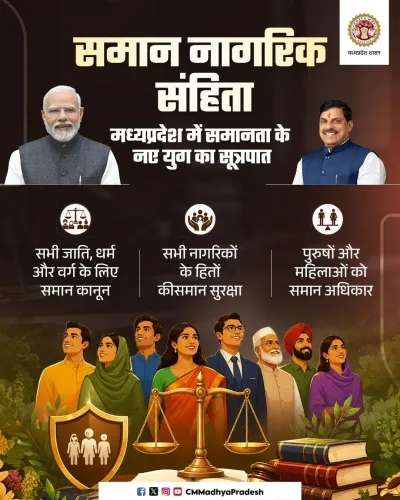
The UCC is framed as a measure to ensure equal rights and equal justice for all citizens regardless of religion.
Uttarakhand remains the only Indian state to have enacted a UCC law so far, having done so in February 2024 .
The constitutional basis for a UCC is Article 44 , a Directive Principle of State Policy in force since 1950 .
A formal UCC bill is expected to be introduced in the Madhya Pradesh legislative assembly as the next legislative step.
Madhya Pradesh Chief Minister Dr. Mohan Yadav on Sunday, 19 July 2026, declared that divorce by mere utterance of words will no longer be valid, announcing a cabinet decision in support of the Uniform Civil Code (UCC) for the state. The post, shared on X, underscored the BJP government's push to replace religion-based personal laws with a single, uniform framework governing marriage, divorce, inheritance, and adoption.
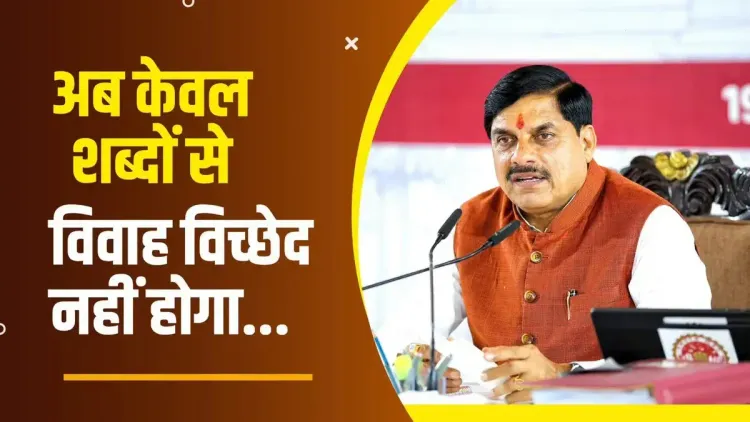
In his post, Dr. Yadav wrote: 'अब केवल शब्दों से विवाह विच्छेद नहीं होगा' ('Now, divorce will no longer happen by mere words alone'), adding that the purpose of the Uniform Civil Code is to ensure 'equal rights and equal justice for all citizens.' The post was tagged with #UniformCivilCode, #UCC, and #Cabinetdecision, signalling a formal government move.
Context
The reference to divorce 'by words alone' is widely understood as a pointed allusion to the practice of instant triple talaq, which was criminalised at the national level in 2019 but continues to be cited by UCC proponents as evidence of unequal treatment under personal laws. Dr. Yadav's framing positions the UCC as a corrective measure ensuring no community's women are subject to less protective divorce provisions than others.
The announcement follows a cabinet decision in Madhya Pradesh, though the specific provisions of that decision remain to be detailed in a formal bill before the state assembly.
Policy Backdrop
Article 44 of the Constitution of India has, since 1950, directed the state to endeavour to secure a Uniform Civil Code for all citizens — a Directive Principle of State Policy that successive governments debated but did not legislate on for over seven decades. Uttarakhand broke that pattern in February 2024, becoming the first Indian state to pass a UCC law, setting a legislative template that other BJP-governed states have since studied closely.
The BJP's 2024 general election manifesto reiterated the party's commitment to a national UCC, and state-level moves such as this one in Madhya Pradesh are seen as building blocks toward that larger goal. The UCC seeks to standardise rules on marriage, divorce, inheritance, and adoption across all religious communities.
Stakeholders and Impact
Women across religious communities stand as the primary beneficiaries cited by UCC proponents, who argue that a uniform code would close gaps in protection that exist under differing personal laws. Advocacy groups focused on gender justice have long called for codified, equal divorce and inheritance rights regardless of religion.
Religious communities — particularly Muslim personal law bodies and some minority rights organisations — have historically contested the UCC, arguing it risks eroding constitutionally protected religious freedoms. Any formal bill introduced in the Madhya Pradesh assembly is expected to renew that debate at the state level and draw scrutiny from the courts.
What's Next
The immediate next step is the introduction of a formal UCC bill in the Madhya Pradesh legislative assembly, which would translate the cabinet decision into enforceable law. Legal challenges before the Supreme Court of India — where petitions related to UCC have been pending — could also be triggered or accelerated by state-level enactments.
With Madhya Pradesh now signalling a concrete legislative intent, pressure may mount on other BJP-ruled states to follow, while the national debate on a central UCC law is likely to intensify ahead of the next parliamentary session.
Point of View
Mirroring the Uttarakhand playbook from 2024 and keeping the party's core ideological agenda visible between national elections. By anchoring the announcement in the language of gender justice — 'divorce by words alone' — the BJP is attempting to reframe UCC as a women's rights issue rather than a religious reform, a framing designed to broaden its appeal beyond the party's traditional base. The move also creates political pressure on opposition-governed states to either engage with or resist UCC, sharpening a fault line that is likely to define state-level politics through the next election cycle. How quickly Madhya Pradesh translates this cabinet decision into a tabled bill will be the real test of legislative intent versus political signalling.
NationPress
18 Oct 2026
Frequently Asked Questions
What did Madhya Pradesh CM Mohan Yadav announce about the Uniform Civil Code?
CM Dr. Mohan Yadav announced on 19 July 2026 that a cabinet decision has been taken in support of the Uniform Civil Code in Madhya Pradesh, stating that divorce by mere utterance of words will no longer be legally valid under the new framework.
What does 'divorce by words alone' mean in the UCC context?
'Divorce by words alone' is widely understood as a reference to the practice of instant triple talaq, whereby a Muslim husband could previously dissolve a marriage by uttering the word 'talaq' three times. The UCC seeks to replace such religion-specific provisions with a uniform law for all citizens.
Which Indian state was the first to implement the Uniform Civil Code?
Uttarakhand was the first Indian state to enact a Uniform Civil Code law, passing it in February 2024, and it has since served as a legislative reference point for other BJP-governed states including Madhya Pradesh.
What is the constitutional basis for the Uniform Civil Code in India?
Article 44 of the Constitution of India, a Directive Principle of State Policy, has since 1950 directed the state to endeavour to secure a Uniform Civil Code for all citizens across the country.
What happens next after Madhya Pradesh's cabinet decision on UCC?
The next step is the introduction of a formal UCC bill in the Madhya Pradesh legislative assembly. Any enacted law could also face legal challenges before the Supreme Court of India, where related petitions are already pending.