MP CM Yogi Rolls Out Solid Waste Management Rules 2026
Synopsis
Madhya Pradesh has enacted the Solid Waste Management Rules, 2026, with the Chief Minister's Office calling cleanliness a collective responsibility. The move builds on India's national waste governance framework established under Swachh Bharat and the central 2016 rules, tasking urban local bodies and residents with formalised waste obligations.
Key Takeaways
The Chief Minister's Office of Madhya Pradesh announced the Solid Waste Management Rules, 2026 on 11 July 2026 .
Mohan Yadav was tagged in the post, which framed cleanliness as a 'collective responsibility'.
Madhya Pradesh has a population of over 80 million , making effective urban waste governance a large-scale challenge.
The 2026 rules build on the central government's Solid Waste Management Rules, 2016 and the Swachh Bharat Mission launched in 2014 .
Urban local bodies and municipal residents are the primary stakeholders expected to operationalise and comply with the new framework.
State-level notifications detailing city-wise implementation timelines are awaited.
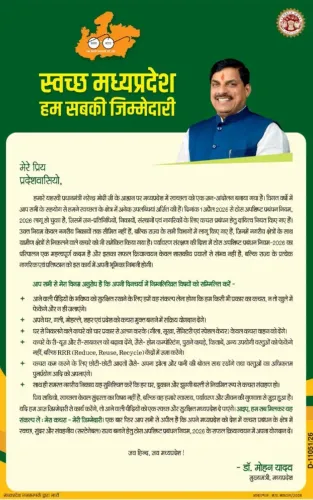
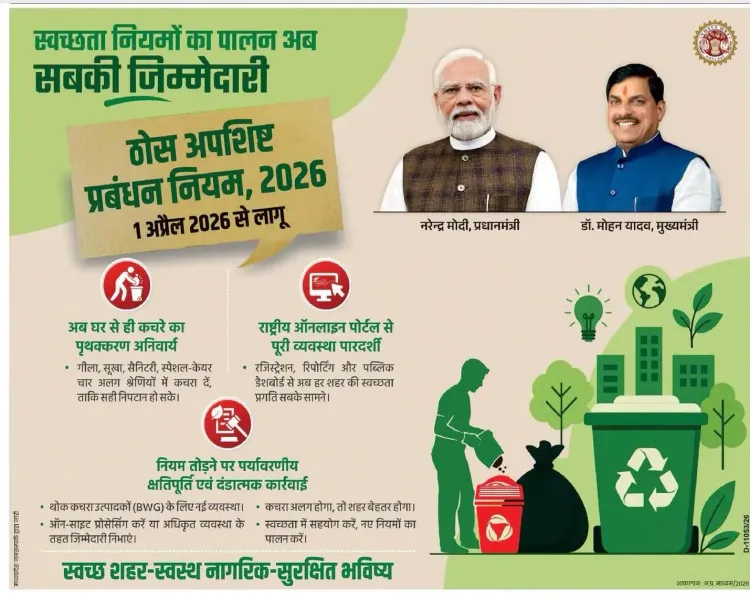
The Chief Minister's Office of Madhya Pradesh announced on Saturday, 11 July 2026 that the state has enacted the Solid Waste Management Rules, 2026, calling on residents to adopt the new framework as a collective civic responsibility toward a cleaner and greener future.
The post, tagged to Chief Minister Dr. Mohan Yadav, declared in Hindi: 'Swachhata sirf aadat nahi, hamari saamoohik zimmedari hai' ('Cleanliness is not merely a habit — it is our collective responsibility'), framing the new rules as a community obligation rather than a regulatory imposition.
Context
Madhya Pradesh, home to over 80 million residents, has introduced state-level solid waste rules that build on the national policy architecture established over the past decade. The announcement positions the 2026 rules as the state's next step in formalising waste management obligations for urban bodies and citizens alike. The official communication calls on all stakeholders to contribute to building a 'swachh, swasth aur harit bhavishy' — a 'clean, healthy and green future'.
Policy Backdrop
India's structured approach to solid waste management began in earnest with the Swachh Bharat Mission, launched in 2014 by the Government of India to overhaul national sanitation and cleanliness standards. This was followed by the central government's Solid Waste Management Rules, 2016, notified by the Ministry of Environment, Forest and Climate Change, which set out responsibilities for urban local bodies covering waste segregation, collection, transportation and disposal.
States have since been expected to align their municipal frameworks with these central guidelines. Madhya Pradesh's 2026 rules represent the state's formal adaptation of that national framework into locally enforceable regulations, continuing a pattern seen across Indian states that have progressively strengthened their own waste governance structures.
Stakeholders and Impact
Urban local bodies across Madhya Pradesh — including municipal corporations, councils and smaller urban authorities — will bear primary implementation responsibility under the new rules. Waste workers, who form the frontline of collection and processing operations, stand to be directly affected by any changes to operational mandates and compliance requirements.
For municipal residents, the rules are expected to translate into clearer obligations around waste segregation at source and responsible disposal. The Chief Minister's Office framed public participation as central to the rules' success, signalling that awareness and behaviour change will be as critical as enforcement.
What's Next
Attention will now turn to state-level notifications and municipal orders that detail specific implementation timelines, compliance deadlines and penalty provisions for cities across Madhya Pradesh. How swiftly urban local bodies operationalise the rules — particularly in smaller towns with limited infrastructure — will determine the on-ground impact of the 2026 framework. The state's performance under this new regulatory regime is also likely to feed into national assessments of urban cleanliness, including rankings under the Swachh Bharat Mission.
Point of View
Where states progressively layer their own regulations atop central frameworks to demonstrate policy ownership and local accountability. By branding the 2026 rules as a matter of 'collective responsibility' rather than top-down regulation, the Madhya Pradesh government is attempting to generate public buy-in — a strategy that has historically been central to the Swachh Bharat Mission's communication playbook. The move also keeps the state visible in national cleanliness rankings, which carry political weight for ruling parties at the state level. The real test, however, lies in municipal implementation capacity, which has been the persistent weak link in India's waste management ambitions.
NationPress
10 Oct 2026
Frequently Asked Questions
What are the Madhya Pradesh Solid Waste Management Rules 2026?
The Solid Waste Management Rules, 2026 are state-level regulations announced by the Madhya Pradesh government on 11 July 2026, setting out obligations for urban local bodies and residents around waste segregation, collection and disposal. They build on the central government's 2016 national rules and the Swachh Bharat Mission framework.
Who announced the new solid waste rules in Madhya Pradesh?
The announcement was made by the Chief Minister's Office of Madhya Pradesh and tagged to Chief Minister Dr. Mohan Yadav on 11 July 2026.
How do the MP 2026 rules differ from the central Solid Waste Management Rules 2016?
The central Solid Waste Management Rules, 2016 were notified by the Ministry of Environment, Forest and Climate Change as a national framework. Madhya Pradesh's 2026 rules represent the state's own adaptation of that framework into locally enforceable regulations applicable to its urban bodies and residents.
What is the Swachh Bharat Mission and how is it related?
The Swachh Bharat Mission is a national cleanliness and sanitation campaign launched by the Government of India in 2014. Madhya Pradesh's new waste rules align with this mission's goals, and the state's compliance is likely to be assessed under national urban cleanliness rankings linked to the programme.
Who is responsible for implementing the new waste rules in Madhya Pradesh?
Urban local bodies — including municipal corporations and councils across Madhya Pradesh — are the primary implementing authorities. Residents are also expected to comply with waste segregation and disposal norms under the new rules.