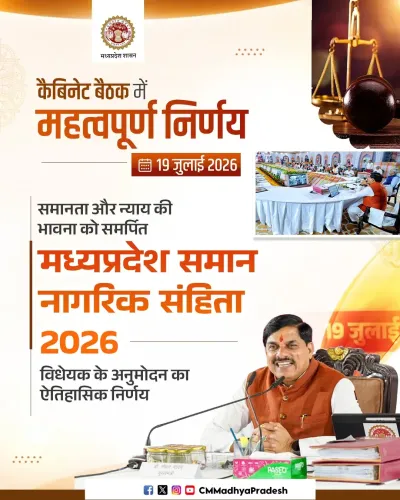
MP CM Office Announces Equality in Marriage and Family Rights
Synopsis
The Chief Minister's Office of Madhya Pradesh has announced that equality will be ensured in marriage and family rights, signalling a state-level push on personal law reform aligned with Article 44 of the Constitution. The move is expected to benefit women and families across the state.
Key Takeaways
The Chief Minister's Office of Madhya Pradesh announced on 25 July 2026 that equality will be provided in marriage and family rights.
The announcement is framed around reducing disparities in personal law as they apply to marriage, divorce, and family matters.
Article 44 of the Constitution of India directs the state to endeavour for a Uniform Civil Code covering these areas.
Primary stakeholders include women and families in Madhya Pradesh who are subject to community-specific personal laws.
The next step to watch is the introduction of related legislation or executive orders in the Madhya Pradesh Vidhan Sabha .
The Chief Minister's Office of Madhya Pradesh announced on Friday, 25 July 2026 that the state government will ensure equality in marriage and family rights, signalling a significant policy push on personal law reform in the central Indian state.
Context
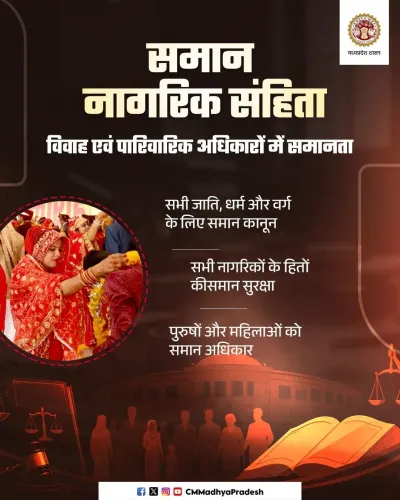
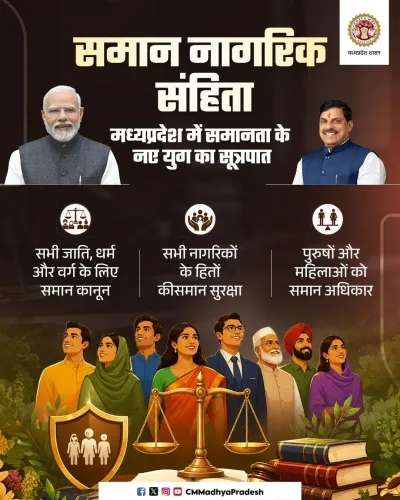
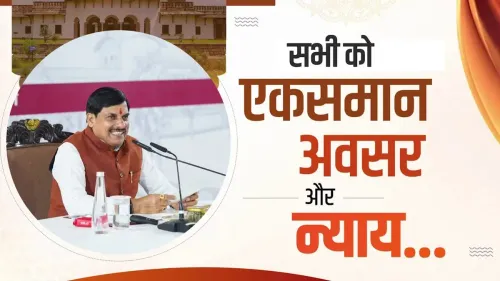
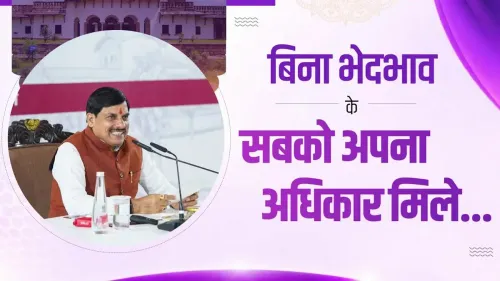
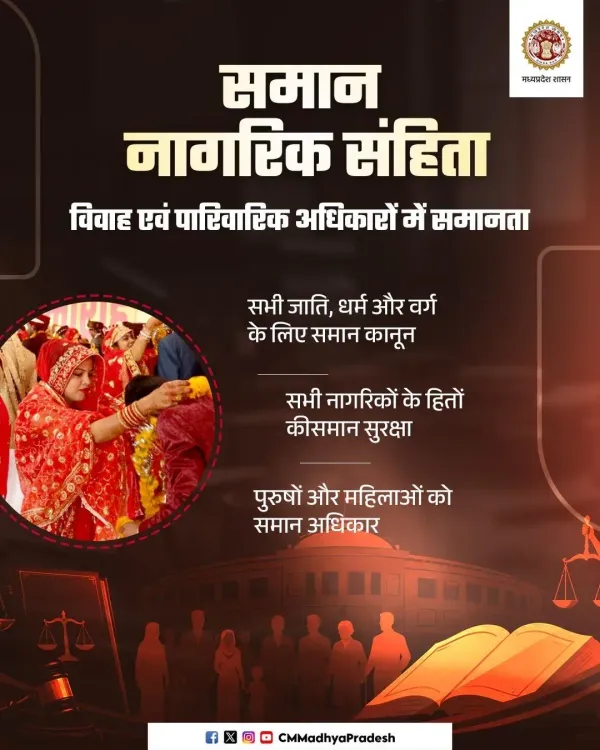
The official post from the Chief Minister's Office declared, 'विवाह एवं पारिवारिक अधिकारों में मिलेगी समानता' — 'Equality will be provided in marriage and family rights.' The announcement points to a state-level initiative aimed at reducing disparities in how marriage, divorce, and related family matters are governed across different communities in Madhya Pradesh.
The statement comes at a time when several Indian states have been actively debating reforms to personal laws, with a focus on bridging gender and community-based inequalities in civil matters.
Policy Backdrop
Article 44 of the Constitution of India (1950) places the Uniform Civil Code among the Directive Principles of State Policy, directing the state to 'endeavour to secure for the citizens a uniform civil code throughout the territory of India.' This provision covers equality in marriage, divorce, inheritance, and adoption across communities.
While personal law in India has historically been governed by community-specific codes — such as Hindu, Muslim, and Christian personal laws — the constitutional framework provides a basis for state-level action aimed at ensuring equal rights for all citizens. Madhya Pradesh, as a state legislature with authority over civil matter implementation, has scope to introduce complementary legislation or administrative measures within this framework.
Stakeholders and Impact
The primary beneficiaries of such a move are expected to be women and families across Madhya Pradesh, particularly those from communities where personal laws have historically placed women at a disadvantage in matters of marriage rights, divorce proceedings, and property inheritance.
Civil society groups and legal experts tracking personal law reform have long argued that uniform standards for marriage and family rights are essential to achieving constitutional equality. Any concrete legislation or administrative order emerging from this announcement would have direct implications for millions of families in the state.
What's Next
The immediate focus will be on whether the Madhya Pradesh Vidhan Sabha introduces related legislation or whether the government proceeds through executive orders and administrative rules. Details on the specific scope — whether the initiative covers all communities or targets particular disparities — are yet to be made public.
Observers will also watch for any model legislation that could influence similar efforts in other states, given the broader national conversation around personal law reform and constitutional equality provisions.
Point of View
The state appears to be building a legal and political foundation for more substantive legislation. The announcement's timing and brevity suggest this is an early-stage signal rather than a fully formed policy, leaving significant room for both legislative ambition and political negotiation in the months ahead. How the government defines 'equality' in practice — and which communities it applies to — will be the real test of its scope and intent.
NationPress
22 Oct 2026
Frequently Asked Questions
What did the Madhya Pradesh Chief Minister's Office announce about marriage rights?
The Chief Minister's Office of Madhya Pradesh announced that equality will be ensured in marriage and family rights, signalling a state-level policy initiative on personal law reform.
What is the Uniform Civil Code and how does it relate to this announcement?
The Uniform Civil Code is a directive under Article 44 of the Constitution of India that calls for uniform laws on marriage, divorce, and inheritance across all communities. The Madhya Pradesh announcement appears to be aligned with this constitutional principle.
Who will benefit from Madhya Pradesh's family rights equality initiative?
The primary beneficiaries are expected to be women and families in Madhya Pradesh, particularly those from communities where existing personal laws create disparities in marriage and divorce rights.
Will Madhya Pradesh introduce a law on marriage equality in the Vidhan Sabha?
The announcement does not yet specify whether legislation will be introduced in the Madhya Pradesh Vidhan Sabha or whether the government will proceed through executive orders. That remains the key development to watch.
Which other Indian states have discussed personal law reform?
Several Indian states have advanced discussions on reforming personal laws to reduce gender disparities in family rights, reflecting a broader national pattern of sub-national action on issues traditionally governed by community-specific laws.