MP Plans 5 Greenfield Corridors at ₹63,296 Cr, 1,398 Km
Synopsis
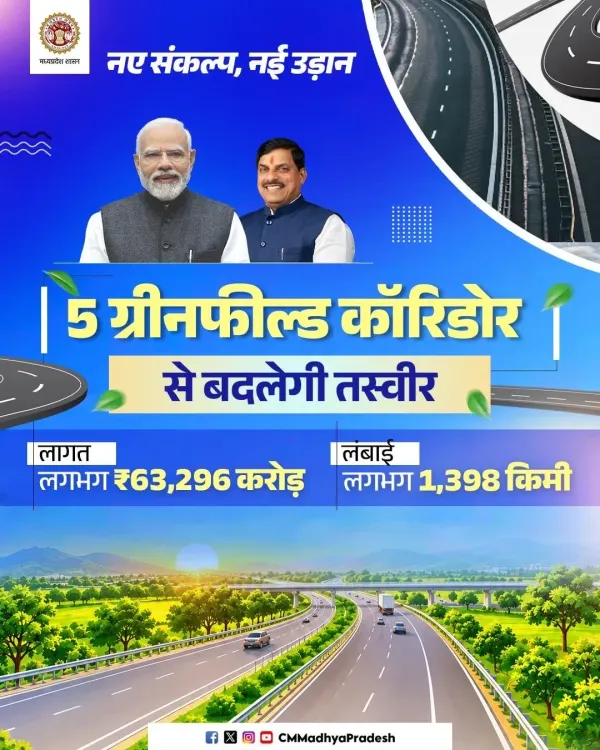
Madhya Pradesh's Chief Minister's Office has announced five greenfield road corridors covering 1,398 km at ₹63,296 crore, aimed at faster inter-city connectivity across the state's major urban centres under CM Dr. Mohan Yadav.
Key Takeaways
Five greenfield corridors totalling 1,398 km are planned across Madhya Pradesh.
Total estimated investment is ₹63,296 crore , averaging roughly ₹45 crore per kilometre.
Projects are aimed at improving movement between the state's major urban centres including Bhopal, Indore, Jabalpur, Gwalior, and Ujjain.
The announcement was made by the Chief Minister's Office and tagged to CM Dr.
Mohan Yadav and the Public Works Department .
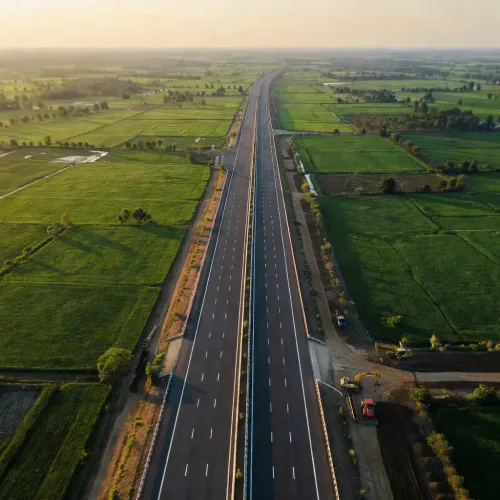
Greenfield alignment means new routes, enabling higher design speeds without disrupting existing traffic.
Key milestones to watch: route alignment finalisation, land acquisition, and tender awards for each corridor.
Five new greenfield highway corridors — stretching 1,398 kilometres and costing a combined ₹63,296 crore — are set to reshape how Madhya Pradesh moves. The Chief Minister's Office of Madhya Pradesh announced the mega road infrastructure push on Friday, 20 November 2026, signalling a decisive push to modernise connectivity across the state's major urban centres.
Five corridors, one ambitious blueprint
The announcement, shared from the official CMO handle and tagged to Chief Minister Dr. Mohan Yadav and the Public Works Department of Madhya Pradesh, describes the initiative as giving development in the state 'nayi raftaar' — new momentum — through modern connectivity. The five corridors are greenfield projects, meaning they will be built on fresh alignments rather than widened from existing roads, minimising disruption to current traffic while enabling high-speed design standards.
At an average project cost of roughly ₹45 crore per kilometre, the scale places this among the most significant state-level highway announcements in Madhya Pradesh's recent history. Greenfield corridors of this length typically involve multi-lane expressway specifications — elevated sections, controlled access, and integrated logistics nodes — that can dramatically cut inter-city travel times.
Connecting MP's urban spine
The corridors are aimed at easing movement between the state's principal cities. Madhya Pradesh's major urban centres — Bhopal, Indore, Jabalpur, Gwalior, and Ujjain — have historically been connected by a mix of national and state highways, many of which carry heavy freight and passenger traffic. Faster, dedicated expressway links would directly benefit urban commuters and the state's growing industrial and logistics sector.
The state has previously benefitted from the Centre's Bharatmala Pariyojana framework, which has funded national highway expansions across Madhya Pradesh including segments linking Bhopal, Indore, and Jabalpur. These five greenfield corridors appear to deepen that momentum at the state level, adding capacity on routes that national programmes may not fully cover.
What comes next: land, tenders, and timelines
Major greenfield road projects of this scale follow a well-worn path: detailed route alignment studies, environmental clearances, land acquisition — often the longest leg — and then tender awards to construction agencies. The pace of land acquisition and the sequencing of which corridors break ground first will determine how quickly commuters and freight operators feel the difference on the ground.
Across India, state governments have accelerated greenfield expressway announcements in recent years, recognising that road infrastructure remains one of the clearest drivers of regional economic activity. Madhya Pradesh, as a landlocked central state straddling major freight arteries between north, west, and south India, stands to gain outsized returns from faster inter-city connectivity.
Five corridors. Nearly fourteen hundred kilometres. Over sixty-three thousand crore rupees. The numbers are large — now the execution has to match them.
Point of View
Expressway-grade connectivity is as much an industrial policy lever as a transport one, since it can attract logistics and manufacturing investment away from more congested western and northern corridors. The alignment with Bharatmala's national highway expansion logic also ensures the state can credibly pitch for central co-funding or complementary investment. The harder test, as always in large greenfield projects across India, will be land acquisition speed — which will ultimately determine whether this announcement translates into ribbon-cutting ceremonies or a prolonged pipeline of pending projects.
NationPress
20 Nov 2026
Frequently Asked Questions
What is the total cost of the 5 greenfield corridors announced for Madhya Pradesh?
The total estimated cost is ₹63,296 crore for five greenfield highway corridors spanning 1,398 km across Madhya Pradesh.
How long are the new Madhya Pradesh greenfield highway corridors?
The five greenfield corridors together cover a total length of 1,398 kilometres .
Which cities in Madhya Pradesh will benefit from these new corridors?
The corridors are aimed at improving connectivity between Madhya Pradesh's major cities, including Bhopal, Indore, Jabalpur, Gwalior, and Ujjain .
What is a greenfield highway corridor?
A greenfield corridor is a road built on an entirely new alignment rather than upgrading an existing route, allowing for higher design speeds, controlled access, and modern expressway specifications.
What is the Bharatmala Pariyojana and how does it relate to MP roads?
Bharatmala Pariyojana is a central government national highway development programme launched from 2015 onwards. It has funded multiple highway expansions in Madhya Pradesh, and the state's greenfield corridors complement this broader national connectivity framework.