MP CM Office: 10.25 Lakh ANC Checkups Under PMSMA in 2025-26

Synopsis
The Chief Minister's Office of Madhya Pradesh reports over 10.25 lakh antenatal checkups completed in 2025-26 under the Pradhan Mantri Surakshit Matritva Abhiyan, framing the milestone as part of a twelve-year welfare and women's empowerment narrative under central-state coordination.
Key Takeaways
The Chief Minister's Office of Madhya Pradesh announced completion of over 10.25 lakh ANC checkups under PMSMA in 2025-26 .
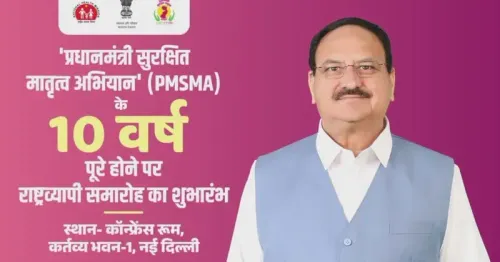
The Pradhan Mantri Surakshit Matritva Abhiyan was launched in June 2016 to provide assured antenatal care through government health facilities.
The announcement is tagged to the PMO, CM Dr.
Mohan Yadav , and the Ministry of Women and Child Development , reflecting joint central-state ownership.
PMSMA operates under the National Health Mission framework alongside Janani Suraksha Yojana and POSHAN Abhiyan .
The hashtags #12YearsOfGaribKalyan and #12YearsOfNariShakti place the milestone within a broader government welfare anniversary narrative.
Updated Madhya Pradesh MMR data and 2026-27 PMSMA budget targets are the key indicators to watch next.
The Chief Minister's Office of Madhya Pradesh announced on Friday, June 12, 2026, that the state has completed more than 10.25 lakh antenatal checkups (ANC) under the Pradhan Mantri Surakshit Matritva Abhiyan (PMSMA) during the financial year 2025-26, underscoring the state government's stated commitment to maternal and infant health.
Context
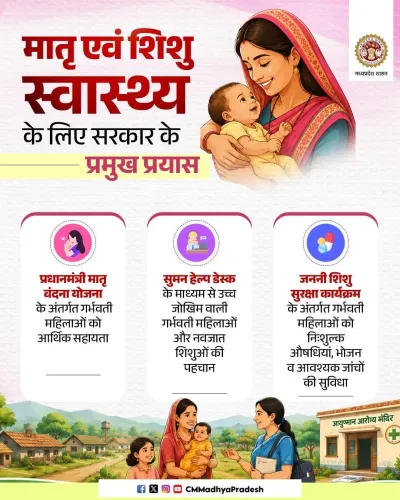
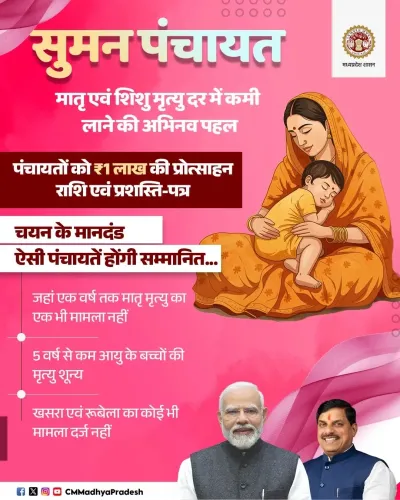
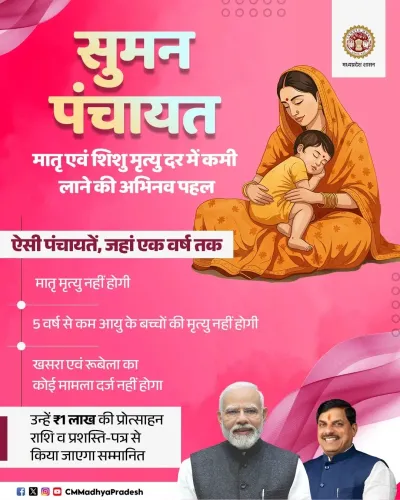
The official post, shared from the Chief Minister's Office of Madhya Pradesh, reads: 'Maa aur shishu ke behtar swasthya ka sankalp' ('A resolve for better health of mother and child'), citing the PMSMA as the vehicle for this progress. The announcement is tagged to Prime Minister's Office, Chief Minister Dr. Mohan Yadav, and the Ministry of Women and Child Development, signalling coordinated central-state ownership of the milestone.
The post also carries the hashtags #12YearsOfGaribKalyan, #12YearsOfSeva, and #12YearsOfNariShakti, situating the achievement within a broader government narrative marking twelve years of welfare and women's empowerment initiatives.
Policy Backdrop
The Pradhan Mantri Surakshit Matritva Abhiyan was launched by the central government in June 2016 under the Ministry of Health and Family Welfare. Its core mandate is to guarantee at least one quality antenatal examination by a qualified physician for every pregnant woman, targeting the ninth day of each month as a fixed service-delivery day at government health facilities.
PMSMA sits within the larger architecture of the National Health Mission (NHM), initiated in 2005 as the umbrella framework for reproductive and child health services. Complementary schemes such as Janani Suraksha Yojana (2005), which incentivises institutional deliveries, and POSHAN Abhiyan (2018), which addresses nutrition for pregnant women and children, together form the policy ecosystem within which ANC coverage targets are pursued.
India's push to expand ANC coverage is directly linked to Sustainable Development Goal 3 (SDG-3) — ensuring healthy lives and promoting well-being — with states expected to report periodic progress toward national maternal and infant mortality reduction targets.
Stakeholders and Impact
Madhya Pradesh, a large central Indian state, has historically faced challenges on maternal health indicators, making ANC coverage a priority metric. The reported figure of over 10.25 lakh checkups in a single financial year points to a significant volume of service delivery reaching pregnant women, particularly in rural and semi-urban areas where access to qualified physicians has traditionally been limited.
Frontline healthcare workers — including ASHA workers, ANMs (Auxiliary Nurse Midwives), and government hospital staff — are the primary implementers of PMSMA at the ground level. The scale of checkups reported reflects their mobilisation capacity across the state's vast geography. For mothers and infants, timely antenatal care can enable early detection of high-risk pregnancies, nutritional deficiencies, and complications that would otherwise go unaddressed.
Chief Minister Dr. Mohan Yadav, who has held office since December 2023, has aligned the state's health communication closely with central government welfare messaging, and this announcement continues that pattern of joint accountability framing.
What's Next
Attention will now turn to whether Madhya Pradesh releases updated state-level Maternal Mortality Ratio (MMR) data reflecting the impact of expanded ANC coverage, and whether the 2026-27 budget cycle brings enhanced allocations or revised targets under PMSMA. The broader question for health policymakers is whether increased checkup volumes translate into measurable improvements in institutional delivery rates and reductions in maternal and infant mortality — the ultimate metrics against which such programmes are judged.
Point of View
Tying state delivery performance to the central government's twelve-year welfare legacy ahead of what the hashtags signal as a broader political commemoration cycle. Reporting process outputs like checkup counts, rather than outcome indicators such as MMR or infant mortality rates, is a well-established pattern in Indian health governance: it allows administrations to demonstrate activity without being held to harder-to-shift mortality statistics. The scale of over 10.25 lakh checkups in a single year, if accurate, would represent a meaningful service-delivery footprint in a state with a large rural population, but the real test will be whether subsequent data shows improvements in high-risk pregnancy detection and institutional delivery rates. For analysts tracking SDG-3 progress, this announcement is best read as a signpost of intent and capacity rather than a verdict on outcomes.
NationPress
26 Oct 2026
Frequently Asked Questions
What is the Pradhan Mantri Surakshit Matritva Abhiyan?
The Pradhan Mantri Surakshit Matritva Abhiyan (PMSMA) is a central government scheme launched in June 2016 to provide every pregnant woman with at least one quality antenatal checkup by a qualified physician, delivered free of cost at government health facilities on the ninth of each month.
How many ANC checkups did Madhya Pradesh complete under PMSMA in 2025-26?
The Chief Minister's Office of Madhya Pradesh announced that over 10.25 lakh antenatal checkups were completed in the state under PMSMA during the financial year 2025-26.
Who is the Chief Minister of Madhya Pradesh?
Dr. Mohan Yadav has been the Chief Minister of Madhya Pradesh since December 2023.
How does PMSMA relate to India's maternal mortality goals?
PMSMA is part of India's National Health Mission and is designed to help the country meet Sustainable Development Goal 3 targets by expanding antenatal care coverage, enabling early detection of high-risk pregnancies, and ultimately reducing maternal and infant mortality ratios.
What other schemes support maternal health in Madhya Pradesh?
Alongside PMSMA, key schemes include Janani Suraksha Yojana, which incentivises institutional deliveries, and POSHAN Abhiyan, which addresses nutrition for pregnant women and children — all operating under the National Health Mission framework.