Nadda approves 320 PG medical seats for Himachal Pradesh
Synopsis
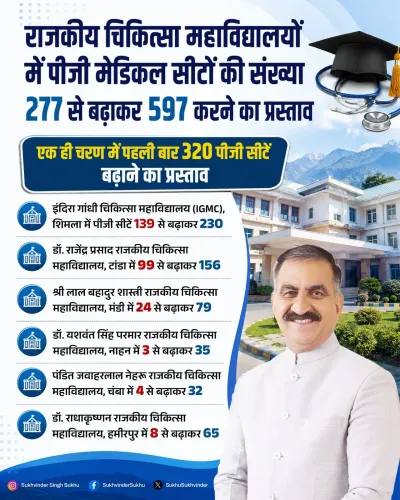
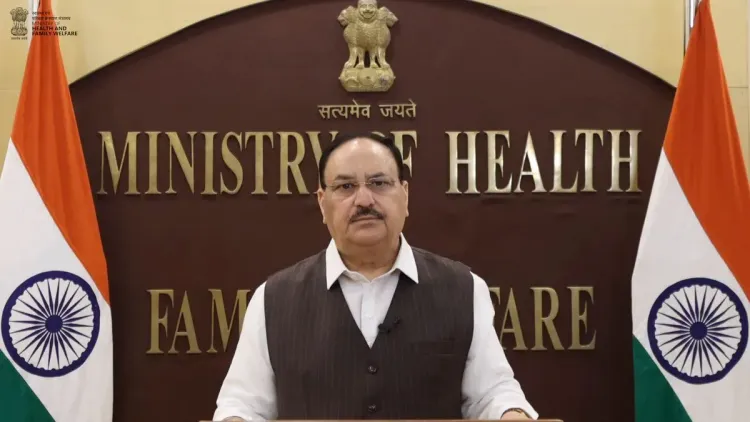
Union Health Minister J. P. Nadda has approved 320 new postgraduate medical seats across six Himachal Pradesh government medical colleges — in Shimla, Tanda, Hamirpur, Mandi, Nahan and Chamba — with the Centre committing roughly ₹415 crore. The clearance came within four months of the state's formal proposal.
Key Takeaways
320 new PG medical seats approved for Himachal Pradesh by the Union Health Ministry.
Six government medical colleges to benefit: Shimla, Tanda, Hamirpur, Mandi, Nahan and Chamba .
Central government to provide a grant of approximately ₹415 crore for the expansion.
The entire process — from state proposal ( 23 June ) to approval ( 24 October ) — completed in under four months .
A discussion between Union Minister Nadda and the Himachal Chief Minister was held at AIIMS Bilaspur on 6 October .
Nadda has publicly called on the Himachal Pradesh government to operationalise the seats at the same speed.
Four months. That is all it took from the moment Himachal Pradesh sent its proposal to the Centre to the moment Union Health Minister J. P. Nadda announced full approval of 320 new postgraduate medical seats across six government medical colleges in the state — a turnaround that underlines the pace at which the Centre is pushing its medical-education expansion agenda.
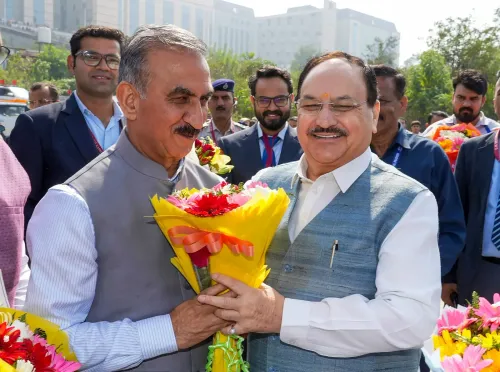
Posting on X on Saturday, 24 October 2026, Nadda outlined the sequence in precise terms: the state government submitted its proposal on 23 June, a discussion with the Chief Minister followed at AIIMS Bilaspur on 6 October, and all 320 seats have now been formally cleared. The Centre will back the expansion with a grant of approximately ₹415 crore.
Six colleges, one decisive push across Himachal
The new seats will be distributed across medical colleges in Shimla, Tanda, Hamirpur, Mandi, Nahan and Chamba — six towns that together anchor healthcare delivery across Himachal Pradesh's mountainous terrain. Nadda, writing in Hindi, said the move would give 'pradeś ke yuvaon ko medical kī uchch śikṣā ke adhik avsar' (more opportunities for higher medical education to the state's youth) and simultaneously strengthen specialist health services for the broader population.
The announcement arrives against the backdrop of a well-documented specialist shortage in hilly and geographically dispersed states, where the absence of local PG seats has historically meant that doctors trained outside the region rarely return to serve in it. Adding 320 PG seats to state colleges directly addresses that pipeline problem.
Where the ₹415 crore fits in India's PG seat drive
The approval draws on policy architecture that has been building for over a decade. The National Health Policy 2017 explicitly targeted an increase in postgraduate medical seats to tackle specialist deficits, while the Pradhan Mantri Swasthya Suraksha Yojana (PMSSY) — active since 2003 and significantly scaled up after 2014 — has funded both new AIIMS campuses and upgrades to existing state colleges. AIIMS Bilaspur, where the October meeting between Nadda and the Chief Minister took place, is itself a product of that central investment in Himachal's health infrastructure.
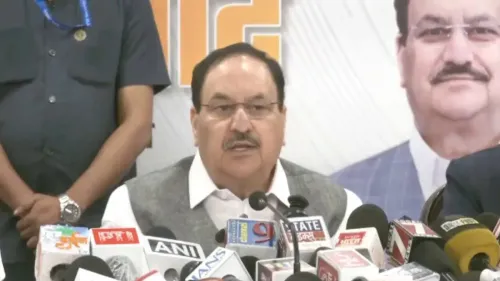
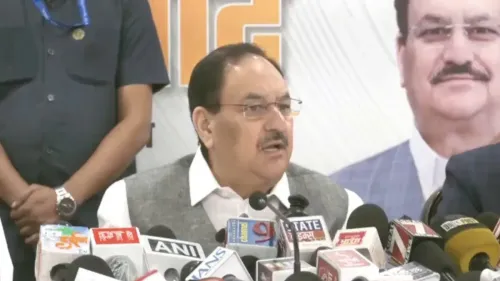
Nadda closed his post with a pointed nudge to the state government: 'mujhe ummīd hai ki rājya sarkār bhī isī gati se sabhī āvaśyak qadam uṭhāegī' — 'I hope the state government will also take all necessary steps at this same speed, so that young people and the general public can benefit at the earliest.' The message is clear: the Centre has done its part; the clock is now ticking for Himachal Pradesh to operationalise faculty, infrastructure and admissions.
What operationalisation actually demands
Seat approval is the start, not the finish line. Each college must now recruit qualified faculty, clear Medical Advisory Committee inspections, and ready hostel and laboratory infrastructure before a single PG student can enrol. In states with thin faculty pipelines — and Himachal is one — that process has historically caused multi-year delays. The political pressure Nadda is applying publicly may accelerate the timeline, but the hard administrative work lies ahead.
If the state matches the Centre's pace, Himachal Pradesh stands to add a cohort of specialist doctors trained within its own borders — doctors statistically more likely to serve in the hills they grew up in. That compound effect, multiplied across future batches, is the real prize behind this approval.
Point of View
Nadda converts an administrative decision into a legible electoral deliverable for Himachal Pradesh. The public nudge to the state government — currently led by the Congress — to 'match the pace' subtly frames any future delay in seat operationalisation as a state-level failure rather than a central one. More broadly, the move is consistent with a multi-year Centre strategy of using PG seat additions in geographically disadvantaged states to address specialist shortages that national-level data have made politically embarrassing.
NationPress
24 Oct 2026
Frequently Asked Questions
How many new PG medical seats have been approved for Himachal Pradesh?
320 new postgraduate medical seats have been approved by the central government across six government medical colleges in Himachal Pradesh.
Which medical colleges in Himachal Pradesh will get the new PG seats?
The six government medical colleges are located in Shimla, Tanda (Kangra), Hamirpur, Mandi, Nahan and Chamba .
How much money is the Centre giving for these PG medical seats?
The central government will provide a grant of approximately ₹415 crore to fund the expansion of postgraduate medical seats in Himachal Pradesh.
How quickly did the Centre approve Himachal Pradesh's medical seat proposal?
The state submitted its proposal on 23 June 2026 and approval was granted on 24 October 2026 — a turnaround of under four months .
Why are more PG medical seats important for Himachal Pradesh?
Hilly and geographically dispersed states like Himachal Pradesh face chronic specialist-doctor shortages. Expanding local PG seats trains doctors within the state, making them more likely to serve in the region after graduating.