Nadda Backs Cabinet Nod for ₹23,731 Cr GOBAR-DHAN Scheme
Synopsis
The Union Cabinet approved the ₹23,731 crore GOBAR-DHAN scheme to boost Compressed Biogas production from organic waste. Union Health Minister J. P. Nadda called it a historic step for clean energy, rural livelihoods, and India's green growth agenda under PM Modi.
Key Takeaways
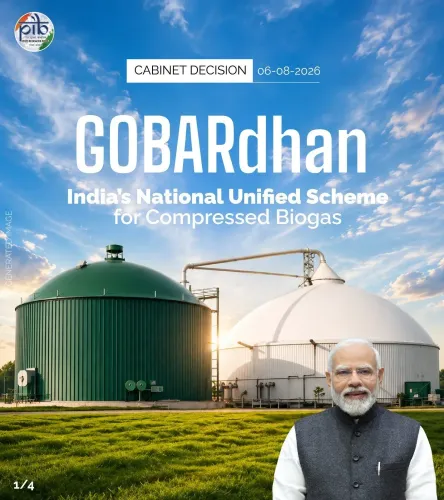
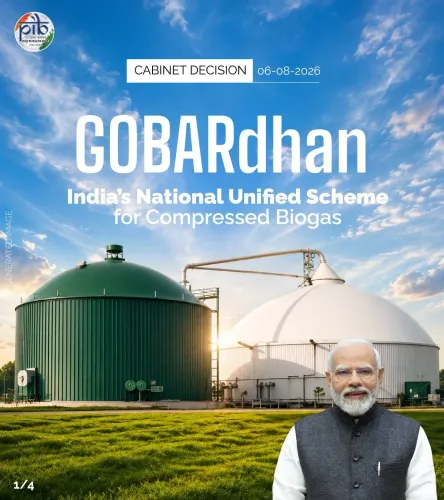
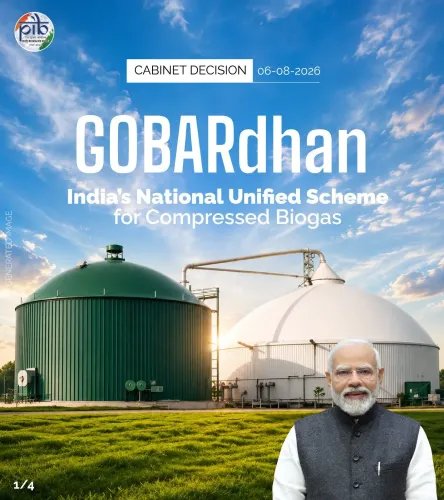
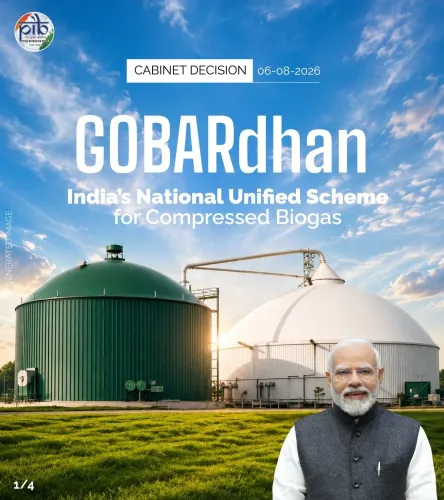
The Union Cabinet approved the National Circular Bio-Economy Scheme 'GOBAR-DHAN' on August 6, 2026 .
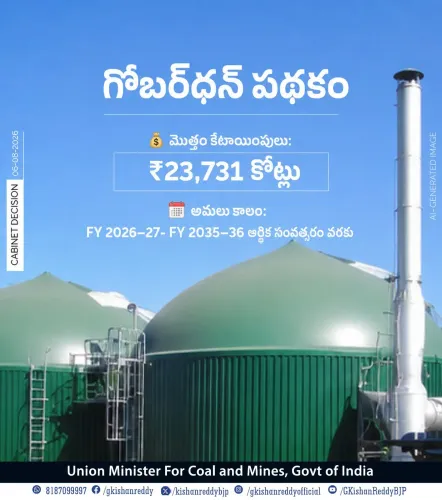
The scheme carries a financial outlay of ₹23,731 crore to scale up Compressed Biogas (CBG) production.
Key support mechanisms include assured offtake, price protection, capital grants, credit guarantees, and CBG infrastructure expansion.
GOBAR-DHAN was originally launched in April 2018 under the Swachh Bharat Mission; this Cabinet decision marks a major expansion in scale and funding.
The scheme targets farmers and rural entrepreneurs as primary beneficiaries, linking organic waste management to energy security and rural income.
Organic manure produced as a byproduct of CBG processing offers an additional income stream and a potential substitute for chemical fertilisers.
India's rural waste just got a serious upgrade. Union Health Minister J. P. Nadda on Thursday, August 6, 2026 welcomed the Union Cabinet's approval of the National Circular Bio-Economy Scheme 'GOBAR-DHAN', calling it a historic step toward clean energy, self-reliance, and green growth under Prime Minister Narendra Modi.
What the Cabinet Approved — and Why It Matters
The scheme, backed by an outlay of ₹23,731 crore, is designed to scale up production of Compressed Biogas (CBG) — a clean fuel derived from cattle dung, agricultural residue, and organic waste that can directly substitute natural gas in transport and industry. Nadda described the decision as 'ऐतिहासिक निर्णय' — a historic decision — that would strengthen energy self-sufficiency while putting rural waste to productive use.
The scheme bundles several financial instruments under one roof: assured offtake agreements, price protection, capital grants, credit guarantees, and targeted CBG infrastructure expansion. Together, these are meant to de-risk private investment and accelerate innovation in a sector that has long struggled to attract sustained capital.
GOBAR-DHAN's Journey From 2018 to a ₹23,731 Crore Mandate
The GOBAR-DHAN scheme — an acronym for Galvanizing Organic Bio-Agro Resources Dhan — was first launched in April 2018 under the Swachh Bharat Mission, initially focused on creating income streams for farmers from cattle dung and crop residue. The latest Cabinet decision marks a substantial escalation in ambition and financial muscle, repositioning the scheme as a pillar of India's broader circular bio-economy strategy.
India has simultaneously pursued solar, wind, and green hydrogen targets, but bio-energy has remained the missing link in the rural energy transition. CBG plants fed by local organic waste could reduce India's dependence on imported fossil fuels while generating livelihoods at the village level — a dual dividend that makes the scheme politically and economically compelling.
New Opportunities for Farmers and Rural Entrepreneurs
Nadda specifically highlighted the scheme's role in creating 'new opportunities for farmers and rural entrepreneurs' — a signal that the government intends GOBAR-DHAN to function as an income programme, not merely an environmental one. Assured purchase commitments and price protection mechanisms are designed to give smallholder farmers and local biogas operators the revenue certainty needed to invest in infrastructure.
The integration of organic manure production alongside CBG output adds another income layer: the slurry left after biogas extraction is nutrient-rich fertiliser, potentially reducing farmers' dependence on chemical inputs and cutting input costs.
India's Green Growth Bet — Watching the Rollout
The real test arrives in the coming fiscal year, when capital grant disbursements, offtake agreements, and new CBG plant approvals begin to move from Cabinet file to ground reality. India's bio-energy ambitions have historically outpaced implementation; the scheme's layered financial architecture is a direct attempt to close that gap.
If the rollout delivers, GOBAR-DHAN could become the template for how India turns its vast agricultural waste stream into an energy and livelihood asset — village by village, biogas plant by biogas plant.
Point of View
The government is attempting to solve the investment-risk problem that has stalled previous biogas initiatives. For the BJP, the scheme also serves a political purpose — it ties the Swachh Bharat legacy to Atmanirbhar Bharat and green growth, giving the party a unified rural-development-meets-environment message ahead of state electoral cycles. The real measure of success will be whether implementation machinery can match the financial architecture the Cabinet has now put in place.
NationPress
6 Aug 2026
Frequently Asked Questions
What is the GOBAR-DHAN scheme?
GOBAR-DHAN stands for Galvanizing Organic Bio-Agro Resources Dhan. It is a central government scheme that promotes conversion of cattle dung, agricultural residue, and organic waste into Compressed Biogas (CBG) and organic manure, creating clean energy and income opportunities for farmers and rural entrepreneurs. It was first launched in April 2018 under the Swachh Bharat Mission.
How much money has the Cabinet approved for GOBAR-DHAN in 2026?
The Union Cabinet approved an outlay of ₹23,731 crore for the National Circular Bio-Economy Scheme 'GOBAR-DHAN' on August 6, 2026, according to Union Health Minister J. P. Nadda's post on X.
What is Compressed Biogas (CBG) and how is it different from regular biogas?
Compressed Biogas (CBG) is biogas — produced from organic waste through anaerobic digestion — that has been purified and compressed to a quality comparable to Compressed Natural Gas (CNG). It can be used as a clean fuel in vehicles and industrial applications, directly substituting fossil-based natural gas.
How will GOBAR-DHAN benefit farmers?
The scheme offers farmers assured purchase agreements and price protection for CBG, capital grants and credit guarantees to set up biogas plants, and organic manure as a byproduct that can replace chemical fertilisers — creating both an energy income stream and lower input costs.
What is the broader significance of GOBAR-DHAN for India's energy goals?
GOBAR-DHAN is part of India's multi-pronged clean energy strategy alongside solar, wind, and green hydrogen. By turning rural organic waste into a domestic fuel source, it directly reduces dependence on imported fossil fuels, advances the circular economy, and links rural waste management to national energy security.