Nadda Inaugurates Arogya Manthan 2026, Marks 8 Years of PM-JAY

Synopsis
Union Health Minister J. P. Nadda inaugurated Arogya Manthan 2026, marking 8 years of PM-JAY and 5 years of ABDM. He launched five digital health tools including an auto-adjudication claims framework and a secure data environment, citing 60 crore+ PM-JAY beneficiaries and 97.8 crore+ ABHA IDs created.
Key Takeaways
Arogya Manthan 2026 marked the 8th anniversary of Ayushman Bharat PM-JAY and the 5th anniversary of ABDM , inaugurated by Union Health Minister J.
Nadda on September 25, 2026 .
Five new digital tools were launched: the NHPR Mobile App , NHCX Implementation Guide for Payers , Model Digital Health Facility Guidebook , Secure Data Environment , and an Auto-Adjudication Framework for PM-JAY claims.
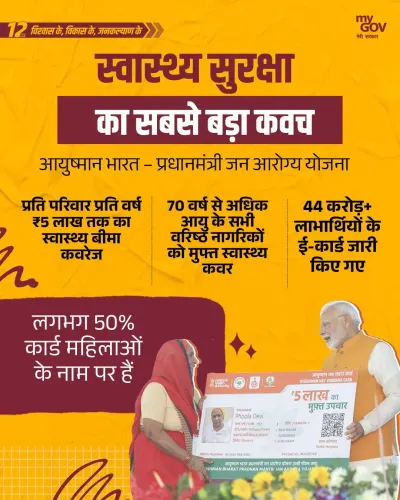
AB PM-JAY now covers 60 crore+ beneficiaries with up to Rs 5 lakh annual cashless hospitalisation coverage for economically vulnerable families.
97.8 crore+ ABHA IDs have been created under the Ayushman Bharat Digital Mission, forming the backbone of India's interoperable health-data ecosystem.
The Auto-Adjudication Framework targets a long-standing pressure point — manual claims delays — which deter empanelled hospitals, especially in smaller towns, from treating beneficiaries without upfront payment.
State-level adoption of the NHCX standard and the new mobile registry app will be the key variable determining real-world impact of today's launches.
Eight years after Ayushman Bharat PM-JAY changed the calculus of healthcare access for India's poorest families, Union Health Minister J. P. Nadda used the Arogya Manthan 2026 event on Friday, September 25 to unveil a clutch of digital tools designed to take the scheme's next leap — from coverage to connected, interoperable care.
Five launches in one day: what hit the stage at Arogya Manthan
The inauguration was far more than a milestone ceremony. Nadda launched five concrete deliverables in a single sitting: the National Healthcare Providers Registry (NHPR) Mobile App, the NHCX Implementation Guide for Payers, a Model Digital Health Facility Guidebook, a Secure Data Environment, and an Auto-Adjudication Framework for AB PM-JAY claims. Each tool targets a specific friction point in the health-delivery chain — from streamlining insurer-to-hospital claims settlement to giving patients and providers a portable, machine-readable health identity.
The Auto-Adjudication Framework is particularly consequential. Manual claims processing has long been a pressure point for hospitals empanelled under PM-JAY, creating delays that deter providers and slow reimbursements. Automating that pipeline could directly affect how quickly facilities — especially in smaller towns — agree to treat beneficiaries without demanding upfront payment.
The numbers that frame the moment: 60 crore+ and 97.8 crore+
Nadda cited more than 60 crore beneficiaries under AB PM-JAY and over 97.8 crore Ayushman Bharat Health Account (ABHA) IDs created under the Ayushman Bharat Digital Mission (ABDM) — numbers that, if realised at scale, would make this among the world's largest government-backed health-data ecosystems. The ABDM, formally launched in September 2021, turns five this year; PM-JAY, which began in September 2018, turns eight.
The dual anniversary gave Arogya Manthan an unusual occasion to measure two parallel tracks: insurance coverage and digital infrastructure. The government's argument, implicit in today's launches, is that neither track is complete without the other — coverage without interoperability means fragmented records; digital IDs without coverage mean data without protection.
From insurance card to digital health ecosystem
When Prime Minister Narendra Modi launched Ayushman Bharat in 2018, the ambition was cashless hospitalisation for over 10 crore economically vulnerable families — up to Rs 5 lakh per family per year for secondary and tertiary care. The National Digital Health Mission, later rebranded as ABDM, added the infrastructure layer: unique health IDs, facility registries, and personal health records designed to move with a patient across states and providers.
Today's Secure Data Environment and NHCX Implementation Guide push that architecture further — toward a framework where health data can be used for research and innovation under defined safety rails, and where insurers, public or private, plug into a common claims exchange standard. The broader policy thrust has been consistent: reduce leakage, enable portability, and draw the private sector into a national standards framework rather than leaving it outside the ecosystem.
What to watch as these tools roll out
The real test will be state-level adoption. India's health delivery is constitutionally a state subject, and the pace at which state governments and empanelled hospitals integrate the NHCX standard and the Auto-Adjudication Framework will determine whether today's launches translate into shorter claim cycles and better patient experience on the ground. The NHPR Mobile App, aimed at healthcare providers, is another adoption variable — its uptake among smaller clinics and district hospitals will signal how far the registry's reach actually extends.
Nadda framed the journey ahead in terms of accessibility, efficiency, and patient-centricity — a triangulation that puts the end-user, not the bureaucratic architecture, at the centre of the pitch. Whether the digital scaffold can deliver on that promise at Bharat's scale is the question the next phase of Arogya Manthan will have to answer.
Point of View
Data-enabled entitlement. The Auto-Adjudication Framework is arguably the most operationally significant piece: if it meaningfully shortens reimbursement cycles, it could improve provider participation rates, which has been a quiet but persistent challenge for PM-JAY's real-world reach. The Secure Data Environment and NHCX standard signal an ambition to open health data for research and private-sector innovation within a national regulatory frame — a move that aligns with India's broader push to monetise public data assets responsibly. Whether the political momentum of dual anniversaries converts into ground-level adoption across states, however, remains the central execution question.
NationPress
25 Sept 2026
Frequently Asked Questions
What is Arogya Manthan 2026?
Arogya Manthan 2026 is the annual review event organised by the National Health Authority to assess progress under Ayushman Bharat schemes. This year it marked 8 years of PM-JAY and 5 years of the Ayushman Bharat Digital Mission, and was inaugurated by Union Health Minister J. P. Nadda on September 25, 2026.
What is the Auto-Adjudication Framework for PM-JAY?
The Auto-Adjudication Framework is a newly launched digital system designed to automate the processing of health insurance claims under AB PM-JAY, reducing manual delays in reimbursement to empanelled hospitals and making cashless treatment more reliable for beneficiaries.
How many beneficiaries does Ayushman Bharat PM-JAY cover?
According to statements at Arogya Manthan 2026, AB PM-JAY covers more than 60 crore beneficiaries, providing up to Rs 5 lakh per family per year in cashless hospitalisation coverage for secondary and tertiary care.
What is an ABHA ID and how many have been created?
An ABHA (Ayushman Bharat Health Account) ID is a unique digital health identifier created under the Ayushman Bharat Digital Mission (ABDM) that allows patients to store and share health records across providers. More than 97.8 crore ABHAs have been created as of Arogya Manthan 2026.
What is the NHCX Implementation Guide for Payers?
The NHCX (National Health Claims Exchange) Implementation Guide for Payers is a newly released technical standard that enables insurance payers — public and private — to connect to a common health claims exchange, improving interoperability and reducing fragmentation in claims settlement.