Nadda Hails BJP's 12 Years of Repeated Public Mandates
Synopsis
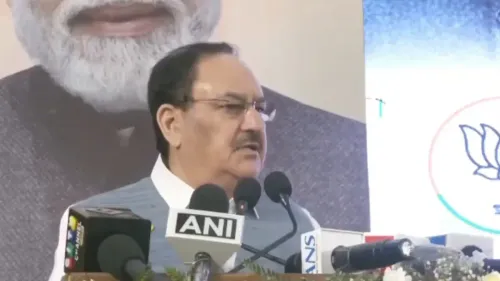
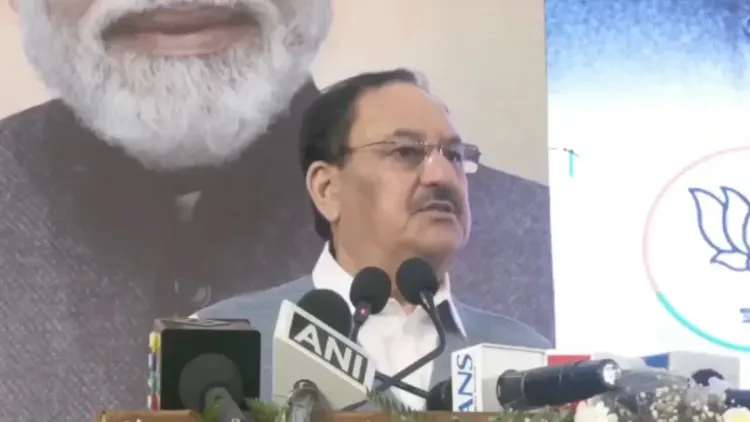
Union Health Minister and BJP President J. P. Nadda on June 12, 2026, celebrated the party's 12-year rule at the Centre, calling the repeated public mandates for PM Narendra Modi a historic record and the defining 'capital' of BJP's governance journey.
Key Takeaways
Nadda , Union Health Minister and BJP National President, posted on June 12, 2026 , marking the party's 12-year tenure at the Centre.
He described the repeated electoral victories and public mandates for PM Narendra Modi as a record in Indian political history.
The post used the phrase 'ek baar nahin, barambar' — 'not once, but repeatedly' — to stress the significance of successive mandates.
The messaging was part of the #12YearsOfSeva campaign, accompanied by a video, indicating a coordinated party communication effort.
The BJP first won a majority at the Centre in the 2014 Lok Sabha elections and was re-elected with a larger majority in 2019 .
Nadda frames repeated voter endorsements as the party's core political 'capital' heading into future electoral cycles.
Union Health Minister and BJP National President J. P. Nadda on Friday, June 12, 2026, marked the Bharatiya Janata Party's 12-year tenure at the Centre, calling the party's repeated electoral victories a record in themselves and a testament to the public's continuing trust in Prime Minister Narendra Modi.
Context
Posting under the hashtag #12YearsOfSeva (12 Years of Service), Nadda wrote in Hindi that when discussing these 12 years, the electoral victories the party has achieved — and the blessings the people of India have repeatedly bestowed upon the BJP and Prime Minister Modi — are themselves a record and the 'capital' of the party's 12-year journey. The phrase 'ek baar nahin, barambar' (not once, but repeatedly) underscores the emphasis on successive mandates rather than a single electoral win.
The post was accompanied by a video, signalling it was part of a coordinated party communication marking the anniversary of the BJP-led government's formation in 2014.
Policy Backdrop
The Bharatiya Janata Party first came to power at the Centre after the 2014 Lok Sabha elections, when it secured an outright majority — the first time any single party had done so in three decades. The party was returned to power again in the 2019 general elections with an even larger majority, consolidating its position as the dominant force in national politics.
Nadda, who holds the dual charge of the Ministry of Health and Family Welfare and the Ministry of Chemicals and Fertilizers, has been the party's national president through a significant stretch of this period. His framing of repeated public mandates as the party's 'capital' aligns with the BJP's long-standing communications strategy of linking governance continuity to voter endorsement.
Stakeholders and Impact
The message is aimed squarely at BJP workers and the broader voter base, reinforcing a narrative of organisational achievement and popular legitimacy. By invoking Prime Minister Modi by name and handle, Nadda ties the party's electoral record directly to the leader's personal connect with voters.
For opposition parties, the BJP's framing of 12 uninterrupted years at the Centre as a 'record' sets the terms of political debate heading into future electoral cycles. The emphasis on 'blessings of the people of India' positions the party's tenure as a democratic validation rather than merely an administrative milestone.
What's Next
The #12YearsOfSeva campaign is expected to run across BJP's digital and organisational platforms, with senior leaders amplifying the messaging. Analysts will watch whether the party uses this anniversary to announce fresh policy initiatives under Nadda's health and fertilizer portfolios, or whether the communication remains primarily electoral in tone.
State assembly elections scheduled in the coming months will be the next test of whether the goodwill the party attributes to its 12-year record translates into fresh mandates at the sub-national level.
Frequently Asked Questions
What is the BJP's #12YearsOfSeva campaign about?
The #12YearsOfSeva campaign marks the Bharatiya Janata Party's 12 years in power at the Centre since winning the 2014 Lok Sabha elections . Senior leaders including J. P. Nadda have used the hashtag to highlight the party's electoral record and governance milestones.
What did JP Nadda say about BJP's 12 years in power?
J. P. Nadda said that the repeated electoral victories and the blessings the people of India have given to the BJP and PM Narendra Modi — not once but again and again — are themselves a record and the defining 'capital' of the party's 12-year journey.
When did BJP first come to power at the Centre under Narendra Modi?
The BJP first formed the government at the Centre after the 2014 Lok Sabha elections , when it secured an outright majority. It was re-elected with an even larger majority in the 2019 general elections .
What portfolios does JP Nadda currently hold?
J. P. Nadda is currently the Union Minister of Health and Family Welfare and the Minister of Chemicals and Fertilizers . He also serves as the National President of the Bharatiya Janata Party .
Why does BJP call its repeated election wins a record?
The BJP frames its successive national mandates — winning outright majorities in both 2014 and 2019 — as historically significant because no single party had secured such consecutive majorities at the Centre for several decades before 2014 .