Nadda Hails EC's Door-to-Door Voter Drive
Synopsis
BJP national president J. P. Nadda praised the Election Commission's BLO system and its treks into Gir's forests and Arunachal's mountains, arguing that in Indian democracy every single vote carries equal weight.
Key Takeaways
Union Health Minister and BJP president J.
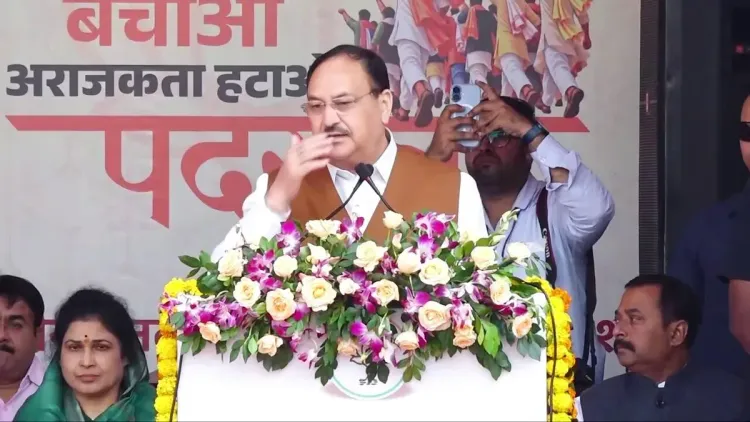
Nadda posted on X on 4 November 2026 praising India's Election Commission.
He highlighted the Booth Level Officer (BLO) system, under which government officials visit homes to register voters rather than requiring citizens to visit offices.
Nadda cited an EC team trekking 10 kilometres through Gir forest and climbing mountains in Arunachal Pradesh to reach isolated voters as evidence of the Commission's commitment.
He stated that in Indian democracy, one vote is as important as crores of votes , underscoring the principle of universal suffrage.
The post was tagged #SaveDemocracyRemoveAnarchy , situating the tribute within a broader political argument against unnamed opponents.
Ten kilometres through the forests of Gir for a single vote. Climbing mountain ridges in Arunachal Pradesh to reach a handful of voters. These are not extraordinary exceptions — they are the deliberate, daily practice of India's Election Commission, and on Wednesday, 4 November 2026, Union Health Minister and BJP national president J. P. Nadda held them up as the defining proof of Indian democracy's strength.
Posting on X, Nadda wrote: 'भारत में लोकतंत्र की ताकत यही है कि यहां वोटर को वोट बनवाने के लिए इलेक्शन ऑफिस नहीं जाना पड़ता, बल्कि BLO घर-घर पहुंचता है।' — 'The strength of democracy in India is that the voter does not have to go to the election office to register; the Booth Level Officer comes to every home.' He invoked the Gir jungle and Arunachal's peaks as vivid evidence, closing with the declaration: 'In our democracy, one vote matters as much as crores of votes.'The BLO System: Democracy's Last-Mile Machinery
The Booth Level Officer (BLO) is the Election Commission's frontline foot-soldier — a government employee assigned to a specific polling booth who is responsible for maintaining accurate electoral rolls, verifying new registrations, and physically visiting households to ensure no eligible voter is left off the list. It is a system built on the principle that the administrative burden must rest with the state, not the citizen.
Nadda's examples — the Gir Wildlife Sanctuary in Gujarat, one of India's most restricted forest zones, and the high-altitude tribal belts of Arunachal Pradesh — are precisely the kind of geographically extreme cases that test whether that principle holds. The fact that EC teams have trekked into both underlines that voter enfranchisement is treated as a logistical challenge to be solved, not a threshold citizens must clear on their own.
'One Vote as Valuable as Crores': The Philosophical Stake
The post carries a pointed political hashtag — #SaveDemocracyRemoveAnarchy — signalling that the tribute to the Election Commission is also a jab at unnamed opponents. By framing the EC's reach as evidence that Indian democracy is functional and robust, Nadda implicitly pushes back against narratives that question the integrity or inclusiveness of the country's electoral machinery.
The rhetorical architecture is deliberate: a concrete operational detail (BLO at your doorstep), a cinematic extreme-case image (a team scaling Arunachal ridges), and then a sweeping democratic principle — one vote equals millions. It is a message aimed as much at the political gallery as at voters themselves.
India's voter rolls are among the largest on earth — well over 900 million registered electors — making the BLO network's door-to-door mandate a genuinely staggering administrative undertaking. That scale makes Nadda's point sharper: the machinery exists, it moves, and it reaches even where roads do not.
Point of View
Championing the EC's grassroots reach also reinforces a broader governance narrative — that state machinery works and reaches the last citizen. The choice of Gir and Arunachal as examples is strategically vivid: they are unimpeachably remote, visually dramatic, and difficult to dismiss.
NationPress
4 Nov 2026
Frequently Asked Questions
What is a Booth Level Officer (BLO) in India?
A Booth Level Officer is a government official assigned by the Election Commission to a specific polling booth. The BLO visits households in the booth's area to verify and update electoral rolls, ensuring eligible voters are registered without requiring them to visit an election office.
What did J. P. Nadda say about the Election Commission?
On 4 November 2026, Nadda praised the Election Commission for its BLO home-visit system and cited examples of EC teams trekking 10 kilometres through Gir forest and climbing mountains in Arunachal Pradesh to reach isolated voters, calling this the strength of Indian democracy.
Why did the Election Commission team trek through Gir forest?
According to Nadda's post, an Election Commission team travelled 10 kilometres through the Gir Wildlife Sanctuary in Gujarat to reach a voter, demonstrating the Commission's commitment to ensuring every eligible citizen can be registered regardless of geographic barriers.
What does #SaveDemocracyRemoveAnarchy mean in Nadda's post?
The hashtag is a political slogan used by BJP leaders to argue that Indian democracy is functioning robustly and to push back against opposition parties they accuse of undermining democratic institutions.
How large is India's voter roll?
India's registered electorate is among the largest in the world, with well over 900 million registered voters, making the Election Commission's door-to-door BLO outreach a massive administrative undertaking.