Nagaland Assembly Assigns ‘Vande Mataram’ Controversy to Select Committee

Synopsis
The Nagaland Assembly has taken a significant step by referring the contentious issue of singing ‘Vande Mataram’ to a Select Committee, addressing various legislators' concerns about its implications in a predominantly Christian state.
Key Takeaways
Nagaland Assembly is addressing the 'Vande Mataram' issue through a Select Committee.
Concerns raised include religious sensitivities in a predominantly Christian state.
Historical context of 'Vande Mataram' was highlighted by legislators.
Article 371A offers protections for religious practices.
Patriotism is emphasized as respect for constitutional values.
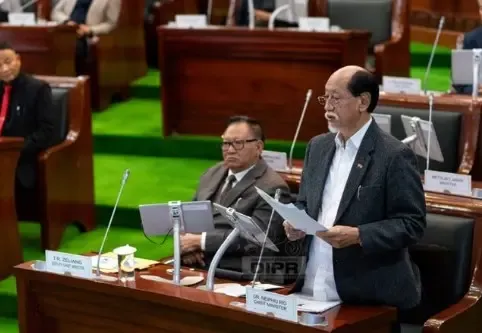
Kohima, March 3 (NationPress) The Nagaland Assembly convened on Tuesday and resolved to send the matter regarding the performance of the national song “Vande Mataram” in the assembly to a Select Committee for thorough scrutiny, in light of objections voiced by various lawmakers.
Speaker Sharingain Longkumer declared this decision after representatives, including those from the Naga People's Front (NPF), expressed significant concerns about the instruction to play or sing “Vande Mataram” prior to the national anthem during discussions related to the motion of thanks for the Governor's address.
The Ministry of Home Affairs (MHA), in a directive issued on January 28, stated that the official version encompassing all six stanzas of “Vande Mataram” should be sung at official events.
It also clarified that when both the national song and the national anthem are performed concurrently, “Vande Mataram” will precede “Jana Gana Mana”.
Earlier in the proceedings, Chief Minister Neiphiu Rio acknowledged that the views shared by legislators had been duly recorded and respected. He recognized the historical importance of the national song but stressed that the nation's strength lies in its diversity, secular principles, and commitment to constitutional values.
Rio suggested that the issue be referred to a Select Committee of the House for in-depth investigation, including legal consultations, before reaching a well-informed conclusion.
MLA Tseilhoutuo Rhutso voiced his opposition to the proposal of singing “Vande Mataram” as a prelude to the national anthem, citing concerns regarding religious sensitivities in a predominantly Christian state. While expressing respect for Prime Minister Narendra Modi and the concept of inclusive governance, he argued that patriotism must be constitutional and inclusive.
He highlighted that India's strength is rooted in its secular framework and asserted that Nagaland's patriotism is demonstrated through its reverence for the Tricolour and the national anthem, “Jana Gana Mana”.
Rhutso noted that only the first two stanzas of “Vande Mataram”, penned by Bankim Chandra Chatterjee in his novel Anandamath, were designated as the National Song in 1950.
He also referenced a Supreme Court observation from 1986 indicating that singing “Vande Mataram” is not mandatory, and that enforcing it could violate the freedom of religion as per Article 25(1) of the Constitution.
Considering the context of Nagaland, he pointed out that Article 371A guarantees constitutional protections for religious and customary practices, asserting that any directive must honor the state's unique identity.
Rhutso maintained that opting not to sing the song does not diminish the Constitution or the sovereignty and integrity of India, asserting that true patriotism is exhibited through loyalty, service, and respect for constitutional values.
He urged the government to reassess the directive in consultation with the House to ensure that national unity is inclusive and honors individual conscience.
MLA Ar. Jwenga also contributed to the discussion, raising concerns regarding the mandatory singing of “Vande Mataram” following the MHA announcement.
While recognizing the song's historical significance, he mentioned that making it obligatory in Nagaland could evoke constitutional and religious dilemmas in a predominantly Christian region.
Point of View
The decision to refer the matter to a Select Committee highlights the delicate balance between national identity and regional religious sentiments. It underscores the importance of inclusive governance while respecting the unique cultural fabric of the state.
NationPress
21 Oct 2026
Frequently Asked Questions
Why did the Nagaland Assembly refer 'Vande Mataram' to a committee?
The Assembly referred the issue to a Select Committee for thorough examination due to objections raised by several legislators regarding its implications in a predominantly Christian state.
What is the historical significance of 'Vande Mataram'?
'Vande Mataram' was adopted as the National Song in 1950, with only the first two stanzas being officially recognized from Bankim Chandra Chatterjee's novel Anandamath.
What concerns were raised about singing 'Vande Mataram'?
Legislators expressed concerns about potential religious sensitivities and the constitutional implications of making the song mandatory in Nagaland.
What does Article 371A state?
Article 371A provides constitutional safeguards for the religious and customary practices of the Nagaland populace, ensuring respect for their unique identity.
Is singing 'Vande Mataram' compulsory?
Singing 'Vande Mataram' is not compulsory, as per a Supreme Court observation stating that enforcing it could infringe upon freedom of religion.