Modi completes 25 years in office: Naidu calls it 'remarkable' leadership
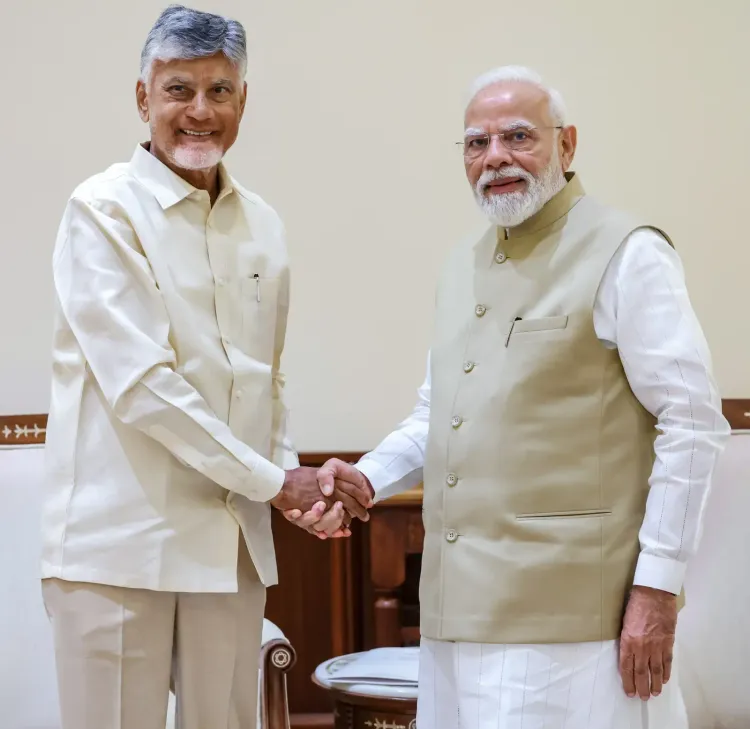
Synopsis
On the day Prime Minister Narendra Modi completes 25 uninterrupted years in executive office, coalition ally Chandrababu Naidu published a sweeping tribute in The Hindu — citing highway expansion, 24.8 crore lifted from poverty, and 296 GW of renewable capacity as evidence of a leadership that has, in his words, shifted India 'from incrementalism to ambition.'
Key Takeaways
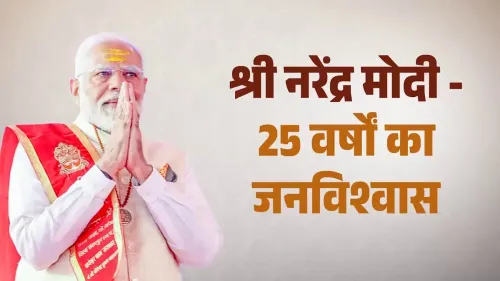
PM Narendra Modi completes 25 uninterrupted years in executive office on 7 October 2026 — first as Gujarat CM from 2001, then as Prime Minister since 2014.
Andhra Pradesh CM N.
Chandrababu Naidu published a tribute in The Hindu , calling the journey 'remarkable' and crediting it to trust, integrity and execution.
National Highway network cited as growing from 91,287 km in 2014 to over 1,46,000 km ; airports from 74 to over 160 .
An estimated 24.8 crore Indians reportedly moved out of multidimensional poverty between 2013-14 and 2022-23 ; tapwater rural coverage rose from 17% to over 82% .
Naidu highlighted the semiconductor mission, quantum mission, PLI schemes, and Digital Public Infrastructure as pillars of a technology-led governance model.
Naidu framed the milestone as a springboard toward Viksit Bharat 2047 , saying the next 20 years can 'establish India's place in history.'
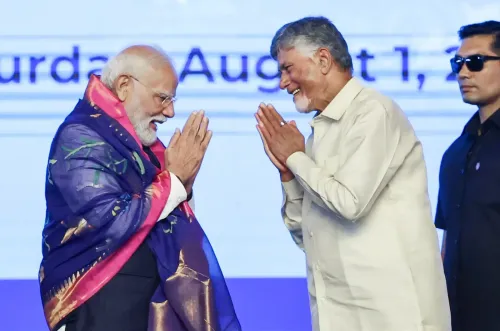
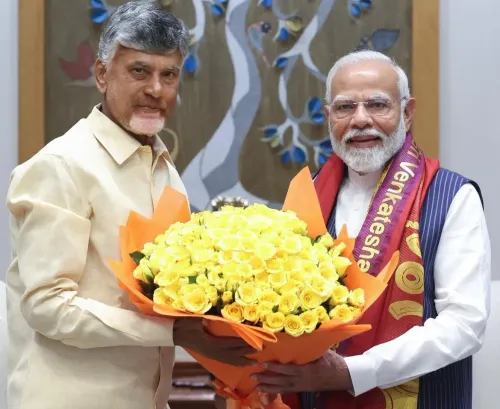
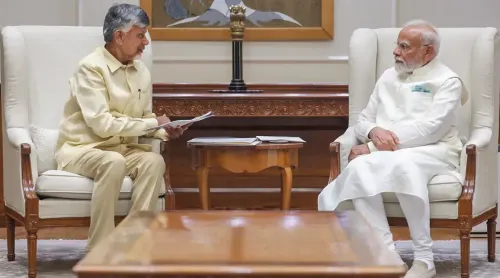
Andhra Pradesh Chief Minister N. Chandrababu Naidu on 7 October 2026 described Prime Minister Narendra Modi's 25 uninterrupted years in executive office as a 'remarkable journey of leadership sustained by public trust,' in a tribute article published in The Hindu. Modi completes the milestone on Wednesday — having served first as Chief Minister of Gujarat from 2001 and then as Prime Minister of India since 2014.
Naidu's tribute: Trust, integrity, and execution
Writing in his personal capacity, the Telugu Desam Party (TDP) supremo — whose party is a key coalition partner in the current National Democratic Alliance (NDA) government — argued that no leader can sustain two and a half decades in office on politics alone. 'It requires trust. Mr. Modi has earned that trust through an established track record, impeccable personal integrity and tireless self-discipline,' Naidu wrote.
He also drew on his own 48 years in public life to argue that leadership — defined by vision, credibility, integrity and the ability to execute — remains the true differentiator for nations in an age when technology, capital and ideas are freely available.
Infrastructure and welfare: Numbers cited
Naidu catalogued a range of statistics he attributed to the Modi era. India's National Highway network, he noted, expanded from roughly 91,287 km in 2014 to more than 1,46,000 km. The country's airport network grew from 74 in 2014 to over 160. Installed renewable energy capacity has reached nearly 296 GW — including large hydro — with solar alone crossing 168 GW.
On the welfare front, Naidu pointed to tapwater coverage in rural homes rising from about 17% in 2019 to over 82%, and cited government data indicating an estimated 24.8 crore Indians moved out of multidimensional poverty between 2013-14 and 2022-23. Around 80 crore people currently receive free foodgrains under central schemes, he added.
Technology and global standing
Naidu, long regarded as one of India's most technology-focused state leaders, credited Modi with a 'deep appreciation of technology' and its role in governance. He highlighted India's Digital Public Infrastructure, the quantum mission, the semiconductor mission, and Production-Linked Incentive (PLI) schemes across electronics and advanced manufacturing as examples of this orientation. He also praised the opening of the space sector to private enterprise, which he said 'unleashed a new generation of entrepreneurs.'
On India's international position, Naidu argued that the country's voice is heard 'with greater respect on global platforms,' and that it has preserved strategic autonomy while building wider partnerships — positioning itself as a 'modern, technology-driven' civilisation.
What comes next: Viksit Bharat 2047
Naidu framed the 25-year milestone not as a culmination but as a launchpad. 'The true significance of these 25 years will be judged by what they enable India to achieve next,' he wrote, adding that the direction set and institutional momentum created during this period would help India realise the Viksit Bharat 2047 ambition. He expressed confidence that the country could 'reclaim its place among the world's leading nations' if the right decisions are made in the years ahead.
Point of View
By its nature, political as much as it is biographical — and readers should weigh it accordingly. The infrastructure and poverty statistics Naidu cites are drawn from government data, which carry their own measurement debates; independent economists have, at various points, questioned the multidimensional poverty methodology and highway-counting norms. What the article does signal, more revealingly, is the political calculus of a regional heavyweight who has staked his return to power on the NDA alliance: effusive praise for Modi is also a statement about TDP's own positioning ahead of future electoral cycles. The substantive question — whether 25 years of executive continuity has structurally transformed India's economy or merely accelerated inherited trajectories — deserves a more forensic accounting than a tribute article can provide.
NationPress
7 Oct 2026
Frequently Asked Questions
How many years has PM Modi been in executive office as of October 2026?
Prime Minister Narendra Modi completes 25 uninterrupted years in executive office on 7 October 2026. This spans his tenure as Chief Minister of Gujarat beginning in 2001 and his service as Prime Minister of India since May 2014.
What did Chandrababu Naidu write about PM Modi in The Hindu?
Andhra Pradesh Chief Minister N. Chandrababu Naidu published a tribute article in The Hindu calling Modi's journey 'remarkable' and sustained by public trust. He credited Modi with infrastructure expansion, welfare delivery, technology adoption, and raising India's global stature over the past decade.
What infrastructure milestones did Naidu highlight in Modi's tenure?
Naidu cited the National Highway network expanding from roughly 91,287 km in 2014 to over 1,46,000 km, airports growing from 74 to over 160, and installed renewable energy capacity reaching nearly 296 GW — with solar alone crossing 168 GW.
What is Viksit Bharat 2047, and how does it feature in Naidu's article?
Viksit Bharat 2047 is the government's stated ambition to make India a developed nation by the centenary of its independence. Naidu argued that the institutional momentum and development trajectory built over Modi's 25 years form the foundation for achieving that goal.
Why is Chandrababu Naidu's tribute politically significant?
Naidu's Telugu Desam Party is a key coalition partner in the current NDA government, making his public endorsement a signal of alliance solidarity. Writing in a national broadsheet amplifies the message beyond routine political courtesy, positioning TDP firmly within the Modi-led dispensation.