National Handloom Day: NABARD honours Assam weavers, targets ₹5,000 crore exports by 2030
Synopsis
At a Guwahati event marking National Handloom Day, NEC Secretary Satinder Kumar Bhalla unveiled a roadmap targeting ₹5,000 crore in handloom and handicraft exports by 2030 — backed by plans to upskill over 50,000 artisans and set up 30-plus Common Facility Centres. For Assam, where handloom is both livelihood and identity, the ambition is significant; the execution framework will be the real test.
Key Takeaways
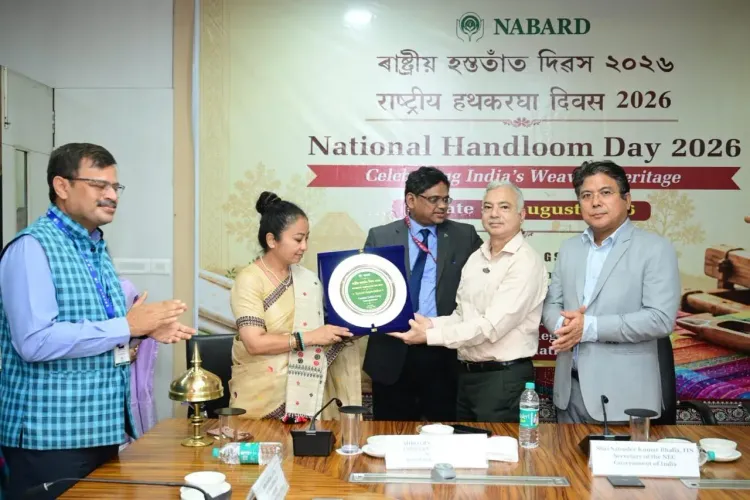
NABARD hosted National Handloom Day celebrations in Guwahati on 7 August 2025 at the NEDFi Conference Hall, Dispur.
NEC Secretary Satinder Kumar Bhalla set a target of ₹5,000 crore in handloom and handicraft exports by 2030 .
Plans include upskilling more than 50,000 artisans and establishing over 30 Common Facility Centres across the northeast.
Designer and entrepreneur Garima Saikia Garg and three weavers were felicitated for contributions to Assam's handloom sector.
A 12-stall exhibition-cum-sale showcased traditional Assam textiles, offering weavers direct consumer access and market exposure.
NABARD on 7 August 2025 marked National Handloom Day in Guwahati by felicitating accomplished handloom weavers and spotlighting Assam's rich weaving traditions, with officials pitching a ₹5,000 crore export target for the region's handloom and handicraft sector by 2030. The event underscored the sector's centrality to women-led rural livelihoods across the northeast.
Event Highlights
The celebration was held at the NEDFi Conference Hall in Dispur and featured a day-long exhibition-cum-sale of handloom products from across Assam. A total of 12 stalls displayed traditional textiles and handcrafted goods made by local artisans, drawing a large turnout of visitors and giving weavers direct access to consumers and broader market exposure.
Eminent entrepreneur and Assamese costume designer Garima Saikia Garg, along with three accomplished weavers, was felicitated for their contributions to Assam's handloom sector. Garg also addressed artisans on improving product quality, design innovation, and marketability.
What the Government Said
North Eastern Council (NEC) Secretary Satinder Kumar Bhalla, the chief guest, recalled the historical significance of National Handloom Day and laid out an ambitious roadmap for the sector. His targets include achieving handloom and handicraft exports worth ₹5,000 crore by 2030, training and upskilling more than 50,000 artisans, and establishing more than 30 Common Facility Centres to strengthen production capacity and design quality.
Bhalla stressed the need to enhance the scale, quality, and competitiveness of the handloom industry to contribute to India's vision of a developed economy by 2047.
NABARD's Role in the Sector
NABARD Assam Chief General Manager G. Ramesh Kumar highlighted the handloom sector's contribution to women's empowerment and the rural economy, reaffirming the institution's commitment to sustainable growth through targeted interventions. This comes amid a broader national push to revive traditional textile industries and integrate artisan clusters into formal supply chains.
Assam Agriculture Secretary P. Uday Praveen and NEDFi Executive Director Lemli Loyi were also present at the event.
Why It Matters
Assam's handloom sector is one of the largest in India, employing a significant share of rural women. Notably, the northeast accounts for a disproportionately high density of handloom households compared to its population share, making policy support here both an economic and social equity issue. The ₹5,000 crore export ambition, if realised, would represent a substantial leap from current levels and could position Assam as a premium handloom export hub within India's broader textile strategy leading up to 2047.
With Common Facility Centres, upskilling programmes, and institutional credit from NABARD all cited as instruments, the roadmap reflects a multi-pronged approach — though independent tracking of these targets remains to be established.
Point of View
000 crore export target is an aspirational headline, but the northeast's handloom sector has historically struggled with the last-mile challenge: getting premium products into export channels without losing artisan margins. Common Facility Centres help on quality, but market linkage — to global buyers, e-commerce platforms, and premium retail — is where past schemes have stalled. NABARD's involvement adds institutional credibility, yet the absence of a stated monitoring framework means these targets risk becoming the latest in a line of well-intentioned announcements that outpace their own implementation. The real signal to watch is whether the 30-plus Centres get built on schedule and whether the 50,000-artisan upskilling programme is independently verified.
NationPress
7 Aug 2026
Frequently Asked Questions
What is National Handloom Day and why is it celebrated?
National Handloom Day is observed every year on 7 August to honour India's handloom weavers and raise awareness about the sector's economic and cultural significance. The date commemorates the Swadeshi Movement launched on 7 August 1905, which gave a major impetus to indigenous textile production.
What is NABARD's role in Assam's handloom sector?
NABARD supports Assam's handloom sector through financial interventions, credit linkages, and capacity-building programmes aimed at sustainable rural livelihoods. At the Guwahati event, NABARD Assam Chief General Manager G. Ramesh Kumar reaffirmed the institution's commitment to the sector's growth and women's empowerment.
What is the ₹5,000 crore handloom export target announced at the event?
NEC Secretary Satinder Kumar Bhalla outlined a roadmap to achieve ₹5,000 crore in handloom and handicraft exports from the northeast by 2030. The plan also includes training over 50,000 artisans and establishing more than 30 Common Facility Centres to improve production capacity and design quality.
Who was felicitated at the National Handloom Day event in Guwahati?
Entrepreneur and Assamese costume designer Garima Saikia Garg, along with three accomplished weavers, was honoured for their contributions to Assam's handloom sector. Garg also shared insights on product quality, design innovation, and marketability with artisans at the event.
What are Common Facility Centres and how will they help Assam's weavers?
Common Facility Centres are shared infrastructure hubs that provide artisans access to modern equipment, quality testing, and design support that individual weavers cannot afford independently. The plan to establish over 30 such centres in the northeast aims to improve production scale, quality standards, and competitiveness of handloom products in export markets.