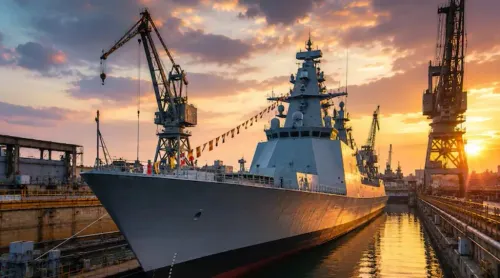
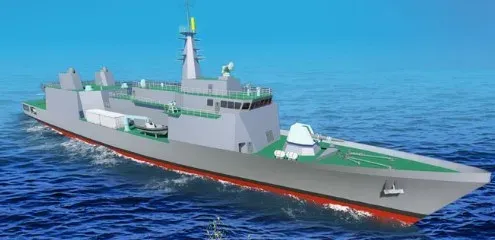
Indian Navy launches NGOPV Shruti in Kolkata, 44 warships on order
Synopsis
With the US-Iran war straining the Strait of Hormuz, India's Navy is racing to expand its fleet — and its shipyards. The launch of NGOPV Shruti at GRSE Kolkata, with 85% indigenous content and 44 warships already on order, signals how seriously New Delhi is treating both energy security and the ₹70,000 crore bet to make India the world's 5th-largest shipbuilder by 2047.
Key Takeaways
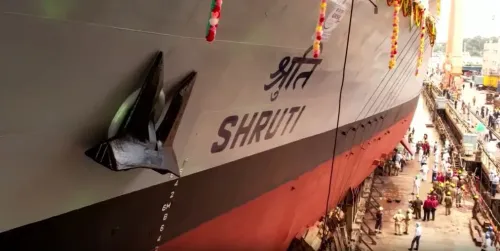
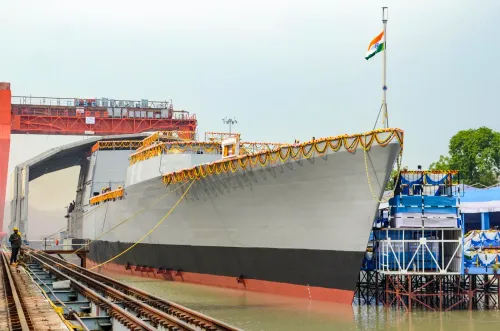
NGOPV 'Shruti' was launched at Garden Reach Shipbuilders and Engineers (GRSE) in Kolkata on Tuesday, 11 August .
The vessel will have 85 per cent indigenous content upon completion.
The Indian Navy has 44 platforms on order , all being built by Indian shipyards.
Vice Admiral Sanjay Sadhu cited the US-Iran war and its impact on the Strait of Hormuz as a key driver of naval expansion.
The government has earmarked ₹70,000 crore for shipbuilding, targeting 5% of global ship construction by 2035 and a 5th-place global rank by 2047 .
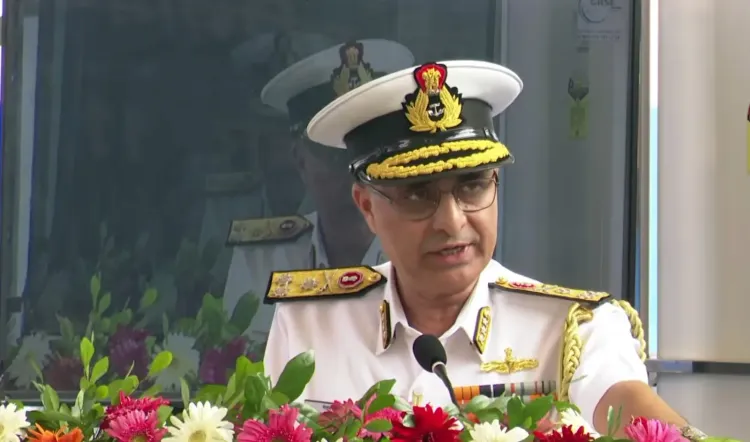
Vice Admiral Sanjay Sadhu, Controller of Warship Production & Acquisition, on Tuesday said the Indian Navy will need many more advanced warships to guarantee free navigation and the uninterrupted flow of India's energy supplies and essential commodities. He was speaking at the launch of the Next Generation Offshore Patrol Vessel (NGOPV) 'Shruti' at Garden Reach Shipbuilders and Engineers (GRSE) Ltd in Kolkata.
Shruti's Launch and Indigenous Content
The NGOPV Shruti marks a significant milestone for domestic defence manufacturing. Vice Admiral Sadhu noted that the vessel will carry 85 per cent indigenous content upon completion, calling the launch a celebration of 'the capability of our shipyards to build advanced warships.'
The Navy currently has 44 platforms on order, all of which are being constructed by Indian shipyards — a development the Vice Admiral described as 'speaking volumes on Atmanirbharta' that the government is actively promoting.
Regional Security and Energy Supply Lanes
'Given the situation in the region, such as the US-Iran war, which has had an impact on vital chokepoints like the Strait of Hormuz, the Navy is playing a key role in protecting our sea lanes and ensuring the supply of India's energy requirements and other essential commodities,' Sadhu said. He added that versatile vessels like the NGOPV Shruti would be central to protecting the country's maritime borders while carrying out multiple operational roles.
This comes amid heightened global attention on energy transit routes, with the Strait of Hormuz — through which a significant share of India's crude oil imports pass — facing periodic disruption risks tied to West Asian tensions.
India's Shipbuilding Ambitions by 2047
Beyond immediate security concerns, Vice Admiral Sadhu outlined the government's broader maritime industrial vision. The Centre plans to position India as a global shipbuilding hub, with a target for Indian yards to account for 5 per cent of global ship construction by 2035. Additionally, at least 50 per cent of India's commercial fleet is to be indigenously built by that year.
The government has earmarked ₹70,000 crore towards this initiative. The longer-term ambition is for India to rank 5th among global shipbuilding nations by 2047 — a goal Sadhu described as 'achievable' but contingent on sustained effort from the entire workforce and industry stakeholders. He addressed workers and supervisors directly, switching to Hindi to reach a wider audience at the shipyard.
Call to Industry
Sadhu urged all stakeholders in the shipbuilding sector to prioritise top-quality construction, both for naval and commercial customers. 'India is a true maritime nation with such a long coastline,' he said, underscoring that the country's strategic and economic interests are deeply tied to its maritime capability. With GRSE delivering the Shruti as part of a broader naval expansion drive, the shipyard is expected to remain central to the Navy's indigenisation roadmap in the years ahead.
Point of View
000 crore shipbuilding push is ambitious, but the gap between target and capacity remains wide — Indian yards currently account for a fraction of global output. The explicit linkage of the Navy's expansion to the US-Iran war and Strait of Hormuz disruptions is notable: it signals that energy supply vulnerability, not just territorial defence, is now driving procurement timelines. Whether the 2047 ranking target translates into verifiable industrial benchmarks, or remains an aspirational headline, will depend on whether the Centre ties disbursements to measurable output milestones rather than order books alone.
NationPress
26 Sept 2026
Frequently Asked Questions
What is the NGOPV Shruti and why was it launched?
The NGOPV Shruti is a Next Generation Offshore Patrol Vessel built by Garden Reach Shipbuilders and Engineers (GRSE) in Kolkata for the Indian Navy. It was launched on 11 August as part of the Navy's fleet expansion drive, with 85 per cent indigenous content, to strengthen maritime border protection and safeguard India's sea-based energy supply routes.
How many warships does the Indian Navy currently have on order?
The Indian Navy has 44 platforms on order, all of which are being constructed by Indian shipyards. Vice Admiral Sanjay Sadhu cited this as evidence of the government's Atmanirbharta push in defence manufacturing.
Why is the Strait of Hormuz relevant to India's naval expansion?
The Strait of Hormuz is a critical chokepoint through which a large share of India's crude oil imports transit. The ongoing US-Iran war has heightened risks to this passage, prompting the Navy to accelerate fleet expansion to protect energy supply lanes.
What is India's shipbuilding target by 2035 and 2047?
The government aims for Indian shipyards to build 5 per cent of all ships constructed globally by 2035, with at least 50 per cent of India's commercial fleet to be indigenously built by then. By 2047, India targets ranking 5th among global shipbuilding nations. The Centre has allocated ₹70,000 crore towards this goal.
What role does GRSE play in India's naval indigenisation?
Garden Reach Shipbuilders and Engineers (GRSE), based in Kolkata, is one of India's primary naval shipyards. The launch of the NGOPV Shruti underscores GRSE's central role in the Navy's indigenisation roadmap, delivering vessels with high domestic content as part of the broader Atmanirbharta defence manufacturing policy.