NFSU's IDDRC goes operational; Justice AR Dave named President
Synopsis
India's first AI and blockchain-integrated arbitration institution — the IDDRC at NFSU Gandhinagar — has moved from inauguration to live operations, with a former Supreme Court judge at the helm. It is now open to empanel domain-expert arbitrators, signalling a structural shift in how institutional dispute resolution could work in a digital-first economy.
Key Takeaways
The IDDRC at NFSU Gandhinagar was formally declared operational on 26 August 2026 .
Former Supreme Court judge Justice A.R.
Dave was unanimously nominated as President at the Centre's first Board of Governors meeting.
The Board also included former SC judges Justice M.R.
Shah and Justice Rajesh Bindal , and former Gujarat HC Chief Justice Justice Sonia Gokani .
The Centre's architecture integrates AI-enabled systems and blockchain for confidentiality, traceability, and auditability.
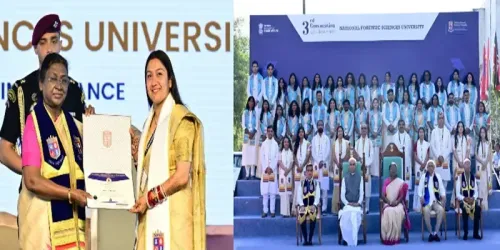
IDDRC was inaugurated on 27 February 2026 by Chief Justice of India Justice Surya Kant .
The Centre has begun inviting expressions of interest from domain-expert arbitrators.
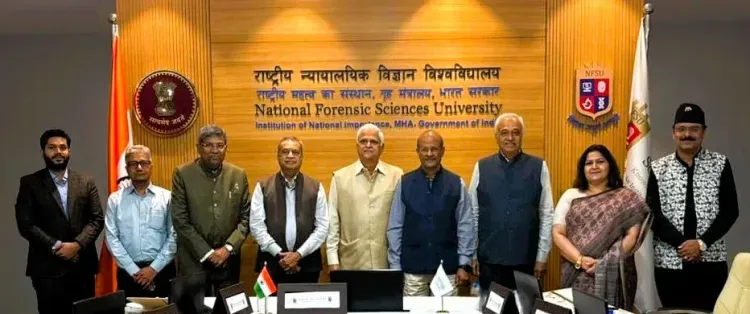
The International Digital Dispute Resolution Centre (IDDRC) of the National Forensic Sciences University (NFSU) in Gandhinagar was formally declared operational on 26 August 2026 as an institutional provider of arbitration and mediation services, with former Supreme Court judge Justice Anil R. Dave unanimously nominated as its President. The decision was taken at the Centre's first Board of Governors meeting, held at the NFSU Gandhinagar campus.
First Board Meeting and Leadership
The inaugural Board meeting was presided over by Justice A.R. Dave and attended by a distinguished panel of legal luminaries. These included former Supreme Court judges Justice M.R. Shah and Justice Rajesh Bindal, former Chief Justice of the Gujarat High Court Justice Sonia Gokani, former Gujarat High Court judge Justice P.P. Bhatt, and senior advocate Ratan Singh, Chairman of the Society of Construction Law, India. The unanimous nomination of Justice Dave as President marks the Centre's formal transition from its establishment phase to active institutional functioning.
Technology Architecture at the Core
NFSU Vice-Chancellor Padma Shri Dr J.M. Vyas conceived the IDDRC as a digital-first institution, with technology woven into every layer of the dispute-resolution process. The Centre's infrastructure incorporates AI-enabled capabilities and blockchain-integrated systems, with confidentiality, data protection, traceability, and auditability forming the pillars of its institutional framework. This positions IDDRC as one of the few arbitration bodies in India to embed both artificial intelligence and blockchain at the institutional design stage.
Background and Inauguration
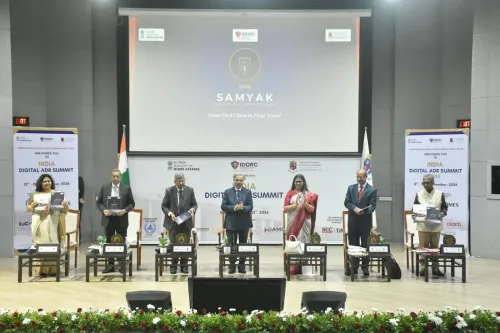
The Centre was inaugurated on 27 February 2026 by Chief Justice of India Justice Surya Kant, in the presence of Gujarat Deputy Chief Minister Harsh Sanghavi and Gujarat High Court Chief Justice Justice Sunita Agarwal. The operationalisation announced on 26 August marks the next critical milestone — moving from inauguration to active case intake.
What Happens Next
With the Centre now operational, IDDRC has invited expressions of interest from eminent domain-expert arbitrators. The Centre stated it would prioritise professional credibility, relevant experience, and subject-matter expertise in empanelling arbitrators. The emphasis on digital processes also signals that IDDRC intends to handle disputes that specifically require technology-enabled resolution frameworks — a growing category as commerce increasingly moves online.
Point of View
But the real test will be whether it can attract credible domain-expert arbitrators and actually resolve disputes faster than conventional forums. The legal pedigree of the Board is strong; the execution challenge is converting that credibility into case volume. Watch whether IDDRC can become the default forum for technology and digital-commerce disputes — a space that has no clear institutional home in India today.
NationPress
11 Oct 2026
Frequently Asked Questions
What is the IDDRC at NFSU Gandhinagar?
The International Digital Dispute Resolution Centre (IDDRC) is an institutional arbitration and mediation body established at the National Forensic Sciences University in Gandhinagar. It is designed as a digital-first forum, integrating AI-enabled systems and blockchain technology into the dispute-resolution process.
Who is the President of IDDRC?
Former Supreme Court judge Justice Anil R. Dave was unanimously nominated as President of the IDDRC at the Centre's first Board of Governors meeting on 26 August 2026. The nomination was endorsed by the full Board.
When was the IDDRC inaugurated and when did it become operational?
The IDDRC was inaugurated on 27 February 2026 by Chief Justice of India Justice Surya Kant. It was formally declared operational on 26 August 2026, following the conclusion of its first Board of Governors meeting.
What technology does the IDDRC use?
The Centre's infrastructure includes AI-enabled capabilities and blockchain-integrated systems, with a focus on confidentiality, data protection, traceability, and auditability. NFSU Vice-Chancellor Dr J.M. Vyas conceived it as a digital-first arbitration institution.
How can arbitrators join the IDDRC panel?
The IDDRC has invited expressions of interest from eminent domain-expert arbitrators following its declaration of operational status. The Centre stated it will evaluate candidates on professional credibility, relevant experience, and subject-matter expertise.