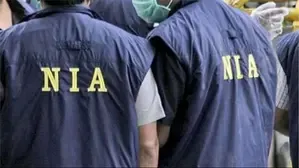
NIA Arrests Second Accused in Bengal Bomb Blast That Killed One

Synopsis
The NIA arrested Ahidul Islam Molla from South 24 Parganas as the second accused in the deadly West Bengal bomb explosion case that killed one person in March 2025. Simultaneously, the agency filed charges against a sixth accused in a Bihar illegal arms smuggling case involving AK-47 rifles being funnelled to Maoists.
Key Takeaways
Ahidul Islam Molla of South 24 Parganas, West Bengal was arrested by the NIA on April 26 as a prime accused in the Dakshin Bamunia bomb explosion case .
The March 2025 blast killed one person and left three others seriously injured ; the bomb detonated prematurely during its own preparation.
Molla is the second accused arrested in the case — the first was apprehended earlier by West Bengal state police .
In a separate case, the NIA filed a supplementary charge sheet against Kundan Kumar alias Kundan Bhagat of Muzaffarpur, Bihar , making him the sixth accused in the 2024 Bihar illegal arms smuggling case .
Kundan Kumar was found to be smuggling prohibited bore weapons including AK-47 rifles from Nagaland to supply Maoists and criminals in Bihar .
Both NIA investigations are ongoing , with further arrests and charge sheets expected as agencies trace higher links in both conspiracy networks.
The National Investigation Agency (NIA) on Sunday, April 26, arrested a prime accused in the West Bengal bomb explosion case, marking a significant breakthrough in the investigation into a deadly blast that claimed one life and left three others critically injured earlier this year. The arrested individual has been identified as Ahidul Islam Molla, a resident of Bijoyganj Bazar area in South 24 Parganas district, West Bengal.
Who Is Ahidul Islam Molla and What Was His Role
Ahidul Islam Molla was apprehended by the NIA following a thorough and detailed examination of his involvement in the explosion, which occurred in March 2025 at Dakshin Bamunia village in West Bengal. Investigators established that Molla was a co-conspirator in the criminal plot, directly involved in the preparation of improvised explosive devices and the subsequent destruction of evidence to conceal the crime.
This arrest marks the second in the case. An earlier accused had been apprehended by the West Bengal state police in the initial phase of the investigation, before the NIA took over the probe.
How the Bomb Blast Unfolded at Dakshin Bamunia
According to the NIA's official statement, the bombs detonated prematurely — while they were being assembled as part of the conspiracy — killing one of the accused individuals involved in the bomb-making operation itself. Three other persons sustained serious injuries in the accidental explosion.
The incident raises serious concerns about the organised manufacture of crude bombs in rural West Bengal, a pattern that security agencies have flagged repeatedly over the past several years. South 24 Parganas has historically been a region of heightened political and criminal violence, and this case adds to a troubling trend of illegal explosive manufacturing in the state.
The NIA confirmed that its investigation is actively continuing to identify and apprehend other co-accused individuals who may have been part of the wider conspiracy.
NIA Also Files Charges in Bihar Illegal Arms Smuggling Case
In a separate but equally significant development, the NIA earlier this month filed a supplementary charge sheet against Kundan Kumar alias Kundan Bhagat, a resident of Muzaffarpur, Bihar, in connection with a 2024 Bihar illegal weapons smuggling case. The charge sheet was filed before the NIA Special Court in Patna.
Kundan Kumar, who was arrested by the NIA in November 2025, was found to be actively engaged in the illegal procurement and smuggling of prohibited bore weapons from Nagaland. He becomes the sixth accused to be charge-sheeted in this case, which originated with the Bihar Police's seizure of an AK-47 rifle along with a scope lens.
Investigations revealed that the weapons were being channelled to Maoists and organised criminals in Bihar, pointing to a deeply entrenched nexus between arms traffickers and left-wing extremist networks. The charge sheet invokes provisions of the Indian Penal Code (IPC), the Arms Act, and the Unlawful Activities (Prevention) Act (UAPA).
Timeline of Accused in the Bihar Arms Case
The Bihar arms smuggling case has seen a methodical expansion of its accused list. Four individuals — Vikash Kumar, Devmani Rai, Satyam Kumar, and Ahmad Ansari — were originally charge-sheeted by the NIA in May 2025. A fifth accused, Manjoor Khan, was charged in February 2026, and now Kundan Kumar brings the total to six.
This pattern of incremental charge-sheeting reflects the NIA's strategy of systematically dismantling the supply chain of illegal arms feeding insurgent and criminal networks across eastern India.
Broader Implications for Internal Security
The near-simultaneous developments in both the West Bengal bomb case and the Bihar arms smuggling case underscore the NIA's intensified focus on disrupting networks that manufacture or traffic weapons for use in politically motivated or Maoist violence. Notably, both cases involve states that have historically grappled with extremist activity and political crime.
Security analysts note that the crude bomb-making networks in Bengal and the arms pipeline from Nagaland to Bihar's Maoist belt represent two distinct but equally dangerous threats to civilian safety and democratic processes. The NIA's proactive approach in both cases signals a broader federal push to contain these threats ahead of upcoming state-level political cycles.
As investigations in both cases continue, further arrests and charge sheets are expected in the coming weeks, with the NIA likely to trace higher links in both conspiracy chains.
Point of View
And a six-person arms supply chain in Bihar, both pointing to networks with operational discipline. The mainstream narrative will celebrate the arrests, but the harder question is why these networks continue to regenerate despite years of crackdowns — and whether political patronage at the local level is providing them cover.
NationPress
22 Sept 2026
Frequently Asked Questions
Who is Ahidul Islam Molla and why was he arrested by NIA?
Ahidul Islam Molla is a resident of Bijoyganj Bazar in South 24 Parganas, West Bengal, arrested by the NIA on April 26 as a prime accused in the Dakshin Bamunia bomb explosion case. He was found to be a co-conspirator involved in bomb preparation and destruction of evidence.
What happened in the West Bengal bomb explosion case?
A bomb explosion occurred in March 2025 at Dakshin Bamunia village in West Bengal, killing one person and seriously injuring three others. The NIA investigation revealed the bombs detonated prematurely while being assembled by the accused conspirators.
Who is Kundan Kumar and what is his connection to the Bihar arms case?
Kundan Kumar alias Kundan Bhagat is a Muzaffarpur resident arrested by the NIA in November 2025 for illegally procuring and smuggling prohibited bore weapons, including AK-47 rifles, from Nagaland to Bihar. He is the sixth accused to be charge-sheeted in the 2024 Bihar illegal arms smuggling case.
How many accused have been charged in the Bihar AK-47 smuggling case?
Six accused have been charged in total in the Bihar illegal arms smuggling case. The first four — Vikash Kumar, Devmani Rai, Satyam Kumar, and Ahmad Ansari — were charged in May 2025, followed by Manjoor Khan in February 2026, and now Kundan Kumar.
What laws has the NIA invoked in the Bihar arms smuggling case?
The NIA filed charges against Kundan Kumar under provisions of the Indian Penal Code (IPC), the Arms Act, and the Unlawful Activities (Prevention) Act (UAPA). The supplementary charge sheet was filed before the NIA Special Court in Patna.