Southwest monsoon exits Northeast India with 26% rainfall deficit: IMD
Synopsis
The Southwest monsoon has exited the entire Northeast on its near-normal date, but left a damaging 26% rainfall deficit behind — with Meghalaya receiving barely 40% of its expected rain and East-Northeast India logging its lowest monsoon total since 1901. For Manipur, the deficit compounds an already acute humanitarian and agricultural crisis.
Key Takeaways
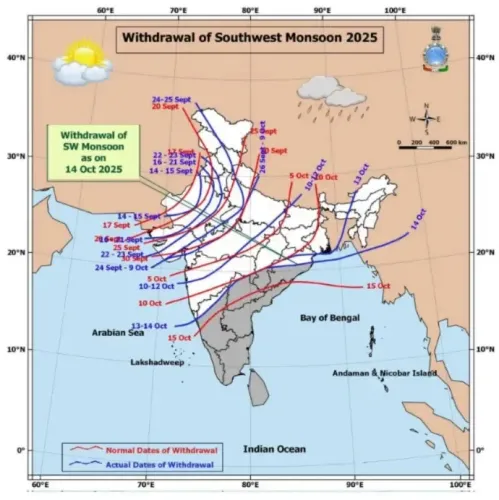
The Southwest monsoon withdrew from all eight northeastern states as of 15 October 2026 , close to its normal withdrawal date.
The region recorded a 26 per cent deficit in average rainfall during the June–September 2026 monsoon season.
Meghalaya was worst hit with a 60 per cent deficit, receiving only 1,077.1 mm against a normal of 2,695.3 mm .
All-India monsoon rainfall in 2026 was 759.4 mm — 87% of LPA — the 4th lowest since 2001 and 13th lowest since 1901 .
Rainfall over East and Northeast India at 1,017.1 mm was the lowest since 1901 .
In Manipur , a 46 per cent rainfall deficit combined with the ongoing ethnic conflict severely disrupted Kharif season agriculture.
The Southwest monsoon completed its withdrawal from all eight northeastern states of India as of Thursday, 15 October 2026, the India Meteorological Department (IMD) confirmed, with the retreat occurring close to its historically normal date. The region recorded a 26 per cent deficit in average rainfall over the four-month monsoon season from June to September 2026, raising concerns for the agricultural sector across the region.
Withdrawal Timeline and Onset
The monsoon's departure from the Northeast came roughly in line with the seasonal norm. In 2025, the Southwest monsoon had withdrawn from the entire northeastern region on 14 October, a senior IMD official said. The 2026 season began slightly delayed, with the monsoon advancing into substantial parts of the Northeast on 7 June — two days later than its normal onset date — before covering the entire region by 10 June. A gradual decrease in both maximum and minimum temperatures is expected from now, with winter conditions anticipated from the last part of November, according to IMD.
State-by-State Rainfall Deficit
The deficit was far from uniform across the eight states. Meghalaya recorded the steepest shortfall at 60 per cent, receiving only 1,077.1 mm of actual rainfall against a predicted normal of 2,695.3 mm — a striking anomaly for a state known for some of the world's highest precipitation. Manipur followed with a 46 per cent deficit, Arunachal Pradesh with 44 per cent, and Assam with 28 per cent.
On the other end, Sikkim and Nagaland recorded 9 per cent and 6 per cent excess rainfall, respectively, placing them within IMD's normal category (between 19 per cent deficient and 19 per cent excess). Mizoram and Tripura recorded 19 per cent and 16 per cent deficient rainfall, respectively — also within the normal band by IMD norms.
National Context: A Historic Low
The Northeast's deficit sits within a broader national underperformance. According to IMD, all-India Southwest monsoon rainfall in 2026 stood at 759.4 mm — just 87 per cent of its Long Period Average (LPA) — making it the fourth lowest since 2001 and the 13th lowest since 1901. Rainfall over East and Northeast India combined reached 1,017.1 mm, the lowest on record since 1901. South Peninsular India recorded 542.0 mm, the fourth lowest since 1901 and the second lowest since 2001. Central India, however, received rainfall within the normal category, offering a partial counterbalance.
Agriculture Under Pressure
Agricultural scientists and IMD officials have flagged that adequate monsoon rainfall — particularly in July — is critical for the Kharif season, when sowing accelerates across the country, including the hilly Northeast. The deficit has compounded existing stress in at least one state: a senior official of the Manipur Agriculture Department said the 46 per cent rainfall shortfall, combined with the state's prolonged ethnic conflict, had severely disrupted farming, particularly given inadequate irrigation infrastructure. The official added, however, that the state government had taken 'adequate arrangements and other supportive measures to facilitate farming activities in both the Imphal Valley and the hill districts during the Kharif cropping season.'
What to Watch
With the monsoon now fully withdrawn, attention turns to the rabi season and how states with significant deficits — particularly Meghalaya, Manipur, and Arunachal Pradesh — manage agricultural output. For Manipur, the dual burden of rainfall deficit and civil unrest could translate into a food security challenge heading into winter. IMD's post-monsoon and northeast monsoon outlooks will be closely tracked by both state governments and farmers across the region.
Point of View
And it points to the growing unpredictability of precipitation patterns even in traditionally wet zones. The Manipur case is particularly worrying: a state already fractured by ethnic violence now faces a food production hit in a season where it can least afford one, yet the response cited by officials remains generic. The broader national picture — East and Northeast India logging their lowest monsoon total on record since 1901 — should be a trigger for revisiting drought contingency frameworks, not a footnote in an end-of-season bulletin.
NationPress
15 Oct 2026
Frequently Asked Questions
When did the Southwest monsoon withdraw from Northeast India in 2026?
The Southwest monsoon completed its withdrawal from all eight northeastern states as of Thursday, 15 October 2026, according to IMD. This is close to the historical normal withdrawal date; in 2025, the retreat from the same region was completed on 14 October.
How much rainfall deficit did Northeast India record in the 2026 monsoon season?
The eight-state northeastern region recorded a 26 per cent deficit in average rainfall during the June–September 2026 monsoon season, according to IMD data. Meghalaya was the worst affected with a 60 per cent shortfall, followed by Manipur at 46 per cent, Arunachal Pradesh at 44 per cent, and Assam at 28 per cent.
How does the 2026 national monsoon rainfall compare historically?
All-India Southwest monsoon rainfall in 2026 stood at 759.4 mm, which is 87 per cent of the Long Period Average — making it the fourth lowest since 2001 and the 13th lowest since 1901. Rainfall over East and Northeast India combined was the lowest recorded since 1901.
How has the monsoon deficit affected agriculture in Northeast India?
The deficit has disrupted the Kharif season across the region, particularly where irrigation infrastructure is limited. Manipur was most severely impacted, where a 46 per cent rainfall shortfall compounded by the ongoing ethnic conflict hit farming in both the Imphal Valley and hill districts; the state agriculture department said it has taken supportive measures to facilitate cropping.
Which northeastern states recorded normal or excess rainfall in 2026?
Sikkim and Nagaland recorded 9 per cent excess and 6 per cent excess rainfall respectively, placing them in IMD's normal category. Mizoram and Tripura recorded 19 per cent and 16 per cent deficient rainfall respectively, which also falls within the normal band under IMD norms (±19 per cent of average).