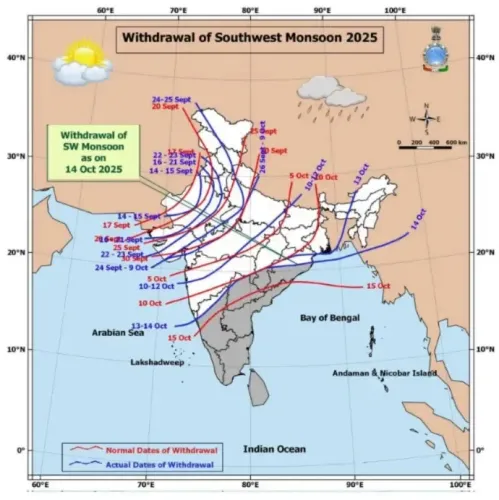
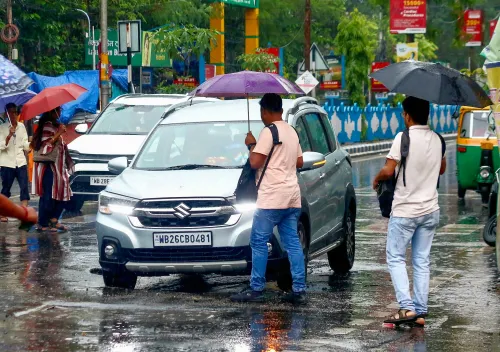
Northeast logs driest southwest monsoon since 1901, IMD data shows

Synopsis
For the first time in 125 years of recorded history, Northeast India has logged its lowest-ever southwest monsoon rainfall — just 1,017.1 mm across June to September 2026. With deficits in every monsoon month across Assam, Meghalaya and Arunachal Pradesh, and a warmer-than-normal September on top, the region faces real stress on agriculture and water supply heading into winter.
Key Takeaways
East and Northeast India recorded just 1,017.1 mm of rainfall in the June–September 2026 monsoon season — the lowest since IMD records began in 1901 .
Assam , Meghalaya , and Arunachal Pradesh each logged deficient rainfall in all four monsoon months: June, July, August , and September .
Late September heavy rainfall spells in Assam were insufficient to bridge the cumulative seasonal deficit, the IMD confirmed.
The region's mean September temperature was 27.95°C — 0.74 degrees above normal — the sixth-highest on record since 1901 .
Nationally, India received 759.4 mm of monsoon rainfall in 2026 — the 13th lowest season since 1901 and fourth-lowest since 2001.
The IMD has forecast below-normal rainfall over most of India in October , with some above-normal pockets in East India.
East and Northeast India recorded just 1,017.1 mm of rainfall during the June–September 2026 southwest monsoon season — the lowest since the India Meteorological Department (IMD) began maintaining rainfall records in 1901, officials confirmed on 1 October 2026. The figure marks a historic departure for a region that is traditionally among the country's wettest, and raises immediate concerns for agriculture, water resources, and livelihoods across the Northeast.
Record Deficit Across the Region
The rainfall shortfall was not confined to a single month or state. According to the IMD, all three meteorological subdivisions covering the Northeast — encompassing Assam, Meghalaya, and Arunachal Pradesh — recorded deficient rainfall in each of the four monsoon months: June, July, August, and September. The persistence of the deficit across all four months underscores the unusual nature of this season's pattern.
The prolonged shortfall is particularly significant because the Northeast typically depends on the southwest monsoon for the bulk of its annual precipitation, driving crop cycles, river systems, and drinking water availability across the region.
Late September Rains Failed to Bridge the Gap
Towards the latter part of September, parts of Assam did receive episodes of heavy to very heavy rainfall. However, the IMD's seasonal assessment concluded that these intense spells were insufficient to compensate for the cumulative deficit built up over the preceding months. The situation, officials noted, did not change substantially despite the late-season activity.
Alongside the rainfall shortfall, the region experienced an unusually warm September as well. East and Northeast India recorded a mean September temperature of 27.95 degrees Celsius — 0.74 degrees above normal — making it the sixth-highest September mean temperature for the region since 1901.
National Picture: 13th Lowest Season Since 1901
The historic deficit in the Northeast stood out even against a below-normal national monsoon. Across India, the June–September 2026 season delivered 759.4 mm of rainfall, making it the 13th lowest monsoon season since 1901 and the fourth-lowest since 2001. The Northeast's shortfall, however, was significantly more acute relative to its historical baseline than the national average.
This comes amid growing concern among climate scientists about shifting monsoon patterns in South Asia, with researchers noting increased variability in seasonal rainfall distribution over recent decades.
Impact on Agriculture and Water Resources
The Northeast's economic and agrarian calendar is closely tied to monsoon performance. Paddy cultivation — the dominant kharif crop across Assam and Meghalaya — relies heavily on June-to-August rainfall for transplanting and grain formation. A four-month deficit spanning all monsoon months raises the risk of reduced yields, stressed river systems, and depleted reservoirs heading into the dry winter months.
Notably, this is the first time since records began that the East and Northeast India subdivision has logged its lowest-ever seasonal total, placing 2026 in a category of its own within the 125-year dataset.
Weather Outlook for October
The IMD has forecast below-normal rainfall over most parts of the country in October, though some areas of East India may receive normal to above-normal precipitation. For most of the Northeast, maximum temperatures are expected to remain around normal, while minimum temperatures are likely to be normal to below normal — signalling continued weather variability as the region transitions into the post-monsoon period.
With the rabi season approaching and water tables potentially stressed, agricultural planners and state governments across the Northeast will be closely monitoring soil moisture levels and reservoir storage in the weeks ahead.
Point of View
River baseflows are lower heading into winter, and the rabi season begins under stress. Climate attribution studies on Indian monsoon variability increasingly point to warming Bay of Bengal surface temperatures disrupting moisture transport into the Northeast — a trend that, if it continues, will demand a fundamental rethink of water and agricultural planning for the entire sub-region.
NationPress
1 Oct 2026
Frequently Asked Questions
What is the significance of Northeast India's 2026 monsoon rainfall?
The June–September 2026 monsoon delivered just 1,017.1 mm of rainfall to East and Northeast India — the lowest seasonal total since IMD records began in 1901. It marks the first time in 125 years that the region has recorded such a historically low seasonal figure.
Which states were worst affected by the monsoon deficit?
Assam, Meghalaya, and Arunachal Pradesh were the most affected, with all three states recording deficient rainfall in each of the four monsoon months — June, July, August, and September 2026.
How does Northeast India's deficit compare to the national monsoon performance?
While India as a whole also had a below-normal monsoon season — ranking 13th lowest since 1901 at 759.4 mm — the Northeast's shortfall was far more extreme relative to its historical baseline, marking an all-time record low for the region.
Why does a monsoon deficit matter so much for the Northeast?
The Northeast is among India's highest-rainfall regions and relies heavily on the southwest monsoon for paddy cultivation, river replenishment, and drinking water supply. A deficit spanning all four monsoon months significantly raises the risk of reduced crop yields and stressed water resources heading into winter.
What is the weather forecast for Northeast India in October 2026?
The IMD has forecast below-normal rainfall over most parts of the country in October, though some areas of East India may see normal to above-normal precipitation. For the Northeast, maximum temperatures are expected near normal, while minimum temperatures are likely to be normal to below normal.