CM Majhi's Cabinet Clears Multi-Sector Reforms for Odisha
Synopsis
The Odisha Cabinet under Chief Minister Mohan Charan Majhi approved a multi-sector package on 15 June 2026, targeting rural livelihoods, street vendors, industrial assets and cultural preservation, as the BJP government advances its 'Samruddha Odisha' agenda two years after ending BJD's 24-year rule.
Key Takeaways
The Odisha Cabinet on 15 June 2026 approved a set of decisions covering four domains: rural livelihoods, street-vendor support, industrial revival, and cultural preservation.
CM Mohan Charan Majhi framed the approvals under the Samruddha Odisha (Prosperous Odisha) vision of responsive governance and meaningful reforms.
The BJP government has been aligning state schemes with central welfare frameworks such as PM SVANidhi since taking office after the 2024 assembly elections .
Key beneficiary groups include rural households , street vendors , industrial workers , and communities invested in Odisha 's cultural heritage.
Detailed implementation orders and budgetary allocations are expected in forthcoming Odisha Legislative Assembly sessions.
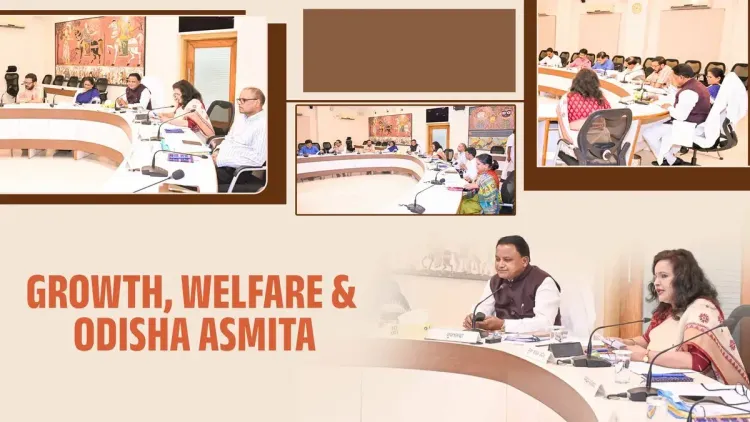
Odisha Chief Minister Mohan Charan Majhi on Monday, 15 June 2026 announced that the state Cabinet had approved a package of people-centric decisions spanning rural livelihoods, street-vendor support, industrial revival, and cultural preservation, framing the moves as a step toward building a Samruddha Odisha (Prosperous Odisha).
Context
CM Majhi posted on X that the Cabinet had cleared 'a series of people-centric decisions that will create opportunities, improve infrastructure and accelerate development across the State.' The announcement spans four broad domains: strengthening rural livelihoods, supporting street vendors, reviving industrial assets, and preserving Odisha's cultural identity. No single scheme or sector was elevated above the others in the post, signalling an intent to present the Cabinet session as a comprehensive governance milestone.
The Chief Minister closed his message with a commitment to 'building a Samruddha Odisha through responsive governance and meaningful reforms,' invoking a phrase that has become a recurring anchor of the BJP-led state government's public communication since it took office in June 2024.
Policy Backdrop
The BJP government that came to power after the 2024 Odisha assembly elections — ending BJD's 24-year uninterrupted rule — has been systematically reviewing predecessor schemes and aligning state-level implementation with central welfare frameworks. National programmes such as PM SVANidhi, which extends micro-credit to street vendors, have been part of state implementation architecture since 2020 and are a natural fit for the Cabinet's stated focus on vendor support.
On the industrial side, Odisha carries a long-standing tension between rapid industrialisation — the state is among India's top mineral-rich regions — and the protection of tribal and indigenous cultural identities. The Cabinet's simultaneous attention to industrial revival and cultural preservation reflects an attempt to address both imperatives within a single governance cycle. Similar multi-sector Cabinet announcements have been a feature of BJP-ruled states seeking to project broad-based administrative responsiveness.
Stakeholders and Impact
Rural households stand to benefit from any strengthened livelihood missions, while street vendors — a significant informal-economy segment in Odisha's towns and cities — could see easier access to credit, vending zones, or regulatory relief depending on the specifics of the Cabinet decisions. Industrial workers tied to stalled or underperforming assets are the third major constituency named in the announcement.
Cultural organisations and communities invested in Odisha's distinct heritage — including its classical dance traditions, tribal art forms, and temple-town economies — are also implicated by the cultural-preservation component. The breadth of the announcement suggests the Cabinet is seeking to consolidate political goodwill across urban informal workers, rural poor, industrial labour, and cultural stakeholders simultaneously.
What's Next
Detailed implementation orders and budgetary allocations for each approved decision are expected to be tabled in subsequent Odisha Legislative Assembly sessions. Scheme-specific notifications from the relevant state departments will clarify the scope, beneficiary criteria, and timelines attached to each Cabinet approval. Observers will watch whether the industrial revival component translates into concrete memoranda of understanding or asset-monetisation plans in the coming weeks.
The broader trajectory of the Majhi government's reform agenda will be tested in how quickly these Cabinet approvals move from announcement to ground-level implementation — a challenge that has historically separated intent from outcome in multi-sector governance pushes across Indian states.
Point of View
Urban informal economy, industrial policy and cultural identity in a single communication — is a deliberate political signalling exercise as much as a governance one. For the Majhi government, now two years into office, the challenge is moving from the review-and-realign phase inherited from the BJD era to demonstrable delivery. The invocation of Samruddha Odisha as an overarching frame mirrors the BJP's tested playbook in other states of branding governance clusters under aspirational slogans. Whether the multi-sector sweep deepens the party's electoral coalition among vendors, tribal communities and industrial labour — three groups with occasionally divergent interests — will be the real test of this approach.
NationPress
14 Sept 2026
Frequently Asked Questions
What did the Odisha Cabinet approve on 15 June 2026?
The Odisha Cabinet approved a package of people-centric decisions covering rural livelihood strengthening, street-vendor support, industrial asset revival, and cultural identity preservation, as announced by Chief Minister Mohan Charan Majhi on 15 June 2026.
What is Samruddha Odisha?
'Samruddha Odisha' means 'Prosperous Odisha' and is the overarching governance vision articulated by the BJP-led Odisha government under CM Mohan Charan Majhi since it came to power in June 2024.
Who is Mohan Charan Majhi?
Mohan Charan Majhi is a BJP leader who became Chief Minister of Odisha in June 2024 after the party won the state assembly elections, ending the BJD's 24-year rule in the state.
How does the Odisha government plan to support street vendors?
The Cabinet's announcement references support for street vendors as one of its approved decisions; national frameworks such as PM SVANidhi, which provides micro-credit to street vendors, have been part of state-level implementation since 2020 and are expected to inform the approach.
When will the Odisha Cabinet decisions be implemented?
Detailed implementation orders and budgetary allocations for the approved decisions are expected to be presented in upcoming Odisha Legislative Assembly sessions, with scheme-specific notifications from relevant state departments to follow.