Odisha CMO: 47 Trains Cancelled as Cyclone Akvan Closes In

Synopsis
Odisha's CMO announced on 20 November 2026 that 47 trains have been cancelled and 28 rescheduled as the state deploys round-the-clock monitoring and multi-level coordination to protect lives ahead of Cyclone Akvan's approach.
Key Takeaways
47 trains cancelled and 28 rescheduled by Indian Railways for passenger safety ahead of Cyclone Akvan.
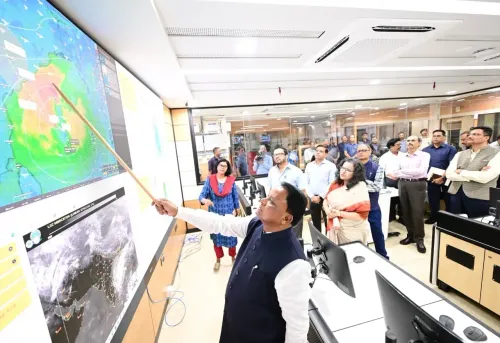
Odisha's State Control Room is operating on a 24-hour monitoring cycle to coordinate emergency response.
Coordination is active across state, district, and central agency levels, following established disaster management doctrine.
Odisha's response framework was built after the 1999 Super Cyclone and refined through Cyclone Fani (2019) .
The Odisha State Disaster Management Authority (OSDMA) underpins the inter-agency coordination being deployed for Akvan.
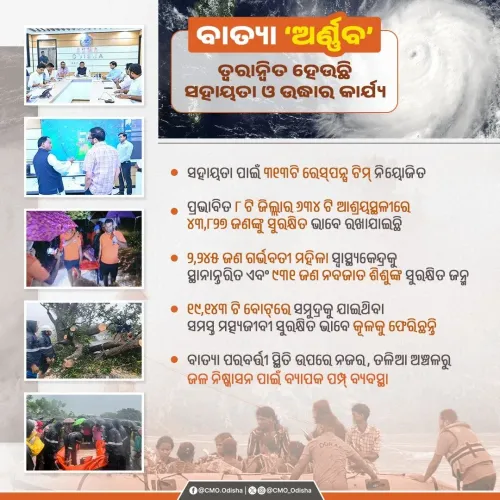
With Cyclone Akvan bearing down on the Bay of Bengal coastline, Odisha's Chief Minister's Office on Friday, 20 November 2026 confirmed that the state has activated its full emergency architecture — cancelling 47 trains, rescheduling 28 more, and placing its State Control Room on round-the-clock alert. The message is unambiguous: passenger safety comes first, and the administration is not waiting for landfall to act.
The CMO's post, written in Odia and English, stated: 'Public safety remains the top priority. Coordination is being maintained across state, district and central agencies to tackle Cyclone Akvan.' The phrasing is deliberate — this is a government signalling to its citizens that the machinery is already in motion, not scrambling to catch up.
A Response System Forged by Tragedy
Odisha's layered cyclone-response playbook did not emerge overnight. It was written in grief — specifically, the catastrophic 1999 Super Cyclone that killed nearly 10,000 people and left vast swaths of the coast in ruin. In the years that followed, the state stood up the Odisha State Disaster Management Authority (OSDMA), built dedicated control rooms, and embedded inter-agency coordination into standard protocol.
That architecture was stress-tested during Cyclone Fani in 2019 — one of the strongest storms to hit the subcontinent in decades — when mass evacuations and continuous control-room monitoring helped keep the death toll remarkably low relative to the storm's intensity. The current mobilisation around Cyclone Akvan follows the same playbook, now refined across two decades of institutional learning.
Rail Network Reconfigured Ahead of Landfall
The decision to pull 47 trains from service and reschedule 28 others reflects how seriously Indian Railways and the state treat the window before a cyclone makes landfall. Coastal rail lines in Odisha are particularly vulnerable to flooding and high winds; having rolling stock and passengers off exposed tracks before conditions deteriorate is a core element of the response doctrine.
The State Control Room's 24-hour monitoring serves as the nerve centre — receiving real-time data from district administrations, feeding updates to central agencies, and triggering rapid responses to any ground-level emergencies. It is the same model that proved its worth during Fani, now on standby as Akvan approaches.
What Coastal Communities Are Watching
For the people living along Odisha's exposed coastline, the state's pre-emptive posture carries a specific reassurance: official acknowledgement that the threat is real and that evacuation orders, if required, will follow the same coordinated chain of command that has saved thousands of lives in previous storms. The focus now shifts to the cyclone's exact track, the intensity at landfall, and whether central government assets — NDRF teams, naval resources — are pre-positioned in sufficient numbers.
Odisha has turned hard-won experience into one of India's most replicable disaster-management models. The test, as always, is in the hours that remain before the storm arrives.
Point of View
Coordination-led prevention. The CMO's public communication itself is part of the strategy: visible, bilingual, and specific, it is designed to maintain public trust and deter panic. The broader policy arc here is India's gradual shift toward treating cyclone-prone states as laboratories for scalable disaster governance. Odisha, having demonstrably reduced per-storm fatalities over two decades, now functions as a benchmark that other coastal states — and central planners — actively study.
NationPress
20 Nov 2026
Frequently Asked Questions
How many trains have been cancelled due to Cyclone Akvan in Odisha?
47 trains have been cancelled and 28 others rescheduled , as confirmed by the Odisha Chief Minister's Office on 20 November 2026 , to protect passenger safety ahead of Cyclone Akvan.
What is the Odisha State Control Room doing during Cyclone Akvan?
The State Control Room is maintaining round-the-clock, 24-hour monitoring to coordinate emergency response and ensure a swift reaction to any developing situation on the ground.
What is Cyclone Akvan and where is it heading?
Cyclone Akvan is a storm system approaching the Bay of Bengal coast . Odisha authorities have activated full emergency protocols in anticipation of its landfall, though the exact track continues to be monitored.
How has Odisha prepared for cyclones after the 1999 Super Cyclone?
Following the devastating 1999 Super Cyclone , Odisha established the Odisha State Disaster Management Authority (OSDMA) and built a dedicated framework involving early evacuations, train cancellations, and centralised control-room coordination — a model that proved effective during Cyclone Fani in 2019 .
Which agencies are coordinating Odisha's response to Cyclone Akvan?
The CMO confirmed that coordination is being maintained across state, district, and central government agencies, in line with Odisha's established multi-tier disaster management protocol.