Odisha CM Office Highlights Farm Cold-Chain Push Across 58 Sub-Divisions
Synopsis
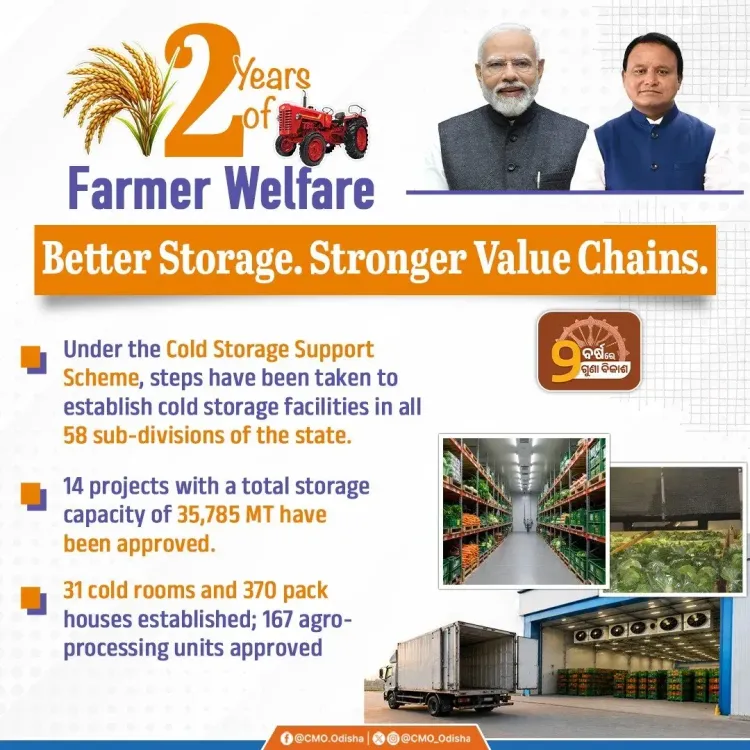
The Chief Minister's Office of Odisha has highlighted a two-year push to establish cold storage facilities across all 58 sub-divisions, alongside cold rooms, pack houses, and agro-processing units, under the Krushak Samruddhi initiative to reduce post-harvest losses and improve farmer incomes.
Key Takeaways
The Chief Minister's Office of Odisha announced agricultural infrastructure expansion on 10 July 2026 , marking two years of the current government.
Cold storage facilities are being established across all 58 sub-divisions of Odisha.
The programme also covers expansion of cold rooms, pack houses, and agro-processing units .
The stated goal is to reduce post-harvest losses and build stronger farm-to-market value chains .
The push is linked to the Krushak Samruddhi initiative and builds on the earlier KALIA scheme launched in 2018.
National estimates place post-harvest losses for fruits and vegetables at 15–20 percent , underscoring the scale of the challenge the infrastructure aims to address.
The Chief Minister's Office of Odisha announced on 10 July 2026 that the state government has been expanding cold storage facilities, cold rooms, pack houses, and agro-processing units across all 58 sub-divisions of Odisha over the past two years, aiming to reduce post-harvest losses and strengthen farm-to-market value chains for the state's farming communities.
Context
The announcement, shared under the hashtags #2YearsofLokankaSarakar and #2YearsofKrushakSamruddhi, marks a two-year milestone of the current government's agricultural infrastructure programme. The post states that steps have been taken to establish cold storage facilities across all 58 sub-divisions, alongside the expansion of cold rooms, pack houses, and agro-processing units. The overarching goal, as stated, is to build 'stronger farm-to-market value chains' for Odisha's farmers.
The Krushak Samruddhi initiative, referenced in the post's hashtag, is the state's farmer-focused scheme aimed at improving agricultural prosperity. It builds on an earlier foundation laid by the KALIA scheme, launched in 2018, which provided direct financial assistance and livelihood support to farmers across the state.
Policy Backdrop
Post-harvest losses remain a significant structural challenge in Indian agriculture, with national estimates placing losses for fruits and vegetables at between 15 and 20 percent. Cold-chain infrastructure — covering cold storage, refrigerated transport, and processing units — is widely recognised as the most effective intervention to address this gap. Odisha's sub-division-level rollout mirrors decentralised approaches adopted by other agriculture-heavy states.
Central government schemes such as the Agriculture Infrastructure Fund have provided a policy and financial framework for states to invest in post-harvest facilities. Odisha's current push appears aligned with this broader national direction, extending infrastructure down to the sub-division level to ensure wider geographic coverage and farmer access.
Stakeholders and Impact
Odisha is an eastern Indian state with a large agrarian economy, where a significant proportion of the population depends on farming for livelihoods. Reducing post-harvest losses directly translates to higher effective incomes for farmers by preserving the quantity and quality of produce that reaches markets. Agro-processors and traders operating within the state's food supply chain also stand to benefit from more reliable and better-quality raw material flows.
Pack houses and agro-processing units, in particular, add value beyond simple storage — enabling grading, sorting, and basic processing that can command higher prices in both domestic and export markets. The expansion of these units signals an intent to move Odisha's agricultural economy up the value chain rather than limiting intervention to raw produce storage alone.
What's Next
The immediate measure of success will lie in facility utilisation rates — whether the cold storage and processing units built across the 58 sub-divisions are being actively used by farmers and agro-processors. State agricultural surveys and supplementary budget allocations in upcoming sessions will be closely watched for data on coverage, operational capacity, and measurable reductions in post-harvest losses.
If the infrastructure rollout translates into documented income gains for farmers, it could strengthen the case for further investment and serve as a model for other states seeking to decentralise cold-chain development beyond district headquarters to the sub-division level.
Point of View
Which has historically been the lowest tier of meaningful infrastructure coverage in most Indian states. If utilisation data backs the rollout claims, Odisha could position itself as a reference case for decentralised post-harvest infrastructure. The broader policy arc here connects to the national Agriculture Infrastructure Fund's logic: that income gains for farmers require not just production support but structural investment in what happens after the harvest.
NationPress
10 Jul 2026
Frequently Asked Questions
What is the Krushak Samruddhi scheme in Odisha?
Krushak Samruddhi is an Odisha government initiative aimed at improving agricultural prosperity for farmers, focusing on value chain development, infrastructure support, and income enhancement. It builds on earlier programmes like the KALIA scheme launched in 2018.
How many sub-divisions does Odisha have and why does this matter for cold storage?
Odisha has 58 sub-divisions . Targeting cold storage at the sub-division level means infrastructure is pushed below the district tier, making facilities more accessible to a larger number of farmers across the state's diverse geography.
What are post-harvest losses and how big a problem are they in India?
Post-harvest losses refer to the degradation or waste of agricultural produce after harvesting, during storage, transport, or processing. Nationally, losses for fruits and vegetables are estimated at 15–20 percent , representing significant income loss for farmers.
What is the Agriculture Infrastructure Fund and is Odisha using it?
The Agriculture Infrastructure Fund is a central government scheme that provides financing for post-harvest management and agri-logistics infrastructure. Odisha's cold-chain expansion aligns with the framework of such central schemes, though specific fund utilisation details were not stated in the announcement.
What is the KALIA scheme in Odisha?
The KALIA (Krushak Assistance for Livelihood and Income Augmentation) scheme was launched by the Odisha government in 2018 to provide direct financial assistance and livelihood support to farmers and landless agricultural labourers, forming an earlier pillar of the state's farmer welfare architecture.