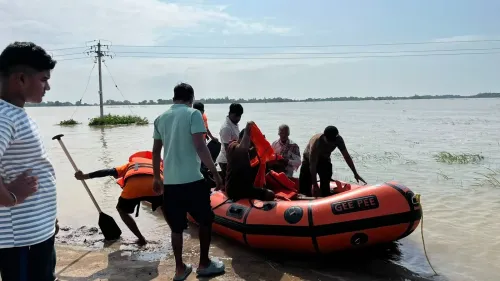
Odisha CM Office: ODRAF Evacuating People as Cyclone Nears

Synopsis
The Chief Minister's Office of Odisha announced on 20 November 2026 that ODRAF teams are evacuating residents from cyclone-vulnerable areas to safe shelters, with the state government declaring public safety its highest priority as a cyclone approaches the coast.
Key Takeaways
The Odisha government has declared public safety the highest priority as a cyclone approaches the state's coast.
ODRAF (Odisha Disaster Rapid Action Force) teams are actively evacuating residents from vulnerable areas to safe shelters.
The Chief Minister's Office issued the update on 20 November 2026 in both Odia and English.
ODRAF was established following the devastating 1999 super cyclone that caused large-scale loss of life in Odisha.
Odisha's Cyclone Phailin (2013) evacuation of nearly a million people is regarded as a national model for cyclone management.
Further updates on the cyclone track, evacuation numbers, and relief arrangements are anticipated from state authorities.
With a cyclone bearing down on Odisha's coast, the state government has shifted into full emergency mode — placing public safety at the top of every order and deploying its elite disaster response units to move people out of harm's way. The Chief Minister's Office of Odisha announced on Friday, 20 November 2026 that ODRAF teams are actively evacuating residents from vulnerable areas and transferring them to safe shelters.
The official post, issued in both Odia and English, states: 'The Government is taking all necessary measures to ensure public safety, keeping it as the highest priority in the face of the cyclone. ODRAF teams are evacuating people from vulnerable areas and relocating them to safe shelters to ensure their safety.'ODRAF: Odisha's Frontline Cyclone Force
The Odisha Disaster Rapid Action Force (ODRAF) is a specialised state unit trained specifically for rapid evacuation, water rescue, and relief operations during cyclones and floods. It was built from the hard lessons of the 1999 super cyclone, which caused catastrophic loss of life along the state's coastline and exposed critical gaps in emergency response capacity.
Since then, Odisha has steadily sharpened its disaster machinery. Cyclone Phailin in 2013 became a landmark moment — the state government evacuated nearly a million people before landfall, dramatically reducing casualties and drawing national and international attention as a replicable model of cyclone preparedness.
A Coastal State That Learned the Hard Way
Odisha sits directly in the path of Bay of Bengal storm systems, making it one of India's most cyclone-exposed states. That geography has forced successive governments to invest in early-warning networks, pre-positioned shelters, and forces like ODRAF that can move fast when a storm signal goes up.
The pattern is now deeply embedded in the state's institutional response: as a cyclone track firms up, evacuation orders go out, ODRAF teams fan into coastal and low-lying districts, and residents are moved into designated cyclone shelters before conditions deteriorate. Friday's announcement reflects exactly that playbook in motion.
What Residents in Vulnerable Areas Should Know
Coastal residents and communities in low-lying zones are the most directly affected. The government's message is clear — ODRAF personnel are on the ground and evacuation is underway. Residents are urged to cooperate with relocation efforts and move to safe shelters as directed by local authorities.
Further updates on cyclone track, evacuation numbers, and relief arrangements are expected as the situation develops. For a state that has turned disaster preparedness into a point of institutional pride, the machinery is already running.
Point of View
Decades-long policy arc: after the 1999 super cyclone exposed the cost of unpreparedness, the state built specialised institutions and protocols that now deploy almost reflexively when a storm signal rises. The CMO's bilingual announcement — Odia and English — signals both domestic mobilisation and an awareness that the state's disaster-response reputation is being watched. For the broader national conversation on climate resilience and state capacity, Odisha continues to function as a live demonstration that institutional memory, when institutionalised properly, saves lives.
NationPress
20 Nov 2026
Frequently Asked Questions
What is ODRAF in Odisha?
ODRAF stands for the Odisha Disaster Rapid Action Force, a specialised state unit trained for rapid evacuation, rescue, and relief operations during cyclones, floods, and other natural disasters.
Is there a cyclone hitting Odisha in November 2026?
The Chief Minister's Office of Odisha confirmed on 20 November 2026 that a cyclone is approaching and that ODRAF teams are evacuating people from vulnerable coastal areas to safe shelters.
How does Odisha prepare for cyclones?
Odisha uses early-warning systems, pre-positioned cyclone shelters, and specialised forces like ODRAF to evacuate residents before landfall. The approach was refined after the catastrophic 1999 super cyclone and demonstrated at scale during Cyclone Phailin in 2013.
What should Odisha coastal residents do during a cyclone evacuation?
Residents in vulnerable or low-lying coastal areas are urged to cooperate with ODRAF and local authority relocation orders and move to designated government cyclone shelters immediately.
When did Odisha last have a major cyclone evacuation?
Cyclone Phailin in 2013 is the most cited example, when nearly a million people were evacuated before landfall, earning Odisha recognition as a model for cyclone preparedness in India.