Odisha CMO: 46 Projects, ₹39,383 Cr Investment at Kalinganagar
Synopsis
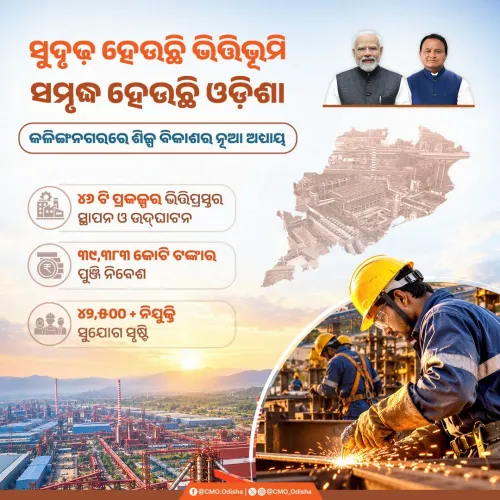
The Chief Minister's Office of Odisha announced the inauguration and foundation-laying of 46 industrial projects at Kalinganagar on 15 October 2026, mobilising ₹39,383 crore in investment and generating over 42,500 employment opportunities in the state's premier steel-and-metals industrial township.
Key Takeaways
46 industrial projects were inaugurated and foundation-stoned at Kalinganagar, Jajpur district on 15 October 2026 .
Total investment announced: ₹39,383 crore , making it one of the largest single-event capital mobilisations at the industrial node.
More than 42,500 employment opportunities are projected to be created as a result of these projects.
Kalinganagar has been a flagship industrial township for Odisha, anchored by steel and metals manufacturing since its inception.
The announcement aligns with Odisha's Make in Odisha cluster-based industrialisation strategy launched in 2016 .
Actual job creation will depend on project execution timelines; state industries department quarterly reviews will be the key tracker.
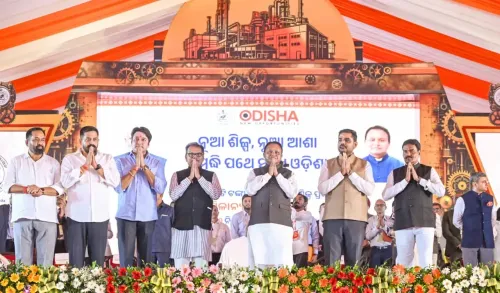
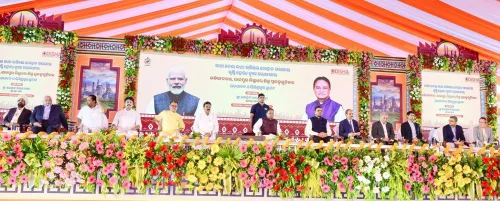
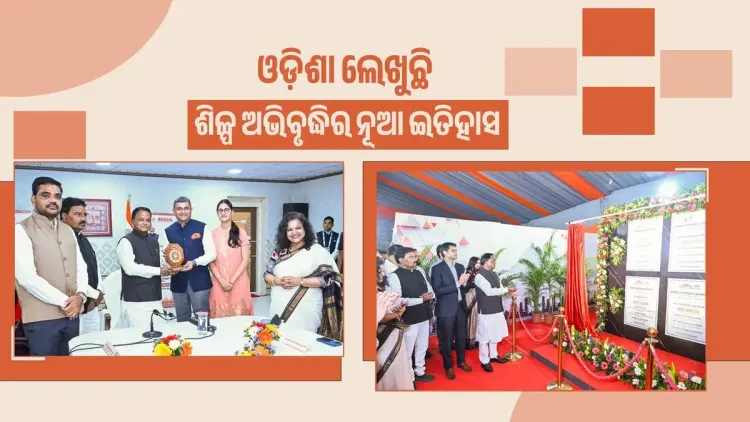
Kalinganagar — long Odisha's steel heartland — is about to get a great deal bigger. The Chief Minister's Office of Odisha announced on Thursday, 15 October 2026 that 46 industrial projects have been inaugurated and foundation-stoned at Kalinganagar, unlocking ₹39,383 crore in fresh investment and promising employment for more than 42,500 people.
The CMO's post, in Odia and English, framed the moment as 'a new chapter of industrial prosperity' — ନୂଆ ଅଧ୍ୟାୟ — driven by 'new confidence, new investment and new employment opportunities.' The accompanying video showcased the scale of activity at the industrial township, underlining that this is not a projection but a ground-level commencement.
Kalinganagar's rise from steel cluster to diversified hub
Kalinganagar, located in Jajpur district, was built around a steel and metals anchor — most visibly the large Tata Steel Kalinganagar complex. For years its growth was tied almost entirely to primary steel output, meaning mineral wealth left the state with limited downstream value addition. The cluster model Odisha has pursued, particularly since the launch of the Make in Odisha initiative in 2016, was explicitly designed to break that cycle: attract ancillary, downstream and value-added manufacturers to set up alongside the anchor plants, capture more of the value chain within the state, and convert raw-material extraction into durable industrial employment.
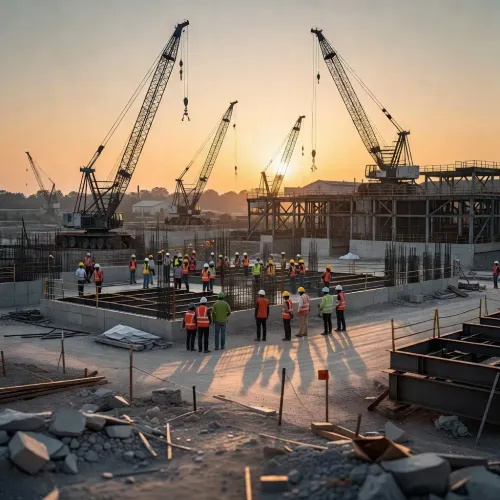
The 46 projects announced today represent a concentrated push in exactly that direction. Steel ancillaries, power, engineering goods and allied industries are the typical profile of Kalinganagar expansions — and a single event commissioning and laying foundations for nearly five dozen units signals that investor appetite, long courted through successive state industrial conclaves, is converting into concrete commitment.
What ₹39,383 crore and 42,500 jobs mean on the ground
Put in context: ₹39,383 crore is a substantial single-event capital mobilisation for a state industrial node. If execution tracks the announced timeline, the downstream effect — wages, logistics, ancillary services, housing demand — would ripple well beyond the plant gates into Jajpur district and neighbouring areas.
The promise of over 42,500 employment opportunities carries particular weight in a state where industrial jobs remain concentrated in a handful of districts. The CMO's framing — ନିଯୁକ୍ତିରୁ ଆତ୍ମନିର୍ଭରତା ('from employment, self-reliance') — positions these numbers not merely as economic statistics but as the foundation of the BJP-led state government's broader social compact: that industrialisation should translate directly into household income and community dignity.
Analysts and the state's own industries department will be watching quarterly progress reports closely. The gap between groundbreaking and job creation in large capital projects can span years, and the real test of this announcement will be in the commissioning reports that follow.
Odisha's industrial trajectory: momentum or milestone?
Today's event is the latest data point in a deliberate arc. Odisha has steadily repositioned itself — from a state seen primarily as a supplier of iron ore and coal to a destination for integrated manufacturing. Kalinganagar is the showpiece of that ambition: a planned industrial city where infrastructure was laid in advance of demand, a bet that has attracted successive rounds of investment.
The question now is whether the 46 projects land on schedule and whether the employment numbers hold. If they do, Odisha's cluster-based model — build the infrastructure, invite the anchor, let the ecosystem follow — will have a powerful new proof point to show prospective investors at future conclaves.
Forty-six foundations poured in a single day. The next chapter writes itself in steel, concrete and paycheques.
Point of View
Now accumulating evidence — is entering a more mature, execution-focused phase. The ₹39,383 crore figure, if it converts to commissioned capacity, would meaningfully advance the state's ambition to move up the value chain beyond raw-material extraction. For the BJP-led state government, framing industrial investment explicitly as a pathway to household self-reliance ('employment to self-reliance') is a deliberate political choice, linking macroeconomic statistics to a lived-standard narrative ahead of future electoral cycles. The real credibility test, however, lies in the quarterly progress reports — large capital announcements in Indian manufacturing have a well-documented history of outpacing on-the-ground commissioning.
NationPress
15 Oct 2026
Frequently Asked Questions
How many industrial projects were launched at Kalinganagar in October 2026?
46 industrial projects were inaugurated and had their foundation stones laid at Kalinganagar on 15 October 2026 , according to the Chief Minister's Office of Odisha.
What is the total investment announced for Kalinganagar projects in 2026?
The Odisha government announced an investment of ₹39,383 crore associated with the 46 new industrial projects at Kalinganagar.
How many jobs will the Kalinganagar projects create?
The projects are expected to generate more than 42,500 employment opportunities , as stated by the Chief Minister's Office of Odisha.
Where is Kalinganagar located and why is it important?
Kalinganagar is an industrial township in Jajpur district, Odisha . It serves as the state's premier steel and metals cluster, hosting major plants and designed to attract ancillary and value-added manufacturers to build an integrated industrial ecosystem.
What is the Make in Odisha initiative?
' Make in Odisha ' is a state investment-promotion initiative launched in 2016 to attract manufacturing, metals and downstream industries to Odisha, with cluster-based industrial zones like Kalinganagar as its centrepiece.