Odisha CMO: Reservation Hike for SC, ST, SEBC in Technical Education
Synopsis
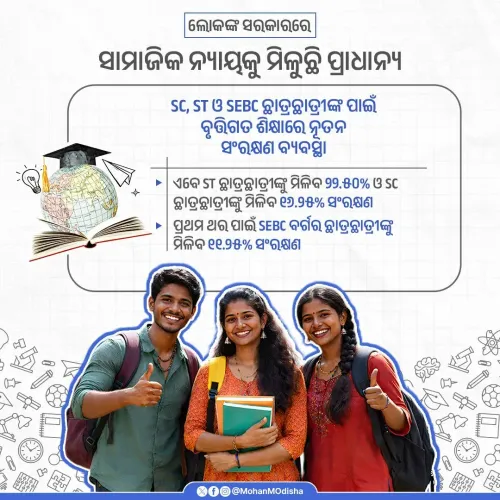
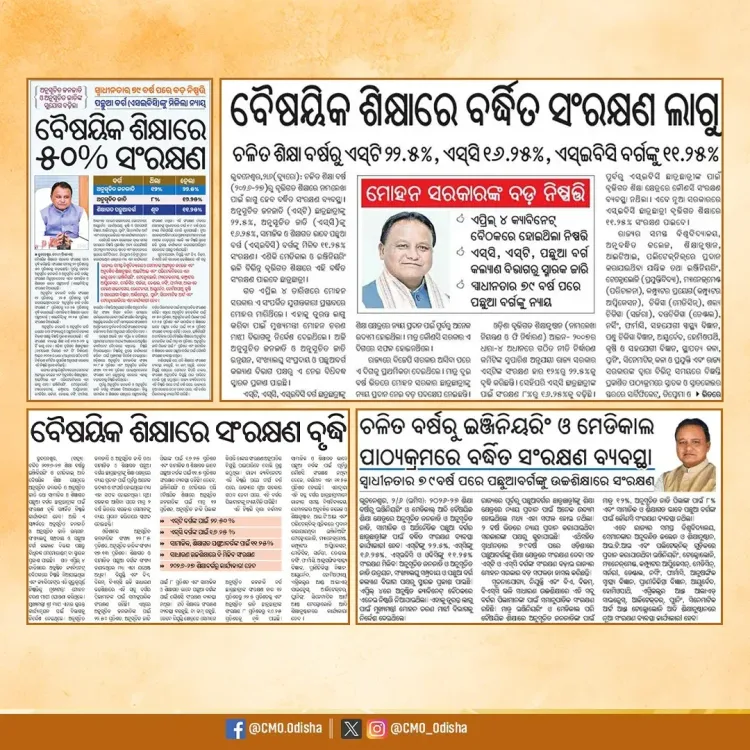
The Chief Minister's Office of Odisha announced on 3 June 2026 that an enhanced reservation for Scheduled Tribe, Scheduled Caste and SEBC students in technical education has been put into effect, framing the move as a push for social justice, inclusive development and wider access to higher and technical education across the state.
Key Takeaways
Odisha CMO announced operationalisation of enhanced reservation for SC, ST and SEBC students in technical education.
Decision covers admissions to higher and technical education institutions in the state.
Move is anchored in Articles 15(4) and 15(5) of the Constitution and the 93rd Amendment, 2005.
Government framed the step as advancing social justice and inclusive development.
Impact will be visible in the next admission cycle for engineering and diploma programmes.
Post carried the hashtag #ଲୋକଙ୍କସରକାର ('People's Government').
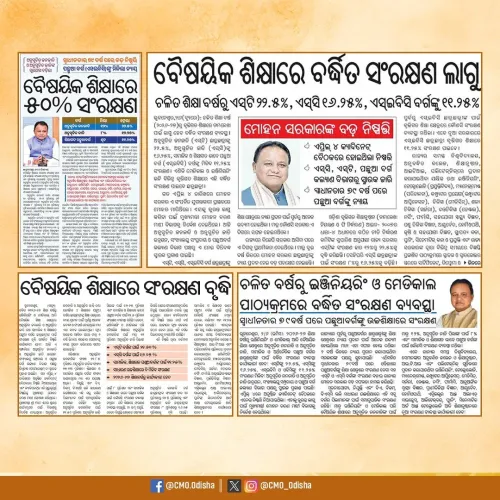
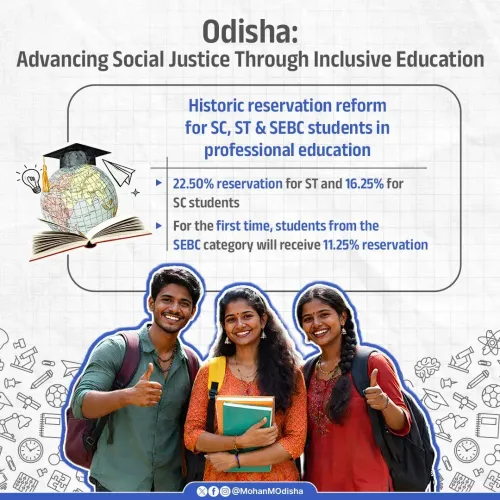
The Chief Minister's Office of Odisha on Wednesday, 3 June 2026, announced that a decision to expand reservation for Scheduled Tribe, Scheduled Caste and Socially and Educationally Backward Class (SEBC) students in technical education has been operationalised in the state. The post described the move as part of the government's commitment to making 'every section of society empowered and self-reliant', tagged with the slogan #ଲୋକଙ୍କସରକାର ('People's Government').
Context
In its statement, the CMO said the 'People's Government is firmly committed to empowering and making every section of society self-reliant', adding that the decision to enhance reservation for SC, ST and SEBC students in technical education had been put into effect. The office further stated that the step would 'create more opportunities in higher and technical education while strengthening social justice and inclusive development'.
The CMO added that the revised reservation framework would 'open a new horizon for the future of students', positioning the measure as a structural intervention in access to professional courses rather than a one-time concession. The post was accompanied by a single image.
Policy backdrop
State-level reservation in higher and technical education in India is grounded in Article 15(4) and Article 15(5) of the Constitution, which empower state governments to make special provisions for the advancement of socially and educationally backward classes, as well as Scheduled Castes and Scheduled Tribes. The 93rd Constitutional Amendment Act, 2005 further enabled states to extend such provisions into both government and private unaided educational institutions, excluding minority institutions.
Odisha, with a substantial Scheduled Tribe and Scheduled Caste population concentrated in districts such as Mayurbhanj, Koraput, Rayagada and Kandhamal, has historically calibrated its admission norms in engineering, polytechnic and diploma programmes to reflect this demographic profile. Successive state governments have used quota policy as a lever to widen the funnel into professional courses where representation from tribal and backward communities has lagged general intake.
Stakeholders and impact
The most immediate beneficiaries are aspirants from SC, ST and SEBC households preparing for entry into state-run and state-aided engineering colleges, polytechnics and other technical institutions. Expanded quotas typically translate into a larger pool of seats reserved at counselling stages conducted by the state's joint entrance bodies for diploma and degree-level technical courses.
Technical institutions in Odisha, including government engineering colleges and polytechnics across Bhubaneswar, Rourkela, Berhampur and Sambalpur, will need to revise seat matrices in line with the new norms. Administrators are also expected to recalibrate intake planning, hostel allocation and scholarship disbursement to absorb the increased reserved cohort.
For families in tribal-majority blocks, the move dovetails with existing welfare instruments such as pre-matric and post-matric scholarships, hostels run by the SC and ST Development Department, and skilling pipelines that feed into industrial clusters in the state's mineral belt.
What's next
The practical test of the announcement will come in the upcoming academic admission cycle, when the revised seat matrices are notified for engineering and diploma programmes. Counselling rounds and cut-off trends will indicate how effectively the expanded quotas convert into actual enrolment, particularly in high-demand branches such as computer science, electronics and mechanical engineering.
Any legal challenge or legislative review of the revised percentages would also shape the durability of the framework, given that quota expansions in professional courses have historically been tested against constitutional ceilings and the doctrine of proportionality. For now, the CMO has framed the step as a signal that affirmative action in technical education remains a core pillar of Odisha's social policy architecture.
Point of View
Where reservation expansion in professional courses doubles as both a welfare instrument and a political signal to consolidated voter blocs. By framing the step under the 'People's Government' banner, the Odisha leadership is positioning affirmative action as a continuing identity of its administration rather than a discrete policy event. The real measure of intent will lie in how cleanly the revised matrices are notified and how institutions absorb the change without diluting seat availability in high-demand branches. Watch also for whether the move triggers similar recalibrations in neighbouring states with comparable tribal demographics.
NationPress
21 Oct 2026
Frequently Asked Questions
What did the Odisha CMO announce on reservation in technical education?
The Chief Minister's Office of Odisha said the decision to enhance reservation for Scheduled Tribe, Scheduled Caste and SEBC students in technical education has been operationalised. It described the move as part of a wider commitment to social justice and inclusive development in higher and technical education.
Who will benefit from the new reservation in Odisha?
Students from Scheduled Tribe, Scheduled Caste and Socially and Educationally Backward Class categories applying to technical education institutions in Odisha will benefit. This includes aspirants for engineering, polytechnic and other diploma and degree-level technical courses in state-run and state-aided colleges.
What is the constitutional basis for state reservation in education?
Articles 15(4) and 15(5) of the Constitution allow states to make special provisions for SC, ST and socially and educationally backward classes in educational institutions. The 93rd Constitutional Amendment, 2005 extended this to private unaided institutions, excluding minority institutions.
When will the revised reservation take effect in Odisha colleges?
The CMO has stated that the decision has been operationalised, with practical implementation expected in the upcoming admission cycle for engineering and diploma programmes. Revised seat matrices will be reflected during state counselling rounds.
Which institutions in Odisha will implement the new quotas?
Government and government-aided technical education institutions in Odisha, including engineering colleges and polytechnics across cities such as Bhubaneswar, Rourkela, Berhampur and Sambalpur, will need to align their seat matrices with the revised reservation framework.