Odisha CMO: Reservation in technical, vocational education for ST, SC, SEBC

Synopsis
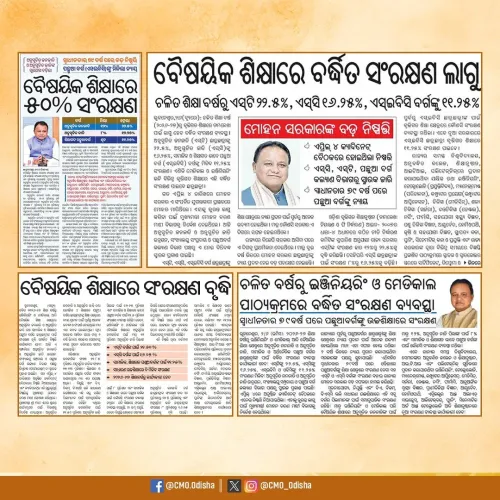
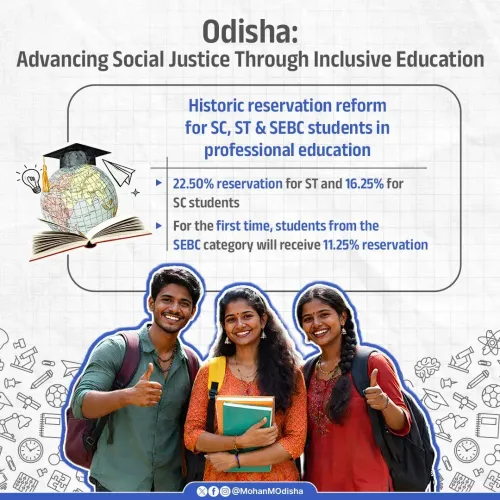
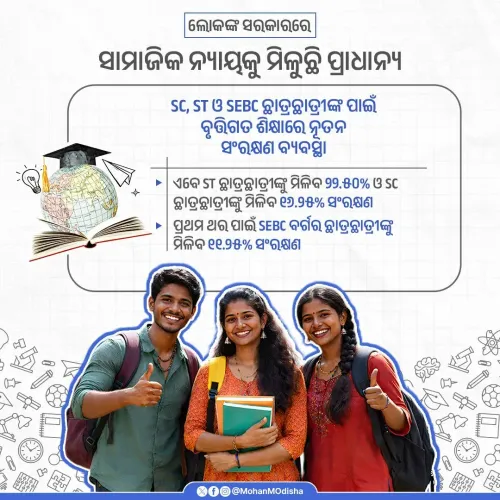
The Chief Minister's Office of Odisha said the state has implemented reservation in technical and vocational education — 22.5% for ST, 16.25% for SC and, for the first time, 11.25% for SEBC students — framing it as a step toward equal opportunity and social inclusion in professional courses.
Key Takeaways
Odisha CMO announced reservation in technical and vocational education for ST, SC and SEBC students.
ST students get 22.5% , SC students 16.25% , and SEBC students 11.25% .
The post described the SEBC quota in this stream as a first-time provision.
The combined quota of 50% aligns with the Supreme Court's reservation ceiling.
Implementation will be tracked through seat-matrix notifications in polytechnics, ITIs and engineering colleges.
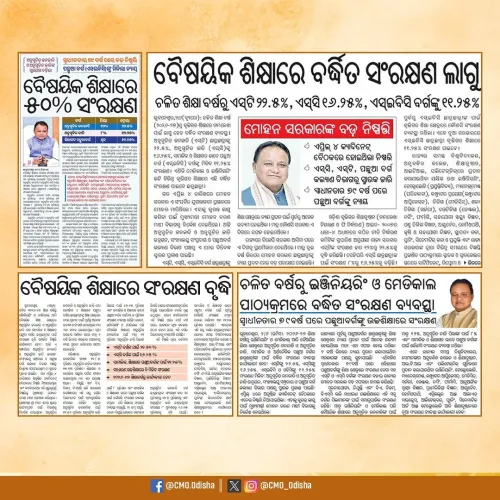
The Chief Minister's Office of Odisha on social media announced that the state government has rolled out a reservation framework for Scheduled Tribe (ST), Scheduled Caste (SC) and Socially and Educationally Backward Classes (SEBC) students in technical and vocational education, terming it a step toward educational empowerment and social justice for backward communities.
According to the post, ST students will receive 22.5% reservation, SC students 16.25%, and SEBC students 11.25% — described in the message as a first-time provision for the SEBC category in this stream. In its own words, the office said this is 'another historic step by the people's government towards educational empowerment of backward classes and social justice', adding that the move strengthens 'equal opportunity in education and social inclusion'.
Context
The announcement frames the reservation as a policy intervention specifically for technical and professional education — a segment that typically covers engineering colleges, polytechnics, industrial training institutes and allied vocational programmes administered through state skill and higher-education channels.
The combined quota under the three categories adds up to 50%, mirroring the long-standing ceiling on caste-based reservations laid down by the Supreme Court in the Indra Sawhney verdict. The percentages also broadly track the demographic share of ST and SC communities in Odisha, where tribal populations are among the highest in the country.
Policy backdrop
Reservation for SC and ST students in publicly funded education flows from Articles 15(4) and 15(5) of the Constitution, while SEBC reservation has expanded across states following the Mandal Commission recommendations of 1990 and subsequent state-level enumerations of backward classes.
Odisha has historically operated separate quota matrices for ST and SC across school, higher and professional education. The extension of an explicit 11.25% slot for SEBC candidates in technical and vocational courses — as described by the office — would bring the state's professional-education pipeline in line with the wider pattern seen in states such as Tamil Nadu and Maharashtra, which have layered SEBC or OBC reservation onto engineering and medical admissions.
Stakeholders and impact
The immediate beneficiaries, as identified in the post, are ST, SC and SEBC students seeking seats in technical and vocational institutions in Odisha. For tribal and Dalit students, the percentages preserve the existing constitutional entitlement; for SEBC aspirants, the office's framing suggests a newly codified share in this specific stream.
Implementation will depend on how seat matrices are notified at the institutional level — including in government polytechnics, ITIs, engineering and pharmacy colleges — and how creamy-layer rules are applied within the SEBC quota. Private unaided institutions, minority institutions and centrally funded campuses operate under separate reservation regimes and may not be directly covered.
Industry and skilling stakeholders will also be watching how the expanded intake interacts with placement outcomes and apprenticeship pipelines, given that vocational education is closely tied to Odisha's manufacturing, mining and services workforce strategy.
What's next
The next operational marker will be the formal notification of revised seat matrices by the relevant admission authorities for the upcoming academic cycle, along with admission brochures clarifying eligibility, income thresholds for the creamy layer, and the list of institutions covered.
Any legal challenge would likely test whether the cumulative quota stays within the 50% ceiling and whether the SEBC list and percentages rest on adequate empirical backing. Enrolment data in the first admission cycle after implementation will indicate whether the new SEBC allocation translates into materially higher representation in Odisha's technical and vocational classrooms.
Point of View
After decades of focus on school and general higher education. By packaging the move as social justice and educational empowerment, the Odisha government signals an attempt to consolidate SEBC support without breaching the constitutional 50% ceiling. The political subtext is significant in a state where tribal and OBC blocs are pivotal. The real test will lie in administrative follow-through — clean seat-matrix notifications, credible creamy-layer enforcement, and whether private and central institutions are eventually pulled into the same framework.
NationPress
22 Oct 2026
Frequently Asked Questions
What reservation has Odisha announced in technical and vocational education?
The Odisha government has implemented 22.5% reservation for ST students, 16.25% for SC students and 11.25% for SEBC students in technical and vocational education, according to the Chief Minister's Office.
Is SEBC reservation new in Odisha's professional courses?
The Chief Minister's Office described the 11.25% SEBC reservation in technical and vocational education as a first-time provision in this stream, alongside the continuing ST and SC quotas.
Does the Odisha reservation breach the 50% Supreme Court cap?
No. The combined quota of 22.5% ST, 16.25% SC and 11.25% SEBC adds up to exactly 50%, which is the ceiling laid down by the Supreme Court in the Indra Sawhney judgment.
Which institutions will the Odisha reservation apply to?
It is aimed at technical and vocational education, which typically includes state engineering colleges, polytechnics and industrial training institutes; the exact list will be clarified through official seat-matrix notifications.
Why is Odisha expanding reservation in vocational education?
The Chief Minister's Office framed the step as part of educational empowerment of backward classes and social justice, aimed at ensuring equal opportunity and social inclusion in professional courses.